


Route Optimization API
Optimize routing, task allocation and dispatch
Distance Matrix API
Calculate accurate ETAs, distances and directions
Directions API
Compute routes between two locations
Navigation API & SDK
Turn by Turn Instructions for Drivers & Technicians
Route Optimization Software
Plan optimized routes with 50+ Constraints
Product Demos
See NextBillion.ai APIs & SDKs In action
Location Reasoning AI
Help your AI agents answer location-based questions
AI Route Optimization
Learns from Your Fleet’s Past Performance
Platform Overview
Learn about how Nextbillion.ai's platform is designed
On-Premise Deployments
Take Full Control of Your Maps and Routing
About Us
Our story, vision
and mission
Contact Us
Reach out to us for any product- or media-related queries
Write to us at

Table of Contents
What if a delivery route could redesign itself every minute based on traffic, order priority, and vehicle capacity? Modern logistics operations are under constant uncertainty. eCommerce demand varies around the clock, city traffic slows down deliveries, and customer demands to deliver goods faster constantly grow. The conventional routing systems were designed on predictable schedules and fixed routes. The current delivery networks need something much more responsive.
Artificial intelligence is now coming into the picture and transforming logistics by analyzing vast amounts of operational data and computing the best routes in real time. AI-based routing applications can minimize delivery times, reduce fuel usage, and improve fleet efficiency in complex delivery networks by integrating machine learning, predictive analytics, and real-time traffic intelligence.
Read this blog to learn how AI-driven intelligent routing works, the technologies that power it, and how logistics companies are transforming delivery operations through smarter route optimization.
AI-powered intelligent routing is transforming logistics by replacing static route planning with real-time, data-driven optimization. Key takeaways:

AI-powered intelligent routing in logistics refers to the use of artificial intelligence, machine learning algorithms, and real-time data analysis to determine the most efficient delivery routes for vehicles and fleets. Conventional routing systems are normally based on predetermined paths or naive shortest paths. Intelligent routing systems, on the contrary, consider various operational parameters like traffic conditions, delivery time windows, vehicle capacity, driver schedule, road limitations, and order priority to create optimal routes.
Through constant processing of real-time data from GPS systems, traffic platforms, and logistics management software, AI routing engines can modify routes dynamically during the delivery cycle. This enables the logistics companies to minimize the delivery delays, maximize the use of their fleet, reduce fuel usage, and better control the complex last-mile delivery networks.
Below is a comparison between traditional routing systems and AI-powered intelligent routing used in modern logistics operations:
Factor | Traditional Routing Systems | AI-Powered Intelligent Routing |
Route Planning | Fixed routes planned before delivery begins | Dynamic routes recalculated continuously |
Data Usage | Limited historical or static data | Real-time traffic, weather, GPS, and delivery data |
Traffic Handling | Cannot adjust easily to congestion | Automatically reroutes vehicles in real-time |
Optimization Method | Basic shortest-path calculations | Advanced machine learning and optimization algorithms |
Delivery Accuracy | Delivery times often estimated roughly | Accurate delivery time predictions |
Fleet Efficiency | Lower vehicle utilization | Higher fleet productivity and route efficiency |
Scalability | Difficult to manage large delivery networks | Scales efficiently across thousands of deliveries |
The following are the key AI technologies that power intelligent routing systems in modern logistics operations:
Intelligent routing systems are based on machine learning algorithms that process massive amounts of historical delivery information to determine patterns in travel time, route efficiency, and delivery performance. These models analyze previous routes, traffic patterns, and operational outcomes to suggest optimal delivery routes. Machine learning models improve their predictions over time, allowing logistics systems to generate more precise route plans for complex delivery networks.
Real time traffic intelligence incorporates real time traffic feeds, road congestion information, and accident reporting into routing engines. This information is constantly processed by AI systems to change delivery routes according to the changing conditions throughout the day. The system re-computes alternative routes when there is sudden congestion or road closures to ensure that delivery schedules are not disrupted and delays are reduced throughout the fleet.
Predictive analytics assists the logistics firms in predicting the demand, travel time, and operational limitations of the delivery operations before the process starts. Predictive models make predictions based on the historical volumes of delivery, the pattern of the seasons, and groups of demand locations. This prediction enhances the accuracy of the route planning and enables the logistics teams to distribute vehicles and drivers in a more efficient manner.
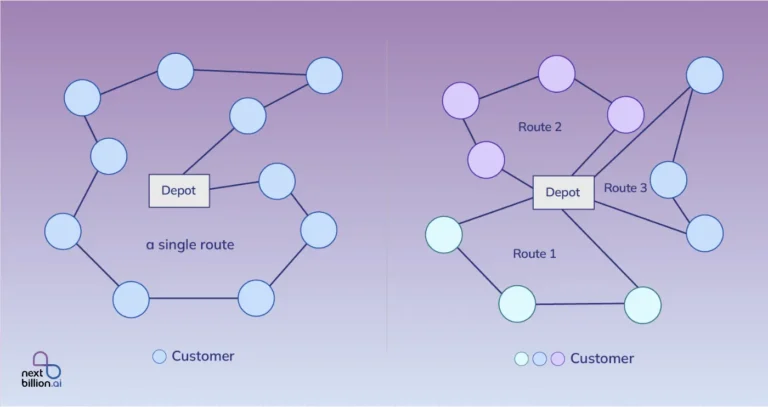
Complex routing problems like the Vehicle Routing Problem (VRP), which entails the identification of the most efficient routes of multiple vehicles serving multiple destinations, are solved using advanced optimization algorithms. These algorithms consider many combinations of routes and take into account the limitations of delivery windows, the capacity of vehicles, and the working hours of drivers. The output is a mathematically optimized delivery plan that reduces travel distance and costs of operation.
Geospatial intelligence enables routing systems to decipher location information, road systems, delivery areas, and geographical restrictions. AI systems process mapping data, work with addresses, and accessibility of routes to make sure that vehicles use practical and legal routes. Effective geospatial analysis enhances the precision of navigation, especially in overcrowded urban areas or areas where the road network is complicated.
Fleet sensors with IoT capabilities gather data about vehicles and their operations, such as GPS positioning, speed, fuel consumption, and the state of the vehicle. This information gets directly to AI routing platforms, which offer real-time fleet movement and performance. Constant data collection enables the routing systems to track the movement of the vehicles and change the delivery plans in case of disruptions.
Cloud computing infrastructure allows intelligent routing systems to use large datasets and calculate route optimization at scale. Cloud solutions enable logistics firms to combine traffic APIs, order management systems, mapping services, and fleet tracking solutions into a single routing environment. This architecture can be used to optimize routes of thousands of deliveries at scale without compromising the system reliability and performance.
Businesses should switch to AI-driven intelligent routing in modern logistics operations because of the following benefits:
Routing systems based on AI analyze the current state of traffic, delivery points, capacity of vehicles, and priorities of orders to identify the most efficient delivery order. AI does not rely on predetermined routes but instead recalculates routes whenever conditions change. This reduces time lost due to unnecessary detours, congested roads, and general delays. This means that logistics companies are able to deliver goods at a faster rate and also to deliver at a steady level, even during times of peak demand.
The shortened delivery cycles also enable firms to satisfy the strict delivery schedules, such as same-day or next-day delivery. In high volume logistic networks, a slight increase in the efficiency of routes can save hours of travel time in hundreds of vehicles. In the long run, these benefits are converted into more stable operations and capacity management at the times of the peak demand.
Smart routing software finds the most efficient and shortest routes between various destinations of delivery. AI also minimizes the distance covered by vehicles by optimizing the delivery sequences and minimizing backtracking. The short distance is directly correlated with the reduction of fuel usage and the decrease in the number of kilometers covered during each delivery cycle. This further leads to fewer emissions and more sustainable logistics activities.
Reduction in the travel distance also minimizes unnecessary vehicle use in big fleets. In cases where the delivery routes are optimized with hundreds or thousands of deliveries per day, logistics companies can reduce the overlapping of routes and the elimination of inefficient travel patterns. This results in improved route consolidation and an equal distribution of workload among drivers.
One of the biggest cost centers of the logistics operations is transportation. AI-based routing saves fuel, enhances the performance of routes, and eliminates dead air in driving. Fewer unnecessary miles also decrease wear and maintenance needs of vehicles over time. Firms with large fleets have an opportunity to save a lot of money by streamlining routes and enhancing the use of assets in a delivery network.
The cost cuts are particularly evident in big logistics networks where minor inefficiencies multiply very fast. When AI decreases the average distance of delivery, idle time, and unnecessary overlaps of routes, the operating margins of companies are observably improved. This renders smart routing an essential business benefit of logistics providers working on scale.
Customer satisfaction depends on the reliability of delivery. The AI routing systems use the past history of delivery and current conditions to create the correct estimated arrival time. The customers are provided with guaranteed delivery windows and live tracking. Higher levels of transparency foster trust and minimize customer service requests regarding the delays of the delivery process or the lack of knowledge about the upcoming arrival.
The brand credibility of logistics providers and e-commerce companies is also enhanced when delivery performance is predictable. Customers will feel confident about the service when they are always provided with the right delivery estimates and updated on the delivery status. Constant delivery communication minimizes missed deliveries and enhances general satisfaction with the logistics experience.
The AI routing platforms allow logistics firms to optimize the number of deliveries made by a vehicle during a shift. Through more efficient routes and less time wasted on the road, drivers spend more time completing deliveries instead of following inefficient routes. The increased productivity per vehicle enables companies to expand the delivery capacity without a corresponding increase in fleet size.
A better fleet productivity also enables the companies to respond better to the changes in demand for delivery. Optimized routing will enable fleets to deliver more during peak seasons or with promotional sales with the same number of vehicles and staff. Such flexibility of operation minimizes the requirement for rapid expansion of the fleet, and the delivery performance is still maintained.
AI-powered intelligent routing systems rely on advanced algorithms to calculate optimal delivery routes across complex logistics networks. These algorithms compute efficient vehicle routes by analyzing road networks, delivery constraints, and fleet capacity. The routing algorithms listed below play an important role in enabling intelligent routing in logistics operations.
Vehicle Routing Problem algorithms form the foundation of logistics route optimization. VRP models identify the most efficient combination of routes by different vehicles supplying goods to various locations, taking into account the limitations of delivery time, vehicle capacity, and driver working hours. Logistics platforms powered by AI use variants of VRP to reduce the total travel distance and enhance the use of fleets in large delivery networks.
Dijkstra’s algorithm is used to compute the shortest distance between two points in a road network. This algorithm is applied by logistics routing engines to calculate the most efficient route between delivery points, depending on distance or travel time. Combined with mapping systems and traffic information, the algorithm of Dijkstra assists routing platforms in choosing a faster path and preventing undeserved detours.
The A* algorithm improves route calculation by combining shortest-path computation with heuristic estimates of the remaining distance. This allows routing engines to evaluate potential paths more efficiently and identify optimal routes faster than traditional shortest-path algorithms. A* is used in logistics systems to make fast route decisions when vehicles must respond to changing traffic conditions.
Genetic algorithms are algorithms that imitate evolution to produce solutions to complicated optimization problems like large-scale delivery routing. These algorithms produce several combinations of routes, compare their efficiency, and refine them repeatedly to find the best solution. Genetic algorithms are applied to logistics platforms that have thousands of deliveries and vehicles, and in which traditional optimization algorithms fail to cope with computational complexity.
Some of the most precise and broadly applicable applications of AI-driven intelligent routing, that enhances the efficiency of delivery and logistics performance, are listed below:
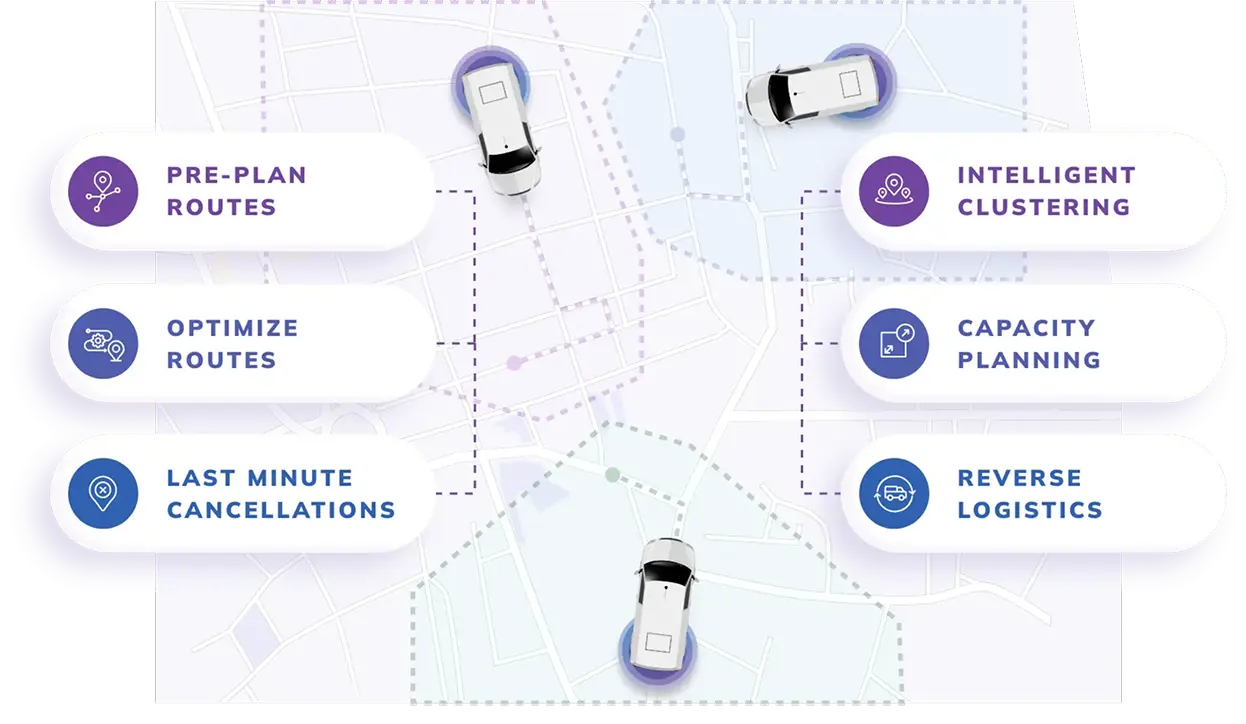
Thousands of small deliveries are carried out by e-commerce companies in the densely populated cities every day. AI routing systems improve delivery routes by clustering orders that are close to each other and determining the most efficient routes for drivers. These systems consider delivery time windows, traffic patterns, and vehicle capacity to minimize travel time and maximize the number of deliveries completed per shift.
Quick commerce systems operate with very strict delivery schedules, typically ranging from 10 to 30 minutes. AI routing systems analyze current order inflow, store locations, and nearby delivery drivers to determine the fastest delivery route. This assists companies in handling high-frequency deliveries and maintaining the same speed of delivery.
Courier firms deal with routes that have dozens or even hundreds of delivery stops per truck. The problem of this complicated routing can be addressed by an intelligent routing platform that calculates the best delivery sequence among all the stops. The system keeps on changing routes as new pickup requests are obtained or as the traffic conditions vary during the delivery cycle.
Firms that handle equipment maintenance or technician visits use AI routing to allocate technicians efficiently across service requests. Smart routing software analyzes technician availability, travel distance, and service priority to determine which technician is best suited for a specific job and how the daily service route should be planned.
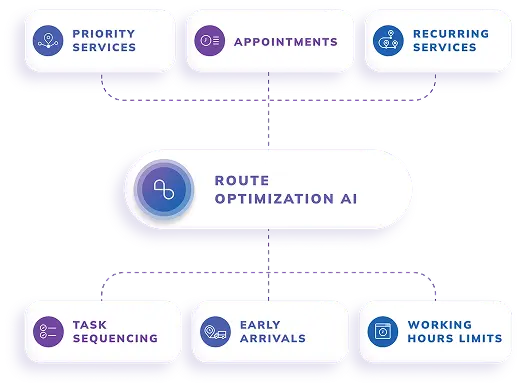
Large distribution networks use trucks to deliver products between warehouses, fulfillment centers, and retail stores. These transportation routes are optimized by AI routing platforms through the analysis of the volume of the shipments, schedules of the delivery, and the state of the roads. This aids logistics firms in organizing bulk freight transportation, besides minimizing delays in transportation and fuel usage.
The intelligent routing systems that are developed using AI work in a number of synchronized stages that convert raw logistics data into optimized delivery paths. Each stage takes operational inputs, analyzes constraints, and produces routing decisions that enhance efficiency in delivery among fleets and distribution networks.
This is initiated by gathering massive amounts of operational information that are available in various sources throughout the logistics network. Such inputs are usually order information, delivery addresses, GPS position of vehicles, road network information, traffic information, weather information, and vehicle capacity information. This data is incorporated into intelligent routing systems, which combine logistics management platforms, mapping services, and fleet tracking systems data. Complete and precise collection of data enables the routing engine to establish a trustworthy base on which the route optimization can be done.
After collecting the data, the routing system analyzes the operational constraints that affect the route planning. These limitations can be delivery time limits, vehicle capacity limits, driver shift schedules, road restrictions, and priority deliveries. The parameters are analyzed by AI models and used to build a routing framework that determines possible delivery routes. This is the step that makes sure that the routes created are viable and in line with operational demands.
During this stage, advanced-level routing algorithms are used to handle the received data and constraints in order to identify the best delivery paths. Vehicle Routing Problem models, shortest paths, and heuristic optimization methods analyze thousands of possible route options. The system then picks the route plans that would reduce the travel distance, reduce the time of delivery, and enhance the efficiency of the fleet in the delivery network.
Once the routing system has created optimal routes, the routing system disseminates them to the drivers via fleet management applications or driver navigation systems. Drivers are also given a sequence of deliveries and a route for every stop. The routing platform keeps track of the vehicle’s movement and delivery status constantly and keeps operations within the scheduled plan.
Traffic jams, new delivery requests, vehicle delays, or road disturbances make the logistics environment continuously change. These conditions are monitored in real time by intelligent routing systems, and routes are recalculated when needed. Dynamic adjustments assist fleets in avoiding time wastage and delivery schedule delays. Constant tracking also enables the logistics teams to have a view of the whole delivery process.
Here is a glimpse of how intelligent routing technologies may reshape logistics networks in the coming years.
Swarm intelligence can be used in future logistics systems to coordinate movement in a manner that is similar to that of ants or bees. Thousands of delivery vehicles, drones, and robots could communicate with each other in real time instead of relying on a central routing engine to allocate routes. Data on traffic conditions, progress of delivery, and efficiency of routes would be shared among each unit. The entire fleet would continuously restructure routes to ensure that delivery flow remains optimal across cities. Such decentralized coordination may render logistics networks very resilient and flexible.
Large cities may eventually develop structured drone corridors in the air, similar to highways for vehicles. AI routing systems would take care of three-dimensional logistics paths that would coordinate thousands of delivery drones flying between buildings, warehouses, and micro-fulfillment hubs. Smart routing systems would compute the altitude layers, air traffic density, and weather conditions to develop safe and efficient delivery routes through the urban airspace.
High-tech logistics systems may create a digital twin of a whole city in real-time that will simulate traffic flow, demand, weather conditions, and utilization of the roads. Thousands of routing scenarios could be tested by AI routing engines before vehicles are deployed. Logistics companies can anticipate congestion, construction disruptions, and demand surges and redesign delivery routes in advance before issues arise in the physical world.
Routing systems in the future can be expanded beyond vehicles to control a whole supply chain autonomously. In case of any disruptions like port delays, warehouse shortages, or transportation failures, AI systems may automatically reroute deliveries, move inventory between distribution centers, and rearrange delivery schedules. The logistics network would successfully self-heal around disruptions without the need for manual coordination.
Here is how NextBillion.ai enables intelligent routing capabilities for modern logistics and delivery operations:
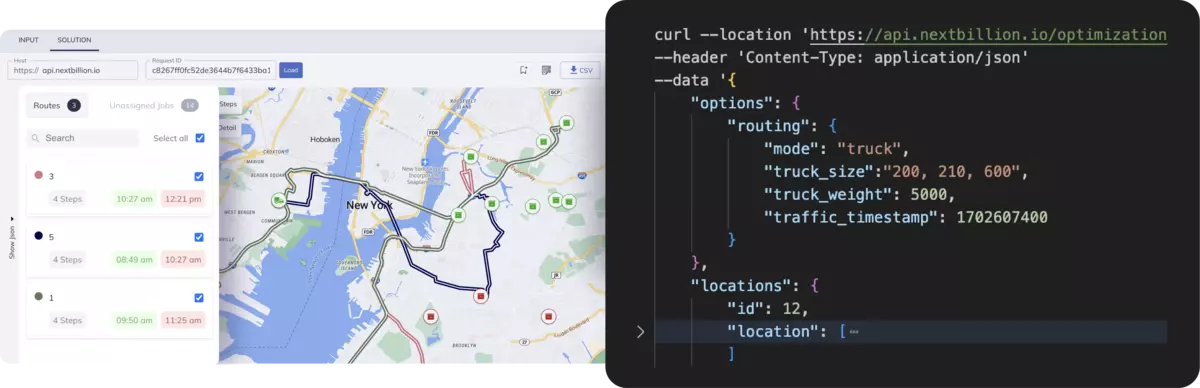
NextBillion.ai is a robust routing and mapping API that is tailored towards logistics firms, mobility providers, and enterprise delivery services. Its route optimization engine assists companies in devising efficient delivery routes by examining variables like vehicle capacity, time constraints, road constraints, and real-time traffic conditions. This allows logistics departments to enhance the efficiency of delivery in extensive and complicated distribution systems.
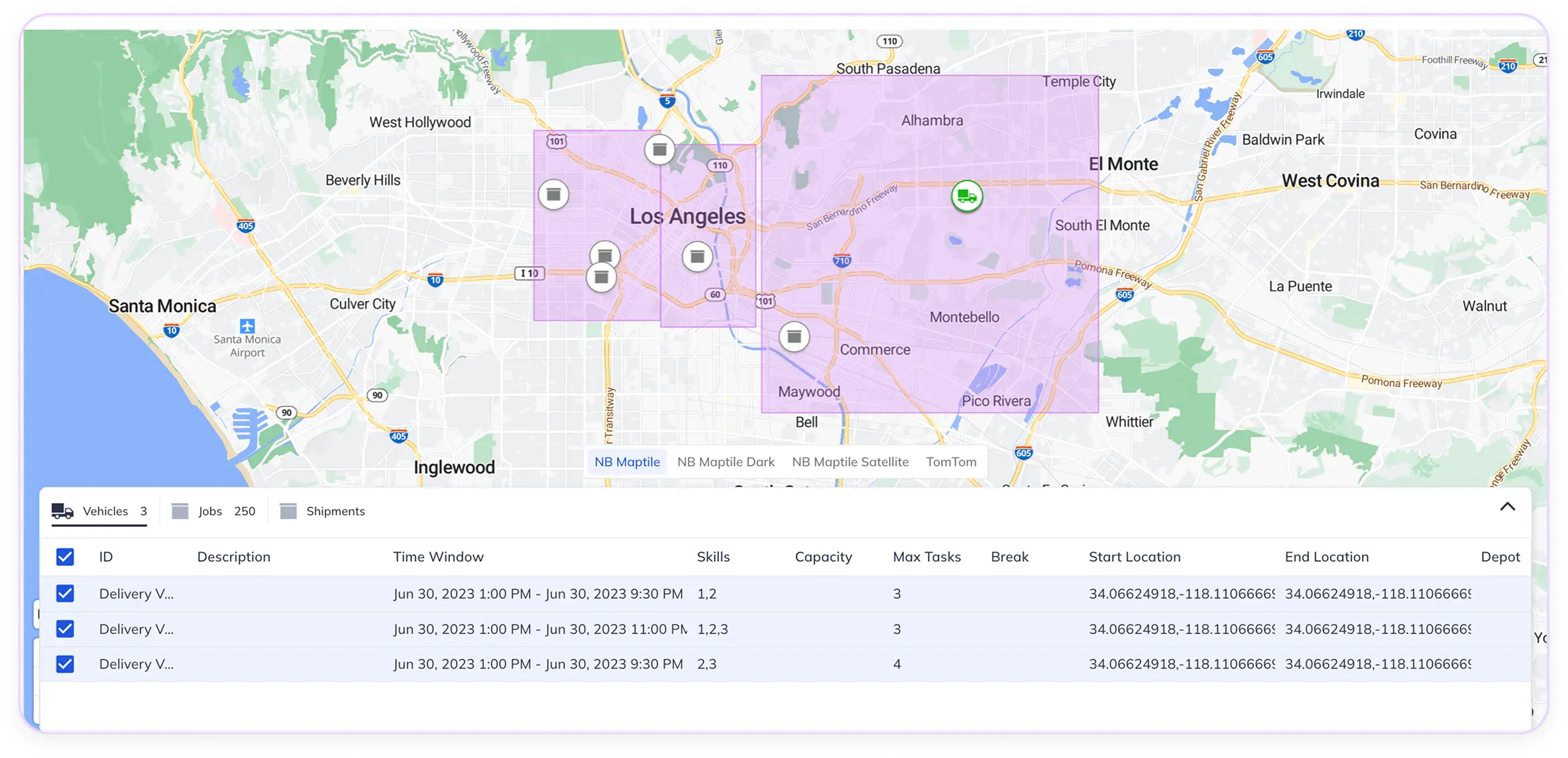
The platform provides scalable APIs to enable developers to add sophisticated routing solutions to logistics software, fleet management platforms, and delivery applications. Routing logic can be tailored by businesses depending on the operational needs, like multi-stop deliveries, driver shifts, and local road regulations. This is flexible and enables organizations to create smart routing systems that are specific to their logistics processes.
NextBillion.ai also provides mapping and geospatial intelligence services that improve navigation accuracy and route planning. Our platform supports high-volume routing calculations, real-time location tracking, and location data processing for logistics companies operating large fleets. With these capabilities, businesses can enhance delivery planning, improve route visibility, and maintain efficient operations across dynamic delivery environments.
Organizations that want to improve delivery efficiency and adopt AI-based routing can consider advanced logistics APIs and mapping solutions. These types of platforms help businesses to optimize the routes, increase the visibility of their fleet, and coordinate complicated delivery networks at scale. With the right routing infrastructure, logistics teams can make faster operational decisions and execute deliveries more efficiently.
Intelligent routing, which is powered by AI, is transforming logistics operations by substituting the traditional route planning system with information-driven decision-making systems. Logistics companies can minimize the delivery delays, decrease the costs of operations, and level up the productivity of the fleet by integrating machine learning, real-time data processing, and enhanced optimization algorithms. With the ongoing development of routing technologies, intelligent systems will be at the forefront of developing faster, more efficient, and scalable delivery networks.
Explore how NextBillion.ai can power intelligent routing and scalable logistics solutions for your delivery operations by connecting with their team today. To learn more about implementing intelligent routing capabilities in your logistics platform, connect with us.
Smart routing systems examine the clusters of delivery, the density of routes, and time constraints to arrange efficient delivery routes. This assists the logistics providers in keeping the delivery windows tight, needed in the same-day or fast delivery services.
Yes. AI routing platforms are developed to handle a large fleet of vehicles, computing optimal routes on hundreds or thousands of vehicles at once and distributing the delivery load among drivers.
Location data assists routing systems in comprehending road networks, delivery areas, and address coordinates. Correct geospatial information enhances the accuracy of navigation and assists vehicles in using realistic delivery paths.
Yes. Intelligent routing assists in the organization of the transportation between warehouses, fulfillment centers, and retail stores by optimizing the routes of shipments and planning the movement of freight in the most effective way.
Intelligent routing is often incorporated into many organizations via APIs and logistics platforms that are linked to existing fleet management systems, order management systems, and mapping systems. This enables routing functionality to be introduced without constructing systems.
Bhavisha Bhatia is a Computer Science graduate with a passion for writing technical blogs that make complex technical concepts engaging and easy to understand. She is intrigued by the technological developments shaping the course of the world and the beautiful nature around us.