



Table of Contents
Driver fatigue is one of the most dangerous variables in commercial trucking. A study by the FMCSA found it contributes to roughly 13% of all commercial vehicle crashes and that number represents real lives, real liability, and real operational risk.
The Hours of Service (HOS) regulations are the federal government’s primary answer to that problem. But for fleet operators, logistics managers, and developers building routing and dispatch software, HOS is not just a safety policy, it’s a hard operational constraint that shapes every route plan, every schedule, and every delivery commitment you make.
This guide covers everything you need to know about HOS regulations, including the rules, who they apply to, available exemptions, penalties, and how fleets use technology to stay compliant.
What Are Hours of Service Regulations?
Hours of Service regulations are a set of federal rules enforced by the Federal Motor Carrier Safety Administration (FMCSA) under the U.S. Department of Transportation. They define:
- How many hours a commercial driver can drive in a day
- How many hours they can be on duty (driving + non-driving work)
- How long they must rest before driving again
- Weekly cumulative driving limits
- When mandatory breaks are required
These rules apply to drivers operating Commercial Motor Vehicles (CMVs) in interstate commerce, broadly defined as any vehicle over 10,001 lbs GVWR, vehicles carrying 9+ passengers for compensation, or vehicles transporting hazardous materials requiring placards.
The core goal is to prevent exhausted drivers from being behind the wheel of 80,000-pound machines at highway speeds.
The Four Core HOS Rules (Property-Carrying Drivers)
The 11-Hour Driving Limit
A driver may drive a maximum of 11 hours after 10 consecutive hours off duty. This is the total driving time , not on-duty time.
Key nuance: Driving hours and on-duty hours are tracked separately. A driver can be “on duty” (doing paperwork, loading, fueling) without burning into driving hours ,but both clocks matter.
The 14-Hour Window
Once a driver begins their duty period, they have a 14-hour window in which all driving must be completed. The clock starts the moment they go on duty and doesn’t stop for breaks, sleeper berth time, or non-driving activities.
This is the most operationally impactful rule for fleet planners. Even if a driver has 11 hours of drive time remaining, they cannot drive once the 14-hour window closes.
Example: A driver goes on duty at 6:00 AM. Regardless of breaks taken, all driving must end by 8:00 PM, after which they need 10 consecutive hours off before driving again.
The 30-Minute Break Rule
Drivers are required to take a 30-minute break after 8 cumulative hours of driving without an interruption of at least 30 minutes. The break can be taken as on-duty not driving (e.g., during loading/unloading) , it doesn’t have to be off-duty time.
2020 reform: Prior to the September 2020 HOS rule update, the break had to be off-duty. The change added flexibility for drivers who already take natural breaks during their day.
The 10-Hour Off-Duty Requirement
Before beginning a new driving period, a driver must have 10 consecutive hours off duty. This resets the 11-hour and 14-hour clocks.
Weekly Limits: The 60/70-Hour Rules
Beyond daily limits, HOS also caps cumulative on-duty time over a rolling weekly period:
| Schedule | Limit |
|---|---|
| 7-day operating period | 60 hours on duty |
| 8-day operating period | 70 hours on duty |
Carriers choose which cycle to operate on. Once a driver hits their weekly cap, they cannot drive until sufficient time has elapsed.
The 34-Hour Restart: Drivers can reset their weekly cycle by taking 34 or more consecutive hours off duty, which includes at least two periods from 1:00 AM to 5:00 AM (home terminal time). This allows drivers to effectively “restart” their 60/70-hour clock rather than waiting for the rolling window to naturally clear.
Sleeper Berth Provisions
For long-haul drivers using a sleeper berth, HOS offers a split-rest option that adds operational flexibility:
- Drivers can split their 10-hour off-duty requirement into two periods
- One period must be at least 7 hours in the sleeper berth
- The other must be at least 2 hours (either in the sleeper berth or off duty)
- Neither period counts against the 14-hour window
This allows team drivers or long-haul operators to structure rest more flexibly across a multi-day trip without losing their full driving window.
Passenger-Carrying Drivers: Key Differences
HOS rules for bus and passenger vehicle operators differ meaningfully:
| Rule | Property Drivers | Passenger Drivers |
|---|---|---|
| Max daily driving | 11 hours | 10 hours |
| Driving window | 14 hours | 15 hours |
| Off-duty requirement | 10 hours | 8 hours |
| Weekly limits | 60/70 hours | 60/70 hours |
HOS Exemptions: Where the Rules Don’t Fully Apply
Exemptions are one of the most operationally significant and most misunderstood in the case of HOS. Here’s a breakdown of the major ones:
Short-Haul Exemption (100 Air-Mile Radius)
Drivers operating within a 100 air-mile radius of their normal work reporting location are exempt from the 30-minute break requirement and the 14-hour window rule, provided they:
- Return to the reporting location within 12 hours
- Have at least 10 consecutive hours off between shifts
- Do not use a sleeper berth
- Do not exceed 11 hours of driving
These drivers can use timecards instead of ELDs or paper logs, significantly reducing administrative burden.
Short-Haul Exemption (150 Air-Mile Radius)
A slightly broader exemption for non-CDL drivers operating within 150 air miles, with similar conditions. CDL drivers must stay within the 100-mile radius for the timecard exception.
The moment a driver crosses outside the 150-mile radius, HOS rules apply immediately. The burden of proof falls on the driver to demonstrate the exemption was lawful.
Drivers may extend both the 11-hour driving limit and the 14-hour window by up to 2 hours if they encounter unexpected adverse driving conditions such as severe weather, road closures, or accidents that were not documented before the trip began.
Emergency Exemptions
During declared national or state emergencies, the FMCSA can temporarily suspend or modify HOS requirements. This has been invoked during hurricanes, wildfires, and during COVID-19 for essential supply drivers.
Oilfield Operations
Drivers in oil and gas field operations have specialized exceptions due to the unpredictable nature of wait times at well sites. Waiting time at a well can be counted as off-duty time under certain conditions, providing meaningful flexibility.
Electronic Logging Devices (ELDs): The Compliance Infrastructure
Since December 2017, the FMCSA has required most CMV drivers to use Electronic Logging Devices (ELDs) instead of paper logs. ELDs automatically record:
- Engine on/off status
- Vehicle motion
- Miles driven
- Engine hours
- GPS location at each duty status change
ELDs synchronize directly with the vehicle’s engine control module (ECM), making manual manipulation significantly harder than paper logs.
Who is exempt from ELDs?
- Vehicles with engines manufactured before model year 2000 (ECM incompatibility)
- Short-haul drivers qualifying for the timecard exception
- Drivers using paper RODS no more than 8 days in any 30-day period
- Driveaway-towaway operations where the vehicle being driven is the cargo
- Agricultural operations within the 150-mile exemption zone
2025 enforcement note: ELD audit capabilities have intensified. Roadside inspectors are now reviewing not just current status but historical patterns that may indicate hours manipulation or device tampering. The FMCSA issued 321,000 HOS violations in 2024, up 15% from the prior year.
The 14-Hour Window Pause: What’s Coming
In September 2025, the FMCSA proposed a pilot program that would allow property-carrying drivers to pause their 14-hour driving window once per day for 2-3 hours. The intent is to give drivers more flexibility to avoid peak-hour traffic or take meaningful rest mid-day without losing their full window.
This is particularly significant for urban last-mile operations where traffic patterns create predictable 1-2 hour dead zones in the middle of the driving day. If adopted, it could reshape how dispatch software calculates available driver hours.
HOS Violations: What They Actually Cost
Violations are categorized by severity and assessed at both the driver and carrier level:
| Violation Type | Fine Range |
|---|---|
| Minor HOS violation | $1,000 – $3,000 |
| Serious HOS violation | $3,000 – $11,000 |
| Falsification of logs | Up to $11,000 per violation |
| Out-of-service order | Revenue loss + compliance review |
Beyond fines, carriers accumulate points under the FMCSA’s Safety Measurement System (SMS). High scores trigger interventions, investigations, and in extreme cases, carrier shutdown orders. Insurance premiums also spike significantly after violations are recorded.
How Logistics Technology Keeps HOS Inside Route Planning
Understanding HOS regulations is one thing. Operationalizing them inside a route planning system at scale, in real time, across a fleet of dozens or hundreds of drivers is an entirely different engineering problem.
The challenge most route optimization platforms face isn’t awareness of the rules. It’s that HOS compliance is treated as a check that happens *after* a route is generated, rather than a constraint that shapes the route from the start. A dispatcher gets a red flag. A driver gets a warning notification. But the plan was already broken before anyone caught it.
The platforms that get this right move HOS upstream, into the optimizer itself. That’s the shift that logistics technology, built on capable routing APIs, makes possible.
How NextBillion.ai Helps Fleets Stay HOS Compliant
Understanding HOS rules is one thing. Making sure every route follows them in real-world operations is much harder.
Many routing systems check HOS compliance only after a route has been created. This often leads to situations where dispatchers discover too late that a driver cannot legally complete the assigned route.
NextBillion.ai helps solve this by considering HOS requirements during route planning itself.
Plan Routes Around Driver Availability
Every driver has different available driving hours based on:
- Shift start time
- Hours already driven
- Remaining on-duty time
- Break requirements
- Weekly hour limits
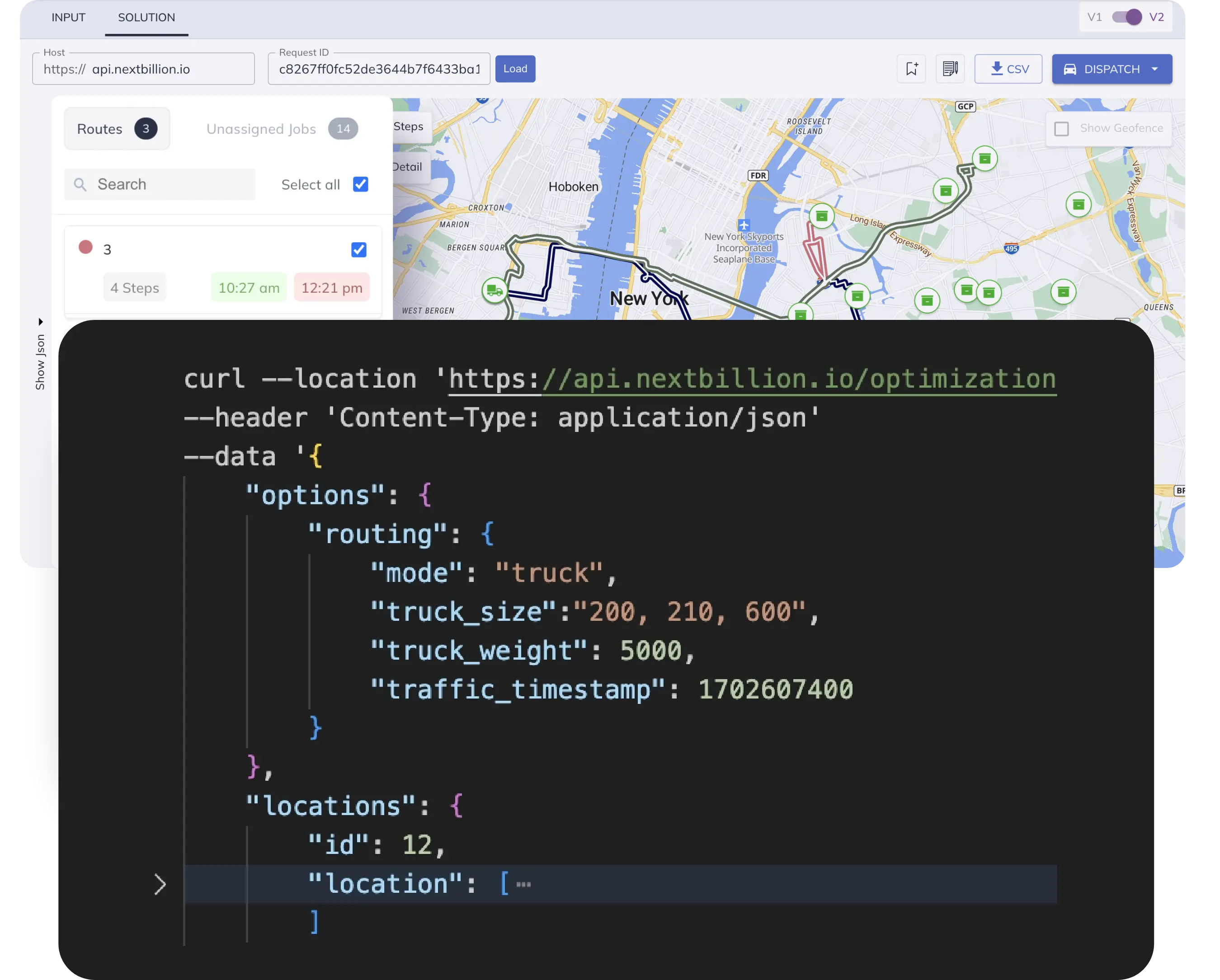
NextBillion.ai’s Route Optimization API can use these inputs while generating routes, ensuring drivers are assigned only the work they can legally complete.
Support Multi-Day Trips
For long-haul operations, compliance becomes more complex because driving limits extend across multiple days.
NextBillion.ai helps fleets:
- Plan routes across several days
- Schedule mandatory rest periods
- Include overnight stops when needed
- Account for weekly driving limits
This reduces manual planning and helps fleets avoid HOS violations on longer journeys.
Adjust Routes When Conditions Change
Unexpected delays such as traffic, loading delays, road closures, or inspections can affect a driver’s available hours.
By combining telematics or ELD data with route optimization, fleets can re-optimize routes based on the driver’s current HOS status and generate an updated, compliant plan.
Maintain Compliance During Navigation
A common challenge is that navigation apps may automatically suggest faster routes that were not part of the original plan.
NextBillion.ai’s navigation solutions allow fleets to follow pre-approved routes, helping drivers stay aligned with planned schedules, vehicle restrictions, and HOS requirements.
Summary
HOS regulations define the hard boundaries of what a commercial driver can legally do in a day, a week, and across a multi-day trip. For product and engineering teams building TMS, fleet management, or telematics platforms, those boundaries aren’t background context, they are constraints that must live inside your route solver from the first call.
The infrastructure to do this correctly is available. NextBillion.ai’s Route Optimization API accepts driver HOS state as a first-class constraint and returns routes that are compatible within each driver’s legal hours of service. The Navigation SDK enforces the compliant plan at execution time. The re-optimization loop keeps the plan legal when on-road conditions change.
Fleets and platforms that wire this together correctly, HOS into the optimizer, compliant plan into the navigation layer, live re-optimization when reality diverges, are the ones delivering on what fleet operators actually need.
To know more about how it helps businesses like yours to stay compliant with hours of service, feel free to get in touch with our experts.
Ready to get started?
Request a DemoTable of Contents
Subscribe to our Newsletters
Get the best practices for route planning & optimization, delivered to your inbox.
Subscribe