


Table of Contents
Generating routes to get the shortest path is not enough in modern logistics. Today’s fleet workflows demand to touch every edge of the network with no or less possibilities of redundant mileage or operational idle hours.
A minor inefficiency in missing a street or creating a duplicate route can be a cost multiplier for coverage-driven logistic operations. Orchestrating on-ground execution for business use cases such as waste collection, snow plowing service providers, field sales services requires accuracy at the network level, where every part of the route needs to be serviced once.
That is where traditional routing systems fail to meet modern business demands. Logistics workflows built around stop-based optimization become operationally inefficient in coverage-driven environments, where every road segment within a service zone must be covered at least once.
As logistics networks grow more complex and operational precision becomes non-negotiable, the relevance of this problem is stronger than ever in 2026.
In this quick guide, we will touch base points to answer the why, when, what and how of the Chinese Postman Problem.
What is the Chinese Postman Problem?
This is defined as a classic routing problem that focuses on identifying and generating the shortest possible route that covers every single edge in a network and returns at the initial point.
In contrast to conventional routing platforms, which focus on identifying the shortest path between specific points, the Chinese Postman Problem (CPP) prioritizes generating the shortest possible route while ensuring full operational coverage of a given zone or region. In technical terms, rather than optimizing point-to-point movement, CPP is designed to cover an entire network with the least possible repetition of route segments.
Let us try to understand CPP with a real-world example. A snow plowing service provider needs to clear every street in a city after a heavy snowfall. The goal is not to cover Point A to Point B, but to ensure complete road coverage is done with unnecessary backtracking and fuel consumption. In such scenarios, the Chinese Postman Problem helps in determining the orchestration of the fleet while ensuring less or no repetition of traveling to the same points.
Why is it called the Chinese Postman Problem?
The Chinese Postman Problem gets its name from Chinese mathematician Mei-Ku Kuan, who first formulated it in 1962. The “postman” example was used to explain the challenge.
For instance, a mail carrier must walk through every street at least once while minimizing total distance. Over time, the name stuck as the problem became a classic in graph theory and routing optimization.
Why Is This Problem Reappearing at Scale Today?
As infrastructure grows more complex and operational precision takes center stage in every logistic network, the Chinese Postman Problem is becoming increasingly relevant among the stakeholders.
Industries such as Waste Collection, Snow Removal, Street Sweeping, Last-mile Deliveries, Utility Maintenance are increasingly recognizing the value of full network coverage in driving operational efficiency and cost control in their day-to-day operations.
As cities expand, regulations grow stricter, competition intensifies, and operating costs rise, even small gaps in route coverage can result in a financial crisis. Traditional point-to-point optimization systems are not designed for coverage-first operations, often resulting in redundant mileage, missed segments, and operational inefficiencies.
This is why logistics businesses are giving equal importance to the Chinese Postman Problem in 2026, as coverage-driven efficiency becomes just as relevant as shortest-path optimization.
The Cost of Getting Coverage Wrong
In coverage-driven operations, small routing mistakes quickly become large operational costs. Missing a required street segment creates compliance and service risks, while covering the same segment twice increases fuel consumption, driver hours, and mileage consumption.
Traditional stop-based optimization systems are not designed for edge-based coverage. As a result, they often generate redundant mileage, uneven workloads, and hidden inefficiencies that compound over time.
As urban infrastructure complexity increases with modernization, the coverage accuracy is not limited only to performance of any logistic organization. It is directly related to cost control, compliance check as well as labor efficiency.
(Key Use Cases) Where CPP Is Actually Used Today
While the above sections explained the “why, what and when “ component of CPP, this section shifts its focus to how – part of it.
Below are a few of key use cases where the concept of Chinese Postman Problem validates its strong presence in the logistics industry.
Waste Collection
Garbage trucks, waste collection vehicles need to service every street once in their designated zone during their working hours. Missing any street or a particular zone can lead to operational disaster. Conversely, duplicating streets during their working hours can result in an increase in fuel as well as time consumption.
Snow Plowing & Winter Operations
During peak winter operations, the snow plowing service providers must clear every road segment of their assigned area. Precise edge coverage areas help in reducing the service turn around time as well as avoiding repetition of already covered streets.
Utility Inspection & Maintenance
Power line inspection, pipeline monitoring, and fiber network audits require covering interconnected network segments within defined service hours. CPP-powered routing ensures complete edge coverage, minimizing the risk of missed segments or redundant traversal.
Courier or Newspaper Delivery
This courier delivery use case requires systematic coverage of all the designated residential areas, that too within the strict delivery timelines. With smart coverage-aware routing, these route maps can be created with no or minimal overlap of roads.
Among all the above use cases, there is a common goal of achieving consistency in their route operations. The CPP based routing allows these coverage-heavy operations to be carried out with utmost efficiency, operational reliability, and accuracy.
Want to explore how this applies to your specific use case? Schedule a call with our experts and discover how coverage-driven routing can transform your operations.
Why Traditional Routing Models Fail for Coverage Problems
The conventional routing models are designed to generate routes based on stop-based optimization. The prime objective of these routing models is to offer the shortest and fastest method of routes. These generated routes often provide navigation between a set of predefined points. These types of routes are closely aligned with the logistics operations where certain delivery points such as A, B, C or more need to be covered.
However, for coverage-driven routes where every road/ segment needs to be covered, these route algorithms fail to serve the fundamental purpose. The traditional models struggle for:
Avoiding Redundant Coverage
Shortest-path routes may repeatedly use the same road segments to connect multiple stops, leading to unnecessary duplication in coverage-heavy workflows.
Incomplete Visibility of Missed Segments
With traditional route algorithms, full network coverage becomes complex. These routing systems are not designed to treat road segments as mandatory tasks, there is a high risk of undetected gaps in coverage, leaving certain segments unserviced without immediate visibility.
Poor Zone-Level Balancing
While the route optimization feature offers minimizing distance between two points, it fails to offer covering systematic zoning and workforce distribution. This leads to incomplete serving of a particular zone.
In short, point-to-point optimization solves for efficiency between locations only. However, coverage problems require efficiency across the entire network. Without an edge-aware routing framework, traditional systems fail to identify hidden inefficiencies that scale rapidly in dense urban environments. This is precisely where the principles of the Chinese Postman Problem become essential.
Advanced CPP with Real World Constraints
When we talk about coverage challenges at the operational level, it is not limited to servicing all roads or segments alone. It involves a broader cycle of managing strict shift hours, service zones, vehicle capacity limits, and real-time traffic conditions.
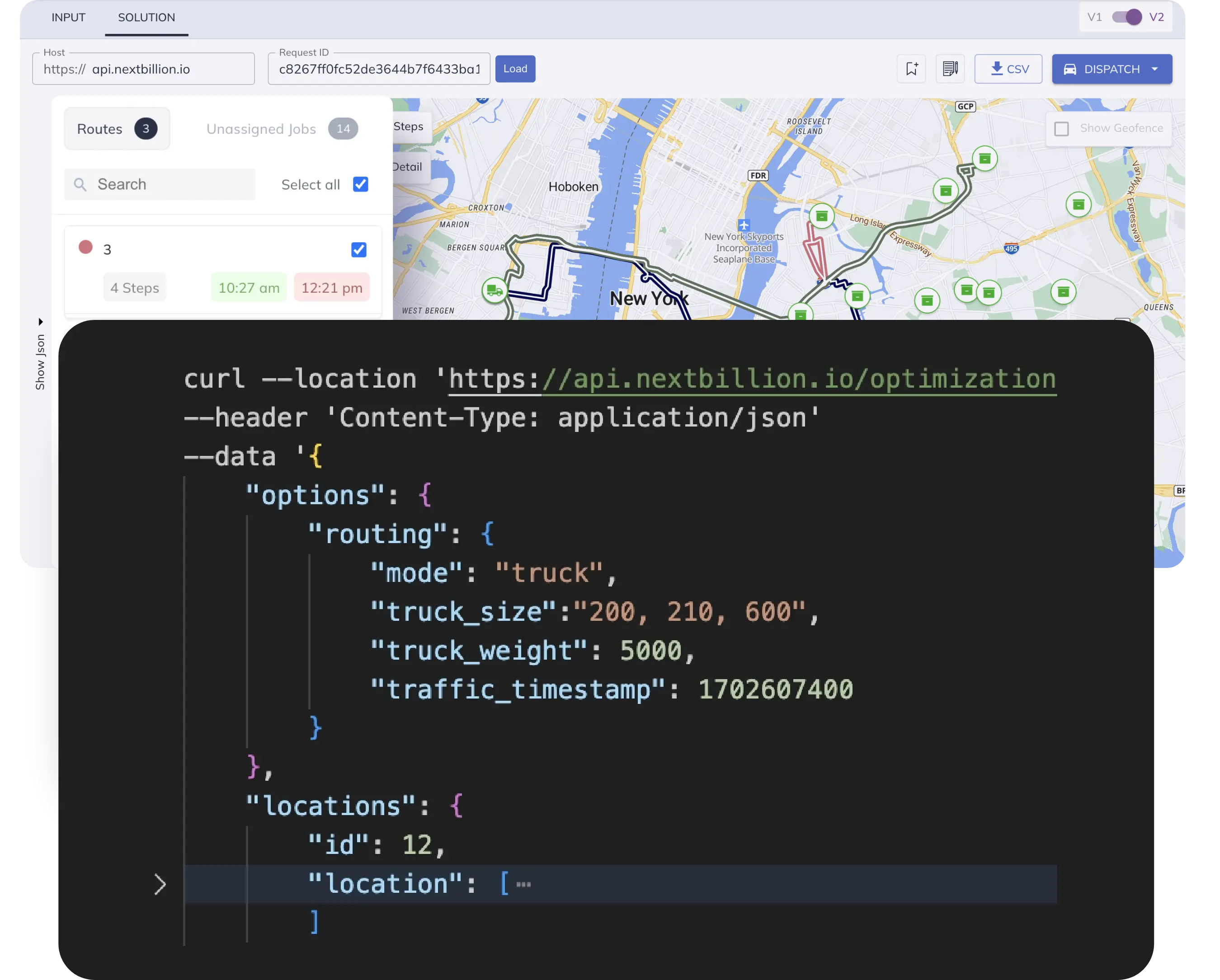
Therefore, operational teams using CPP logic to create routes must carefully account for all these parameters. This is where NextBillion.ai’s Route Optimization (RO) API enables advanced CPP for real-world execution.
The Route Optimization API allows planners to input these constraints directly while generating coverage-driven route plans, ensuring operational reliability at every level.
With the route optimization API, route planner platforms can smartly incorporate:
- Time windows and service-level agreements
- Driver shifts and break rules
- Vehicle capacity and multi-depot operations
- Zone-based territory assignments
- Traffic disruptions and road closures
- Workload balancing across fleets
And more. The 50+ soft constraints can easily be implied in the API calls.
As a result, CPP-oriented routes combined with NextBillion.ai’s Route Optimization API can significantly improve efficiency, compliance, and scalability without adding unnecessary operational costs.
Conclusion: Coverage Is the New Optimization
The above sections highlight the importance of embedding Chinese Postman Problem logics while creating routes, especially for coverage-driven industries. The modernization shifts along with rising demand of taking care of efficiency, compliance as well as reliability at the same time has given equal importance to generating routes that serve the specific business problems.
Route optimization has come a long way from finding a shortest path between the stops to finding the ideal path for a particular route. All while, eliminating the idle hours, extra mileage as well as serving within assigned work hours.
With coverage accuracy steadily taking center stage in 2026, combining it with constraint-aware routing through platforms like NextBillion.ai could define the next wave of route planning in the years ahead.
If we were to summarize this entire discussion in one line, it would be:
“Coverage is no longer optional, it is the new definition of optimization.”
Frequently Asked Questions About Chinese Postman Problem
- What is Chinese Postman routing?
Chinese Postman routing is a route optimization approach designed for scenarios where every required road segment must be traversed at least once. The goal is to find the most efficient path that covers the entire network while minimizing total distance, time, or operational cost.
- How is Chinese Postman routing different from TSP or VRP?
Chinese Postman routing focuses on covering every required road segment, while TSP and VRP focus on visiting a set of locations or stops. Instead of optimizing destination order, Chinese Postman routing optimizes full network traversal with minimal cost, making it ideal for inspections, waste collection, and street services. TSP and VRP are better suited for delivery and stop-based logistics.
- Does NextBillion.ai support non-Eulerian road networks?
Yes. Real-world road networks are often non-Eulerian, requiring some road segments to be traversed more than once. NextBillion.ai intelligently optimizes this edge duplication to ensure complete coverage while minimizing redundant travel, cost, and execution time.
- Can the solution handle directed and mixed road graphs?
The solution supports directed, undirected, and mixed road graphs, including one-way streets and turn restrictions, ensuring Chinese Postman routes remain feasible and compliant in real-world road networks.
- Can Chinese Postman routing be combined with zone-based routing?
Chinese Postman routing can be combined with zone-based routing by constraining coverage routes to specific zones, regions, or service areas. This helps teams split work by territory, keep vehicles within permitted operating areas, and ensure complete street coverage inside each defined zone.
- Is the routing optimized in real time?
Routes can be optimized dynamically to account for real-time changes such as road closures, access restrictions, or updated constraints, ensuring Chinese Postman routes remain efficient and feasible during execution.
- Are there additional costs for real-time optimization?
No, there are no separate add-on fees specifically for real-time optimization. Real-time optimization is included within the usage-based pricing model and is reflected in overall API usage and routing complexity, ensuring transparent and predictable costs without unexpected charges.
- How easy is it to integrate Chinese Postman routing APIs?
Integrating Chinese Postman routing APIs is straightforward and developer-friendly. The APIs are REST-based, well-documented, and designed for quick onboarding, allowing teams to integrate edge-coverage routing into existing systems with minimal setup and configuration.
- Does NextBillion.ai provide developer documentation?
Yes, comprehensive documentation and implementation guides are provided.These resources include clear API references, step-by-step integration instructions, sample requests and responses, and best practices to help teams implement and deploy quickly with minimal friction.
- Is technical support available during integration?
Yes, onboarding and technical support are available for all customers. Dedicated engineering and support teams assist with onboarding, troubleshooting, and best-practice guidance to ensure smooth implementation and faster time to production.
- Can NextBillion.ai support custom routing requirements?
Yes, the platform supports configurable constraints and custom workflows. Teams can define routing rules, operational constraints, and workflow logic tailored to their business needs, allowing the platform to adapt seamlessly to different use cases, service models, and operational requirements.
Ready to get started?
Request a DemoTable of Contents
Subscribe to our Newsletters
Get the best practices for route planning & optimization, delivered to your inbox.
Subscribe