How Dynamic Route Optimization Helps Maintain HOS Compliance

How Dynamic Route Optimization Helps Maintain HOS Compliance

Published: August 25, 2026

Hours of Service (HOS) compliance is one of the most critical and most complex requirements for commercial fleets. Drivers must follow strict limits on driving time, on-duty time, and rest periods, while dispatchers must still meet delivery windows, control costs, and keep customers satisfied. Dynamic route optimization helps maintain HOS compliance by embedding regulatory constraints directly into route planning, continuously recalculating routes as conditions change, and ensuring that every assignment is legally feasible from the moment it is created.

This article explains how HOS rules interact with route planning, why static routes often fail in the real world, and how dynamic, API-driven optimization can keep fleets compliant without sacrificing efficiency. It also shows how Nextbillion.ai’s routing and optimization capabilities, especially its Hours of Service–aware routing and Route Optimization API can be used to build compliant, resilient dispatch systems for long-haul, regional, and last-mile operations.

HOS

Understanding Hours of Service (HOS) Regulations

To build an optimization engine that automatically generates HOS-compliant routes, developers must translate regional legal frameworks into strict algorithmic rules.

In the United States, the FMCSA framework governs property-carrying drivers through four main operational limits:

  • 11-Hour Driving Cap: Limits total daily driving time to 11 cumulative hours, requiring a full 10-hour off-duty reset before driving can resume.

  • 14-Hour Operational Window: Sets a non-extendable 14-hour daily duty clock that continues ticking regardless of off-duty pauses; driving is strictly banned past this mark.

  • 30-Minute Rest Requirement: Mandates a continuous 30-minute non-driving break before reaching 8 accumulated hours behind the wheel.

  • 60/70-Hour Weekly Limit: Caps cumulative work time at 60 hours over 7 days (or 70 hours over 8 days), requiring a 34-hour off-duty period to fully reset the cycle.

By comparison, European Union Regulation 561 enforces different structural constraints tailored to short and long haul transport across Europe:

  • Daily Driving Limit: Standard driving time is capped at 9 hours per day (with an extension to 10 hours permitted up to twice per week), backed by a mandatory 11-hour daily rest period.

  • Mandatory Break Interval: Requires a 45-minute pause after every 4.5 hours of continuous driving, though drivers have the flexibility to split this into one 15-minute break followed by a 30-minute break.

Encoding these distinct rule sets directly into a routing engine ensures the system dynamically plans compliant rest stops, predicts delay impacts, and prevents costly regulatory violations across both jurisdictions.

dynamic route optimization

Why HOS Compliance is Hard in Real Operations

On paper, HOS rules are clear. In practice, they are difficult to manage because real-world operations are dynamic and unpredictable. 

Common challenges include:

  • Variable traffic and delays: Congestion, accidents, and weather can extend travel time beyond planned estimates, eating into a driver’s remaining HOS window.

  • Unpredictable dwell times: Loading and unloading often take longer than expected, reducing available driving time and complicating break planning.

  • Multi-day trips: Long-haul routes must be split across multiple days while respecting daily and weekly limits, rest periods, and delivery commitments.

  • Last-minute changes: New orders, cancellations, and urgent deliveries can disrupt previously compliant plans.

  • Multiple constraints: HOS must be balanced with time windows, vehicle capacity, driver skills, and customer SLAs.

When route planning is static, a plan that is compliant at the start of the day can become non-compliant by midday due to delays or changes. That is why dynamic, HOS-aware optimization is essential.

Static vs. Dynamic Route Planning for HOS

Static Route Planning

Static route planning creates a fixed sequence of stops at the beginning of a shift or day. It assumes that travel times, service times, and driver availability will match the original plan. 


This approach has several limitations for HOS:

  • It cannot easily absorb delays without risking violations.

  • It often requires manual intervention when something changes.

  • It may over-assign work early in the day, leaving no buffer for unexpected events.

  • It does not continuously re-evaluate remaining drive time against upcoming stops.

In a static system, compliance is often checked after the fact, using ELD logs and post-trip reports. That helps with documentation but does not prevent violations from occurring in the first place.

Dynamic Route Planning

Dynamic route planning treats routes as living plans that can be adjusted in real time. It uses live data traffic, driver location, stop status, and remaining HOS to continuously re-optimize. Key characteristics include:

  • Real-time recalculation of ETAs and remaining drive time.

  • Automatic insertion of breaks and rest stops when needed.

  • Reassignment of stops between drivers if one is running out of HOS.

  • Early warning when a planned trip may become non-compliant.

Dynamic planning shifts compliance from a reactive, post-trip activity to a proactive, built-in feature of dispatch. That is the core advantage for fleets that must balance tight delivery schedules with strict regulatory limits.

Why Static Route Plans Fail

Many fleets still create routes using a static planning process. Orders are collected, stops are assigned, and a route sequence is generated before vehicles leave the depot. The plan may include expected arrival times and estimated travel durations, but it often assumes that conditions will remain stable.

That assumption creates compliance risk.

Traffic consumes HOS buffers

Travel-time estimates are predictions. Actual travel time can increase because of:

  • Congestion.

  • Collisions.

  • Road construction.

  • Severe weather.

  • Events and temporary closures.

  • Border or checkpoint delays.

  • Restrictions affecting large vehicles.

  • Unexpected traffic patterns.

Suppose a route is planned with a 30-minute buffer before the driver must take a break. A major incident adds 45 minutes to the trip. The driver may now need to stop before reaching the originally planned location, potentially causing a missed appointment or an infeasible remaining route.

Service time is often underestimated

A route plan that focuses only on driving time is incomplete. Drivers may spend significant time at:

  • Distribution centers.

  • Manufacturing plants.

  • Retail locations.

  • Customer docks.

  • Construction sites.

  • Ports and terminals.

  • Fuel stations.

  • Charging facilities.

Service time may include:

  • Check-in.

  • Security procedures.

  • Dock assignment.

  • Loading.

  • Unloading.

  • Paperwork.

  • Pallet exchange.

  • Proof of delivery.

  • Cargo inspection.

  • Vehicle repositioning within a facility.

If a delivery is modeled as a five-minute stop but usually takes 40 minutes, the route plan will gradually drift beyond its original schedule.

Time windows and duty windows can conflict

A customer might accept deliveries only between 2:00 p.m. and 3:00 p.m., while the driver’s available duty window ends at 2:30 p.m. Another customer may require an early-morning appointment that forces the driver to wait.

Waiting is operationally important. The vehicle may not be moving, but the driver’s available workday can still be affected. An optimizer must therefore consider both:

  1. When the customer is available.

  2. When the driver is legally available.

Manual recovery does not scale

Dispatchers can sometimes repair an individual route manually. They may move a stop, call another driver, or ask a customer to accept a late delivery.

However, manual intervention becomes difficult when the fleet has:

  • Hundreds or thousands of drivers.

  • Multiple depots.

  • Multi-day routes.

  • Cross-border operations.

  • Different HOS profiles.

  • Mixed vehicle types.

  • Strict delivery windows.

  • Live order changes.

  • Frequent delays.

A dispatcher may know that a driver is delayed, but still need software to determine whether the driver can complete the remaining stops, where a break should occur, and which nearby vehicle could take over the work.

What Makes Route Optimization Dynamic?

Dynamic route optimization updates route decisions when new information becomes available. Instead of calculating a route only once, the system continuously evaluates whether the active plan remains feasible.

Potential inputs include:

  • Current driver location.

  • Current vehicle location.

  • Driver duty status.

  • Remaining driving time.

  • Remaining duty-window time.

  • Completed stops.

  • Uncompleted stops.

  • Current traffic.

  • Updated travel-time estimates.

  • New delivery requests.

  • Changes to customer time windows.

  • Loading delays.

  • Road closures.

  • Vehicle breakdowns.

  • Fuel or charging requirements.

  • Rest-stop availability.

Based on these inputs, the system can:

  • Preserve the current route.

  • Reorder remaining stops.

  • Insert a break.

  • Insert a rest period.

  • Assign tasks to another vehicle.

  • Return the driver to a depot.

  • Split the remaining work.

  • Defer a lower-priority delivery.

  • Recalculate customer ETAs.

  • Recommend a safe stopping location.

Dynamic optimization does not necessarily mean changing a route every few minutes. Excessive changes can confuse drivers and dispatchers. A good implementation uses business rules and thresholds.

For example, a fleet may trigger route evaluation when:

  • Predicted arrival at the next stop exceeds its time window.

  • Remaining driving time falls below a defined buffer.

  • A delay exceeds 20 minutes.

  • The driver cannot reach the next planned stop legally.

  • A high-priority task is added.

  • A vehicle becomes unavailable.

  • A road closure invalidates the planned path.

  • The driver’s ELD status changes.

This creates a controlled, event-driven approach to route management.

How Dynamic Route Optimization Supports HOS Compliance

Dynamic route optimization helps maintain HOS compliance in several concrete ways.

Embedding HOS Rules into the Optimization Engine

Instead of treating HOS as a separate check, modern optimization engines embed HOS rules directly into the route calculation. 

This means:

  • The solver respects maximum driving time per day and per week.

  • It enforces mandatory breaks after specified driving durations.

  • It plans rest periods and layovers for multi-day routes.

  • It prevents assignment of loads that would exceed a driver’s remaining HOS before arrival.

When HOS is part of the objective function and constraints, the optimizer will not generate routes that are illegal, even if they appear faster or cheaper on paper.

Automatic Break and Rest Insertion

One of the most valuable features of HOS-aware routing is automatic insertion of breaks and rest stops. The system:

  • Tracks cumulative driving and on-duty time for each driver.

  • Identifies when a mandatory break is due based on regulations.

  • Inserts a break stop at a suitable location along the route (e.g., near a truck stop or rest area).

  • Adjusts downstream ETAs to reflect the break duration.

For multi-day trips, the optimizer can also plan overnight rest and layovers, splitting the journey into compliant daily segments while still aiming to meet delivery windows.

This removes the burden from drivers and dispatchers to manually calculate when and where breaks should occur, reducing the risk of accidental violations.

Real-Time Recalculation When Delays Occur

Delays are inevitable. Traffic jams, accidents, weather, and extended dwell times can all push a route behind schedule. In a dynamic system:

  • The routing engine receives updated travel times and driver status.

  • It recalculates remaining drive time and compares it to HOS limits.

  • If a driver is at risk of exceeding limits, the system can:

    • Insert an additional break or rest stop.

    • Reassign remaining stops to another driver with available HOS.

    • Reschedule non-urgent deliveries to a later window.

This continuous adjustment ensures that compliance is maintained even when the original plan no longer matches reality.

HOS-Aware Dispatch and Load Assignment

Dynamic optimization also helps at the dispatch stage. Before a load is assigned, the system can:

  • Check the driver’s current HOS status (e.g., remaining drive time, cycle hours).

  • Estimate the total time required for the trip, including pickup, drop-off, and expected delays.

  • Reject or modify assignments that would lead to violations.

  • Suggest alternative drivers who have sufficient HOS headroom.

This “compliance-first” dispatch prevents violations from being baked into the plan from the start.

Multi-Day and Multi-Leg Trip Planning

For long-haul operations, trips often span multiple days and must comply with daily and weekly HOS limits. Dynamic optimization supports this by:

  • Splitting long routes into compliant daily segments.

  • Planning rest stops and overnight layovers at appropriate locations.

  • Ensuring weekly cycle limits (e.g., 70 hours in 8 days) are not exceeded.

  • Balancing delivery commitments against regulatory constraints.

This is especially important for carriers that operate across states or countries with different HOS rules, where manual planning is error-prone and risky.

Integration with Telematics and ELD Data

Dynamic route optimization becomes even more powerful when integrated with telematics and Electronic Logging Device (ELD) data. With real-time HOS and location data:

  • The optimizer knows each driver’s exact remaining drive time and duty status.

  • It can adjust routes based on actual on-road progress, not just planned times.
  • It can flag potential violations before they happen and suggest corrective actions.

  • It can generate auditable records that align with ELD logs for compliance reporting.

This closed-loop integration turns HOS from a static log into a live input for dispatch decisions.

Technical Architecture for HOS-Aware Routing

To implement dynamic, HOS-compliant routing, fleets typically need a stack that includes:

  • Order Management / TMS: Captures shipments, time windows, and customer constraints.

  • Driver and Vehicle Master Data: Includes HOS profiles, vehicle types, and capabilities.

  • HOS Engine: Encodes regulatory rules (e.g., 11-hour driving limit, 30-minute break, weekly cycle).

  • Routing and Optimization Service: Solves the vehicle routing problem with HOS constraints.

  • Telematics / ELD Integration: Provides live driver status, location, and HOS remaining.

  • Mobile Driver App: Shows routes, breaks, and compliance status to drivers.

  • Analytics and Reporting: Tracks compliance KPIs, violations, and route performance.

In this architecture, the routing and optimization service is the core component that turns HOS rules into executable plans. That is where APIs like Nextbillion.ai’s Route Optimization API and Hours of Service–aware routing features fit in.

Nextbillion.ai and HOS Compliance

Nextbillion.ai offers a suite of routing and optimization APIs designed for logistics and fleet operations, with explicit support for Hours of Service compliance. Its platform is positioned to help fleets automatically plan compliant breaks, rest periods, and layovers for single-day and multi-day routes, reducing manual scheduling and compliance risk.

Hours of Service–Aware Routing

Nextbillion.ai’s Hours of Service–aware routing embeds HOS rules directly into route optimization. Key capabilities include:

  • Automatic compliance with driving limits and duty cycles: The system respects maximum driving time, on-duty windows, and weekly cycle limits as defined by regulations.

  • Planned breaks and rest stops: Mandatory breaks and rest periods are inserted into routes based on remaining drive time and regulatory requirements.

  • Multi-day route support: The optimizer can split long trips into compliant daily segments, including layovers and rest periods.

  • Dynamic recalculation: When delays occur due to traffic, incidents, or loading issues, routes are recalculated to reflect updated driver availability and remaining HOS limits.

This means fleets can generate compliant routes from the start and maintain compliance even when conditions change.

Route Optimization API with HOS Constraints
truck compliant routes

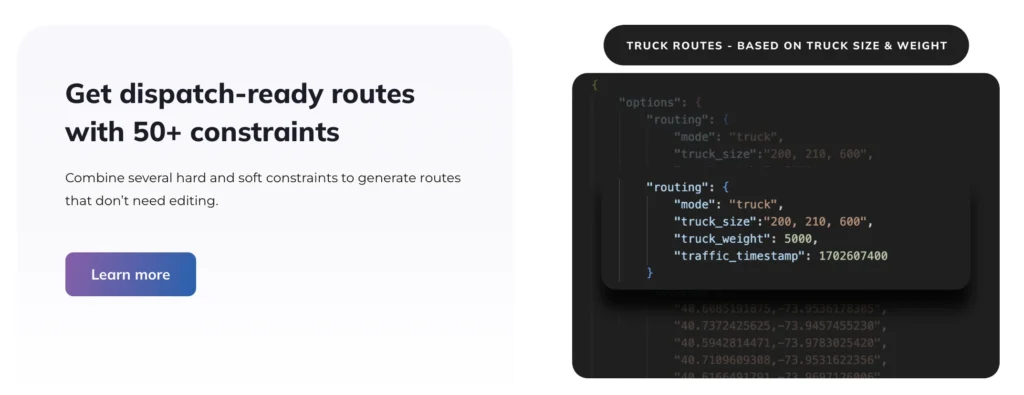
Nextbillion.ai’s Route Optimization API is designed to handle 50+ hard and soft constraints, including time windows, vehicle capacity, driver skills, multi-depot dispatch, hazmat routing, and HOS compliance.

For HOS specifically, the API allows you to:

  • Define driver HOS profiles (e.g., max driving time, break rules, cycle limits).

  • Include HOS as a hard constraint so that no route violates regulatory limits.

  • Optimize across multiple drivers while respecting each driver’s remaining HOS.

  • Re-optimize during the day when HOS status changes due to delays or new orders.

This makes it suitable for long-haul carriers, regional distributors, and last-mile fleets that must balance tight delivery windows with strict HOS rules.

Integration with Telematics and Geofencing
integrating telematics

Nextbillion.ai’s platform can integrate with telematics and geofencing data to enhance HOS compliance:

  • Geofence event logs create verifiable records of where vehicles were and when, supporting ELD compliance and reducing manual recordkeeping.

  • Live ETA recalculations use geofence and traffic data to update routes as conditions change, keeping HOS plans aligned with reality.

  • Telematics integration allows the optimizer to use real-time driver location and HOS remaining data when making dispatch and routing decisions.

This closed-loop approach helps fleets move from post-trip compliance checks to proactive, in-trip compliance management.

Truck-Compliant Routing and Additional Constraints

HOS is only one part of commercial routing compliance. Nextbillion.ai also supports:

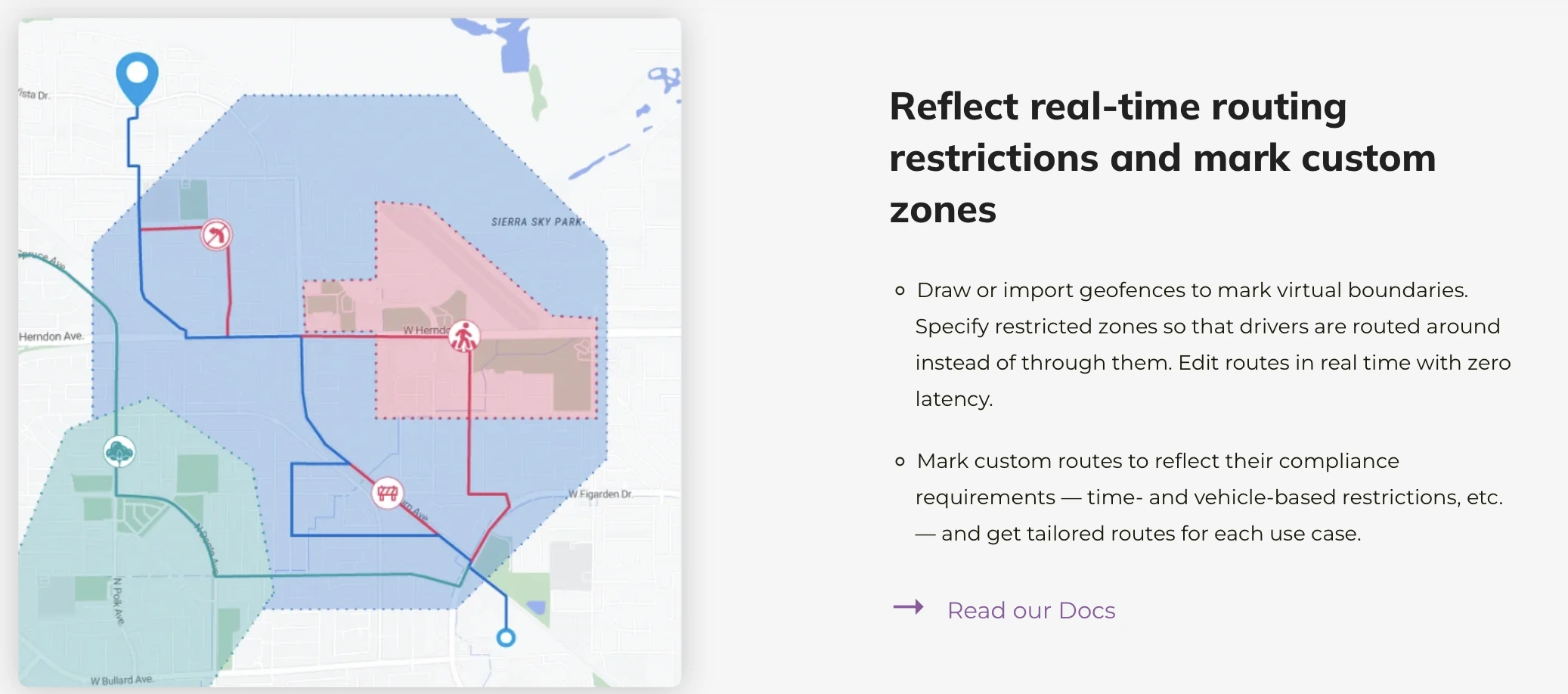
  • Truck-compliant routing that enforces height, weight, and cargo-specific restrictions.

  • Hazmat routing that avoids restricted roads and tunnels for hazardous materials.

  • Custom constraints such as driver skills, multi-compartment loads, territory boundaries, and customer-specific rules.

For fleets that must manage multiple regulatory and operational constraints simultaneously, this unified approach reduces complexity and risk.

Example Workflow: HOS-Aware Dispatch with Nextbillion.ai
 

Consider a regional carrier that must deliver to multiple stores across several states, with strict HOS rules and tight delivery windows. A typical workflow using Nextbillion.ai might look like this:

  1. Order ingestion: Shipments are imported into the TMS with pickup and delivery locations, time windows, and service time estimates.

  2. Driver HOS profiles: Each driver’s HOS status (remaining drive time, cycle hours, break requirements) is loaded into the optimization engine, either from a local HOS module or via telematics/ELD integration.

  3. Route optimization request: The TMS sends a request to Nextbillion.ai’s Route Optimization API, including:

    • Stops and time windows.

    • Vehicle capacities and types.

    • Driver HOS constraints and profiles.

    • Additional constraints (e.g., hazmat, truck restrictions).

  4. Compliant route generation: The optimizer returns routes that:

    • Respect HOS limits (daily driving, breaks, weekly cycle).

    • Insert mandatory breaks and rest stops where needed.

    • Meet delivery windows as closely as possible without violating HOS.

  5. Dispatch and execution: Routes are sent to drivers’ mobile apps, which display stops, ETAs, and planned breaks.

  6. Real-time monitoring: As drivers progress, telematics and geofence data update the system on location and HOS status.

  7. Dynamic re-optimization: If a delay occurs (e.g., traffic accident), the system recalculates routes, possibly:

    • Inserting an additional break.

    • Reassigning some stops to another driver with available HOS.

    • Adjusting ETAs and notifying customers.

  8. Post-trip compliance reporting: Geofence logs, route plans, and ELD data are combined to generate compliance reports and audit trails.

This workflow shows how dynamic optimization turns HOS from a manual, error-prone process into an automated, data-driven capability.

Conclusion

Hours of Service compliance is non-negotiable for commercial fleets, but it is also one of the most complex operational challenges they face. Static route planning and manual HOS tracking are no longer sufficient in a world of tight delivery windows, variable traffic, and constant change.

Dynamic route optimization helps maintain HOS compliance by embedding regulatory rules into the planning process, automatically inserting breaks and rest periods, and continuously recalculating routes as conditions evolve. This proactive approach reduces violation risk, improves safety, and supports more reliable delivery performance.

Nextbillion.ai’s Hours of Service–aware routing and Route Optimization API provide the technical foundation for this capability. With support for 50+ constraints, truck-compliant routing, dynamic re-optimization, and integration with telematics and geofencing, Nextbillion.ai enables fleets to build compliant, resilient dispatch systems that scale with their operations.

For fleets that want to move from reactive compliance to proactive, data-driven HOS management, dynamic route optimization is not just an efficiency tool, it is a core component of a safe, compliant, and sustainable operation.

About Author

Prabhavathi Madhusudan

Prabhavathi is a technical writer based in India. She has diverse experience in documentation, spanning more than 10 years with the ability to transform complex concepts into clear, concise, and user-friendly documentation.

Ready to get started?

Table of Contents