

- BLOG
What is Direct Store Delivery and Why Beverage Companies Depend on it
Published: July 13, 2026
Route Optimization API
Optimize routing, task allocation and dispatch
Distance Matrix API
Calculate accurate ETAs, distances and directions
Directions API
Compute routes between two locations
Navigation API & SDK
Turn by Turn Instructions for Drivers & Technicians
Route Optimization Software
Plan optimized routes with 50+ Constraints
Product Demos
See NextBillion.ai APIs & SDKs In action
AI Route Optimization
Learns from Your Fleet’s Past Performance
Platform Overview
Learn about how Nextbillion.ai's platform is designed
Road Editor App
Private Routing Preferences For Custom Routing
On-Premise Deployments
Take Full Control of Your Maps and Routing
Table of Contents
Direct Store Delivery (DSD) is a distribution model in which beverage manufacturers and their authorized distributors deliver products straight to retail store shelves, bypassing the retailer’s own distribution centers. For beverage companies especially those dealing with high-volume, fast-moving, and often perishable SKUs, DSD is not just a logistics option; it is a strategic dependency that underpins product availability, brand visibility, and ultimately, revenue.
In this in-depth technical blog post, we’ll unpack what DSD really means, how it works in practice, why beverage companies rely on it so heavily, and what technologies, processes, and challenges define modern DSD operations. Along the way, we’ll introduce how modern geospatial and routing platforms like Nextbillion.ai help beverage and DSD operators solve some of their hardest technical problems: from route optimization and EV fleet planning to real-time dispatch and API-driven integration.
Whether you’re writing technical content for fleet management platforms, building route optimization tools, or designing marketing materials for CPG and beverage clients, this guide will give you a comprehensive foundation and show where next-generation routing technology fits in.
Direct Store Delivery (DSD) is a supply chain and distribution strategy where manufacturers or their dedicated distributors deliver goods directly to individual retail locations instead of sending them first to a retailer’s central or regional distribution center (DC). In a traditional “warehouse distribution” model, the retailer takes ownership of goods at their DC, stores them, and then redistributes them to stores. In DSD, the supplier retains more control over how, when, and in what quantity products reach the shelf.
Key characteristics of DSD:
In a conventional model:
In DSD:
This shift changes who owns key decisions: inventory levels, shelf layout, promo execution, and even data capture about what’s selling and where.
As DSD networks grow covering hundreds or thousands of stores across regions, the need for intelligent route planning becomes critical. This is where purpose-built routing and distance matrix APIs start to matter. Solutions like Nextbillion.ai provide the geospatial backbone that DSD planners rely on to turn a list of stores into efficient, executable routes.
Understanding DSD from a technical and operational perspective helps in designing content, APIs, and systems around it. Below is a typical end-to-end flow for beverage DSD, with notes on where modern routing technology fits in.
Before a route is even planned, the system must estimate how much of each SKU each store needs:
Technically, this involves:
Based on forecasts, the DSD platform generates suggested orders per store, which may be:
In more advanced setups, orders are pre-validated against:
Once orders are finalized, the planning engine knows not just which stores to visit, but how much to deliver to each. This directly impacts route planning: heavier loads, more stops, and longer service times all influence vehicle assignment and route design.
This is where fleet management, EV routing, and advanced routing APIs become central and where Nextbillion.ai’s capabilities start to shine.
Given:
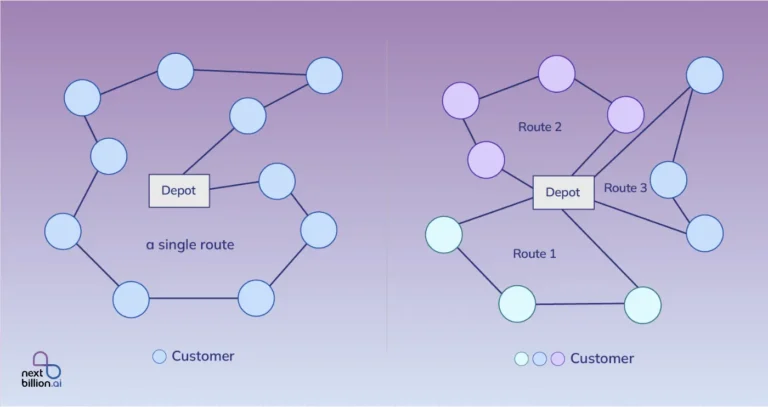
The DSD system must solve a variant of the Vehicle Routing Problem with Time Windows (VRPTW), often with additional constraints like:
For beverage companies, especially those exploring EV fleets, additional constraints include:
This is precisely where a specialized routing and optimization stack matters. Nextbillion.ai offers:
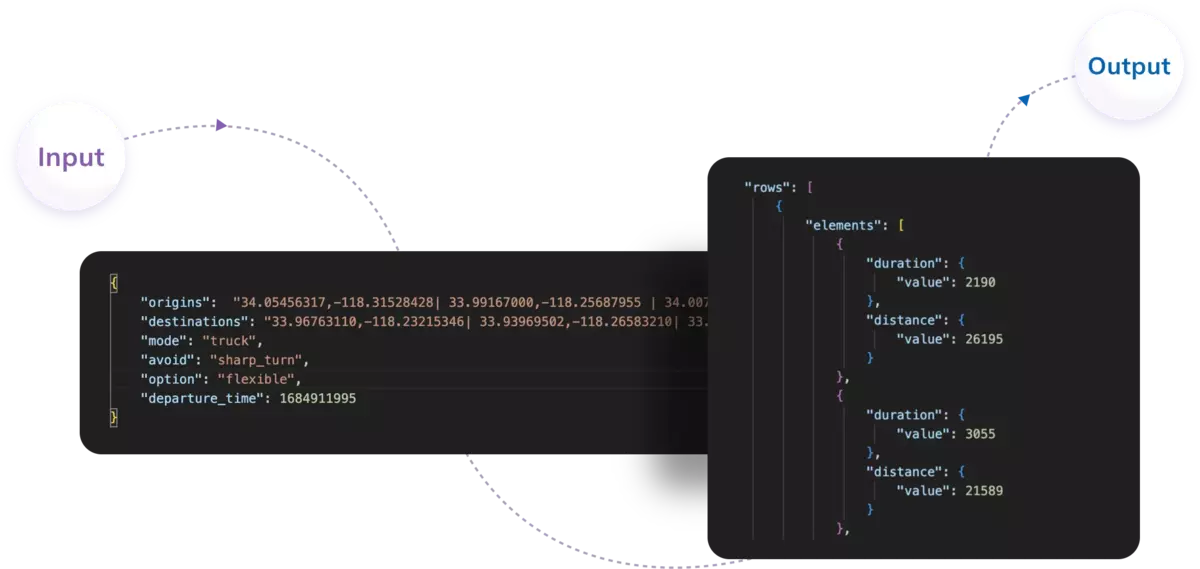
This API computes distances and ETAs between a set of origins and destinations, could be for one-to-many or many-to-many scenarios. The API call returns a matrix of ETAs and distances for each origin and destination pair.

Using these APIs, a DSD platform can:
Once routes are planned, the system must decide:
For beverages, load building is non-trivial:
Fleet management systems track:
Integrating Nextbillion.ai’s routing outputs with telematics data allows operators to continuously calibrate their models: comparing planned vs. actual travel times, identifying chronic bottlenecks, and refining ETA predictions for future planning cycles.
On arrival, the driver or merchandiser:
Geospatial context from routing APIs can enhance this stage too. For example, a mobile DSD app can use the same location and routing logic to:
Unlike traditional distribution, DSD personnel often:
This “last meter” execution is a major differentiator for beverage brands. Data captured here includes:
Increasingly, image recognition and AI are used to:
While Nextbillion.ai’s core focus is routing and geospatial intelligence, its APIs can be part of a broader ecosystem that ties store locations, route performance, and in-store execution data together.
After the route is completed:
With NextBillion.ai’s Route Reconstruction API, you can recreate the actual route taken during a completed trip by providing the waypoints or locations tracked during the trip, as input. Total distance covered during the trip and the geometry of the route taken is returned in the response.
DSD is not optional for most large beverage players; it is a core competitive advantage. Here’s why and how modern routing technology strengthens that advantage.
Beverage purchases are often impulsive. If a consumer’s preferred drink is out of stock, they may switch brands or stores. For high-volume SKUs, even a few hours of out-of-stock can mean significant lost revenue.
DSD helps by:
In technical terms, DSD reduces the “bullwhip effect” by shortening the information and physical flow from consumer purchase to supplier replenishment.
Efficient route optimization is critical here. If routes are poorly planned, drivers spend more time on the road and less time restocking shelves, which can lead to:
In beverages, visibility is everything:
Retail store staff are often overworked and undertrained on brand-specific requirements. DSD teams, by contrast, are brand-trained and measured on:
For beverage companies, DSD is effectively an in-store sales force that also handles logistics.
Better routing means more consistent in-store coverage. When drivers spend less time stuck in traffic or navigating inefficient routes, they have more time to:
Beverage portfolios are complex:
Managing this complexity through a retailer DC would mean:
DSD allows suppliers to:
From a routing perspective, dynamic SKU portfolios mean frequent changes in:
In many DSD models, the supplier invoices the retailer upon delivery, sometimes even collecting payment directly. This can:
Accurate ETAs and reliable route execution also improve financial control by:
Many retailers, especially smaller formats (convenience stores, small supermarkets), have:
DSD effectively outsources part of the retailer’s logistics and merchandising function to the supplier, who is often more efficient at it for their specific category. Retailers benefit from:
This symbiotic relationship reinforces DSD’s dominance in beverages.
For DSD providers, serving these smaller stores often means:
Despite its advantages, DSD is not without challenges. Some of the challenges may include:.
DSD networks can be highly complex:
This complexity can lead to:
Using a robust Route Optimization API helps tame this complexity by:
Many DSD operations still struggle with:
This results in:
A well-designed API strategy, including standardized geospatial services from providers like Nextbillion.ai, can reduce silos by:
DSD is labor- and fuel-intensive. With rising fuel costs, labor shortages, and retailer pressure on margins, beverage companies face:
Optimized routes directly impact these metrics by:
Nextbillion.ai’s focus on commercial vehicle routing and optimization is designed to address exactly these KPIs.
DSD operations must comply with:
In some regions, DSD is also under scrutiny for:
Routing and planning systems can help with compliance by:
To challenge the above pain-points, NextBillion.ai’s Route Optimization API helps maximize the number of productive drops per shift. Nextbillion.ai’s flexible cost and constraint models allow DSD planners to encode these business rules into route optimization, ensuring that commercial priorities are reflected in daily routes. Nextbillion.ai’s accurate ETAs and truck-aware routes reduce variability in arrival times, which makes it easier for store managers to plan for DSD visits and for brands to guarantee certain service levels in their contracts.
The future of DSD is increasingly digital:
Underpinning all of this is high-quality geospatial infrastructure. As DSD platforms become more automated, they will rely even more on:
Sustainability is a major driver:
DSD fleets are likely to be among the first to fully electrify in the CPG sector, given their urban focus and repeatable routes.
As fleets transition, routing platforms must support:
Future DSD ecosystems may feature:
Nextbillion.ai’s positioning as an API-first, developer-friendly platform for commercial routing and optimization makes it a natural fit for next-generation DSD architectures.
Direct Store Delivery is far more than a distribution method; it is a core operational model that enables beverage companies to maintain high product availability, control brand presentation, manage complex, dynamic SKU portfolios with precision, and build closer, more data-rich relationships with retailers.
As beverage companies face mounting pressure to cut costs, reduce emissions, and leverage data, DSD systems are becoming increasingly sophisticated integrating advanced route optimization, EV fleet management, real-time analytics, and seamless API-based collaboration with retail partners.
Modern geospatial and routing platforms like Nextbillion.ai play a pivotal role in this evolution. By providing accurate, commercial-vehicle-aware distance matrices, turn-by-turn routing, and large-scale route optimization via simple APIs, they allow DSD operators to plan more efficient and reliable routes.
To explore and avail the best of NextBillion.ai’s capabilities for your business growth, book a Demo with NextBillion.ai today.
Prabhavathi is a technical writer based in India. She has diverse experience in documentation, spanning more than 10 years with the ability to transform complex concepts into clear, concise, and user-friendly documentation.