
Reducing Out-of-Stocks Through Better Route Planning in Beverage Distribution

Reducing Out-of-Stocks Through Better Route Planning in Beverage Distribution

Published: July 29, 2026

In the fast-moving consumer goods (FMCG) sector, few categories face the operational volatility of the beverage industry. Whether delivering carbonated soft drinks, craft beer, dairy-based protein shakes, or premium spring water, beverage distributors operate on thin margins, high volumetric weight, strict shelf-life limitations, and hyper-sensitive consumer demand.

When a consumer walks into a supermarket, convenience store, or restaurant looking for a specific beverage, failure to find it on the shelf results in immediate revenue loss. Research across retail supply chains consistently demonstrates that when faced with an out-of-stock (OOS) beverage item, up to 45% of consumers will switch to a competing brand, while another 30% will leave the store without purchasing at all.

While inventory management and demand forecasting often take center stage in stockout prevention discussions, the true point of failure frequently occurs during transport and execution and specifically, route planning.

This article explores how advanced route planning, dynamic vehicle routing algorithms, real-time dispatching, and spatial intelligence systematically eradicate out-of-stocks in beverage distribution networks. It concludes with an architectural overview of how NextBillion.ai empowers beverage logistics engineers to solve these complex distribution challenges at enterprise scale.

Anatomy of Out-of-Stocks in Beverage Distribution

To solve the OOS problem, logistics engineers must first understand that a beverage “out-of-stock” is rarely caused by a physical shortage of product at the central warehouse. In over 70% of cases, the inventory exists, it is simply trapped in the supply chain or sitting on a truck delayed by sub-optimal routing.
Beverage Distribution
THE BEVERAGE OOS CASCADE             

  1. Sub-Optimal Master Routes                            

   └─ Static schedules fail to adapt to live demand     

  1. Unpredictable Transit Delays                         

   └─ Missed retailer delivery windows (DEX windows)    

  1. Capacity & Weight Limit Violations                   

   └─ Truck hits weight limits before filling volume    

  1. Fleet & Driver Burnout                               

   └─ Driver turnover leads to missed delivery stops    

  1. Retail Shelf Emptiness                               

   └─ Competitor brand captures customer market share 

The Role of Route Planning

Route planning determines how many stores a fleet can service in a day, which stores are visited first, how much time is available at each stop, and whether urgent replenishment requests can be inserted without disrupting the entire schedule. That means route planning has a direct impact on shelf availability and fill rates.

In beverage distribution, routes are usually high-stop-count, urban or suburban, and constrained by store receiving hours, driver shifts, vehicle capacity, and traffic variability. If those constraints are not modeled correctly, deliveries slip, service frequency drops, and out-of-stocks increase.

Better route planning reduces out-of-stocks by improving on-time performance, shortening travel time between stops, and ensuring higher-priority stores are replenished before they empty. It also helps distributors re-route vehicles when demand spikes, road conditions change, or a store unexpectedly needs an emergency top-up.

Why Out-of-Stocks Happen

Out-of-stocks in beverage distribution are rarely caused by a single failure. They usually result from a chain of issues that includes inaccurate forecasting, missed delivery windows, poor route sequencing, limited vehicle capacity, traffic delays, and inconsistent store-level execution.

Beverage products are especially sensitive to these problems because they sell quickly, are often impulse purchases, and require frequent replenishment across many retail outlets. When a delivery arrives late or a route is inefficient, a store can run out of a fast-moving SKU long before the next visit.

A common mistake is to treat stockouts as an inventory problem only. In practice, they are also a routing and service-frequency problem, because even the best replenishment plan fails if the truck does not arrive at the right store, at the right time, with the right load.

Root Cause 1: Static “Master Routes” vs. “Dynamic Demand”

The primary structural weakness of static master routing is its inability to account for demand elasticity. Traditionally, beverage distributors relied on fixed weekly routes, often referred to as “Master Routes.” In this legacy framework, Store A is always visited on Monday at 8:00 AM, Store B on Tuesday, and so forth.

However, beverage consumption fluctuates wildly based on external variables:

  • A sudden weekend heatwave can triple the sales velocity of isotonic sports drinks in a coastal zip code.

  • A city festival or temporary retail promotion creates localized demand spikes.

  • Holiday weekends drive massive shifts in beer and soda multi-pack consumption.

When a distributor locks drivers into fixed weekly visit schedules, high-velocity accounts rapidly exhaust their safety stock, while lower-volume accounts receive unnecessary service calls. This misalignment creates a double penalty: fast-moving SKUs go out of stock at high-volume retail locations, while fleet capacity and labor hours are wasted making low-yield stops elsewhere on the route.

Root Cause 2: Strict Delivery Windows and DEX Compliance

Modern grocery chains and big-box retailers enforce strict Direct Exchange (DEX) protocols to manage dock throughput. When a delivery truck arrives, the driver must electronically transmit line-item invoice data directly to the store’s backend system before offloading a single pallet. Receiving docks operate on tight 15 to 30-minute arrival windows to prevent backroom bottlenecks. If a beverage truck is delayed by morning traffic or a previous stop’s unloading delay, it misses its scheduled DEX handshake window. Because retail receiving managers prioritize the next scheduled truck, delayed drivers are routinely turned away or forced to wait hours until the dock reopens. This administrative rejection creates an immediate, artificial out-of-stock event on the retail floor, even while the required inventory sits parked outside the building.

Root Cause 3: The Weight-to-Volume Disconnect

Beverages are heavy. Water weighs approximately 8.34 lbs per gallon, and a full pallet of aluminum cans or glass bottles routinely exceeds 2,000 lbs.

Traditional route planning software that calculates vehicle capacity purely based on volumetric space (cubic feet) fails miserably in beverage logistics. A delivery truck may appear 40% empty by volume, yet be completely maxed out on gross vehicle weight rating (GVWR) legal limits. When delivery routes fail to account for multi-dimensional payload constraints (weight, volume, axle weight, ambient vs. refrigerated space), trucks are forced to return to the depot prematurely or leave high-demand cases behind.

Key Constraints Simplified

Multi-Dimensional Capacity Limits

The routing engine enforces rules for both physical weight and volume simultaneously. If adding another pallet of soda causes the truck to exceed its legal axle weight even if there is physically room left in the trailer the engine stops adding inventory to that vehicle and automatically assigns the remaining order to a secondary route.

Strict Retail Time-Window Scheduling

Every store has a designated arrival window. The solver aligns route sequences so that drivers arrive well before dock closure times. If a route sequence risks making a driver arrive late, the solver automatically flags the risk, re-sequences preceding stops, or applies a penalty logic to choose a safer, faster path.

The system automatically tracks mandatory driver breaks, federal regulations, and union work limits. It balances driving time and service time to ensure drivers finish their shifts safely without dropping stops at the end of the day.

Core Operational Strategies to Prevent Stockouts

By transitioning from basic routing spreadsheets or simple GPS plotters to advanced VRP solvers, beverage companies can execute several targeted strategies that systematically eliminate stockouts.

Strategy 1: Dynamic Order-to-Delivery Grouping

Rather than forcing every customer into a fixed weekly delivery day, dynamic route planning evaluates incoming electronic data interchange (EDI) orders in real-time.

When order volumes spike at a high-density cluster of supermarket locations, the optimization engine dynamically re-balances routes across neighboring delivery territories. It groups geographically contiguous orders together to maximize fleet drop density, enabling higher delivery frequencies without increasing the overall fleet size.

Static Territory Mapping (Inflexible):

[Zone A: Driver 1] 

[Zone B: Driver 2]

Store 1 (Overloaded)

Store 3 (Underutilized)

Store 2 (Overloaded)

Store 4 (Underutilized)

Dynamic Routing Engine (Balanced):

[Optimized Route 1]

Store 1, Store 2

[Optimized Route 2]

Store 3, Store 4 + Shifted Overflow from Zone A

Strategy 2: Skill-Based and Vehicle Compartment Allocation

Beverage distribution fleets are rarely uniform. A typical enterprise fleet includes side-loader bay trucks, rear-loading liftgate box trucks, temperature-controlled dual-zone refrigerated units, and full tractor-trailers. Furthermore, specific retail stops require specialized equipment.

Advanced route optimization maps these physical constraints directly into the route planning platform:

  • Ensuring chilled dairy beverages are assigned exclusively to refrigerated vehicle compartments.

  • Preventing 53-foot tractor-trailers from being routed into narrow downtown alleyways.

  • Matching complex Direct Store Delivery (DSD) merchandising tasks to senior route salespeople while assigning drop-and-hook bulk deliveries to standard transport drivers.

By guaranteeing that the correct vehicle and driver arrive at the store on the first attempt, operational failures that lead to skipped deliveries are virtually eliminated.

Strategy 3: Real-Time Traffic Ingestion and Dynamic ETA Recalculation

Static route planning relies on nominal distances or ideal speed limits. In reality, urban traffic congestion, weather anomalies, road construction, and vehicle breakdowns continuously threaten delivery timelines.

Modern routing systems integrate live traffic telemetry and historical time-dependent speed matrices. If an incident on a major highway causes a 30-minute delay for a delivery vehicle, the route solver automatically recalculates down-route estimated times of arrival (ETAs).

If a down-route store’s DEX delivery window is threatened, the dispatch system can trigger an automated dynamic re-route alerting the driver to re-sequence stops or transferring an urgent order to a nearby driver who has spare capacity and time.

Architectural Comparison: Legacy vs. Algorithmic Routing Systems

To contextualize the technical leap required to eliminate out-of-stocks, the table below compares traditional legacy dispatch approaches against modern, algorithmic route optimization platforms.

Feature / Dimension

Legacy Routing Systems

Modern Algorithmic Optimization Systems

Optimization Paradigm

Manual sequence plotting; static master routes.

Dynamic, multi-objective VRP mathematical optimization.

Capacity Handling

Single dimension (usually volume or pallet count).

Multi-dimensional (Weight, Volume, Axle Weight, Pallet Positions).

Traffic Integration

Static average speeds; distance-based logic.

Time-dependent travel matrices; live traffic & historical patterns.

Time Windows

Soft estimation; frequently missed DEX windows.

Hard & soft time-window constraint enforcement with penalty functions.

Re-Optimization Speed

Hours (overnight batch processing).

Seconds to minutes (real-time API-driven dynamic dispatch).

Constraint Support

Limited (< 10 basic parameters).

Enterprise scale (50+ hard/soft constraints, vehicle skills, zones).

Scalability

Struggles above 200–300 stops per instance.

Scales to 10,000+ stops and 5,000×5000 distance matrices per request.

Elevating Beverage Logistics with NextBillion.ai

Eliminating out-of-stocks requires a map intelligence and route optimization platform capable of processing millions of complex data points in real time without sacrificing performance or driving up technology billings. This is where NextBillion.ai shines as an enterprise-grade solution built specifically for complex, margin-sensitive logistics operations like beverage distribution.

NextBillion.ai provides a comprehensive suite of location, routing, and optimization APIs engineered to tackle the exact operational bottlenecks that cause beverage stockouts.

Overview and Solution Fit

Nextbillion.ai offers route planning APIs designed for logistics and fleet operations, including route optimization, routing, and distance matrix capabilities. Its logistics solutions are positioned to help operators automatically assign and schedule deliveries within unique business constraints.

Nextbillion.ai also highlights food and beverage route optimization use cases, including truck-compliant routing, traffic-aware ETAs, geocoding of delivery addresses, and support for advanced constraints. These features align closely with beverage distribution needs where stockouts are tied to route quality.

Route Optimization API 

Distance Matrix API

Geofencing & Clustering APIs

Custom Geospatial Engine

50+ Hard/Soft Constraints

Up to 5000×5000 elements

Automated dock entry/exit

Custom maps & turn-penalties

Multi-vehicle VRP Solver

Truck-specific speed maps

Territory re-balancing

Flexible pay-per-order model

Technical Deep-Dive: NextBillion.ai APIs & Features for Beverage Logistics

A core differentiator of NextBillion.ai’s Route Optimization API is its ability to model complex soft constraints and penalty functions. In real-world beverage logistics, operational rules are rarely binary. While legal weight limits and driver shift hours represent non-negotiable hard constraints, store delivery windows often have varying degrees of flexibility. Instead of dropping an order entirely when a delivery window cannot be perfectly met, developers can configure mathematical penalty curves. The solver weighs the cost of a minor late-arrival penalty against the severe commercial cost of a store stockout. This nuanced calculation ensures high-margin retail orders are prioritized and delivered rather than discarded by rigid, all-or-nothing routing algorithms.

Route Optimization API

The core solver behind vehicle fleet optimization. It accepts clean JSON payloads representing delivery jobs, vehicle fleet capabilities, location matrices, and operational rules.
route optimization

  • Task Sequencing & Dependencies: Using task relationships, developers can enforce that bulk drop-offs occur before small store merchandising stops, or ensure pickup of empty kegs/pallets happens sequentially.

  • Custom Cost Matrix: Beverage fleets often prefer specific truck-approved corridors over residential shortcuts. NextBillion.ai allows custom cost matrices to bias algorithm selection toward preferred commercial freight routes.

  • Soft Constraints: If a store’s receiving window is flexible (e.g., dock closes at 11:00 AM, but late arrivals are accepted with a minor wait time), developers can configure soft time windows with custom penalties, allowing the solver to fulfill high-value beverage orders that would otherwise be dropped by rigid solvers.

For more information on Route Optimization APIs, refer Route Optimization API.

Sample Payload: Ingesting Multi-Dimensional Capacity & Time Windows

The following JSON snippet illustrates how a beverage logistics system configures NextBillion.ai’s Route Optimization API to enforce weight, volume, shift times, and retail dock time windows:

“{

  “locations”: [

    {“id”: “depot_1”, “lat”: 40.7128, “lng”: -74.0060},

    {“id”: “retail_store_101”, “lat”: 40.7306, “lng”: -73.9352},

    {“id”: “supermarket_202”, “lat”: 40.7488, “lng”: -73.9857}

  ],

  “vehicles”: [

    {

      “id”: “truck_bay_01”,

      “start_index”: 0,

      “end_index”: 0,

      “capacity”: [20000, 1500], 

      “time_window”: [28800, 61200],

      “skills”: [“side_loader”, “refrigerated”]

    }

  ],

  “jobs”: [

    {

      “id”: “delivery_order_8891”,

      “location_index”: 1,

      “delivery”: [3500, 250],

      “time_windows”: [[32400, 39600]],

      “service”: 1800,

      “required_skills”: [“side_loader”]

    },

    {

      “id”: “delivery_order_8892”,

      “location_index”: 2,

      “delivery”: [8000, 600],

      “time_windows”: [[36000, 46800]],

      “service”: 3600,

      “required_skills”: [“refrigerated”]

    }

  ]

}” 

Distance Matrix API

Accurate transit time calculation is the backbone of route reliability. The NextBillion.ai Distance Matrix API handles massive dimensions up to 5000×5000 elements computing high-precision time and distance metrics while factoring in truck profiles and live/historical traffic patterns.
distance matrix api
This endpoint powers pre-route feasibility checks, enabling beverage inventory systems to instantly determine if a rush re-order can be physically delivered to a store before stock runs out.

For more information on Distance Matrix APIs, refer Distance Matrix API.

Geofencing & Clustering APIs

  • Geofencing API: Automatically creates virtual boundaries around retail delivery bays. When a beverage truck crosses the geofence, the system automatically transmits DEX check-in data, triggers receiving notifications to store managers, and records exact unloading service times to continuously train future optimization models.

  • Clustering API: Automatically groups thousands of retail accounts into contiguous delivery zones based on workload density, road geometry, and vehicle capacities. This eliminates overlapping routes and drastically increases drop density.

For more information on Geofence APIs, refer Geofence API.

Implementation Roadmap & Expected Business ROI

Implementing NextBillion.ai within an enterprise beverage distribution tech stack follows a structured pipeline designed for seamless integration with existing Enterprise Resource Planning (ERP), Warehouse Management Systems (WMS), and Transport Management Systems (TMS).
system architecture

Business Impact & Return on Investment (ROI)

Beverage enterprises upgrading to AI-driven dynamic route planning with NextBillion.ai consistently realize measurable financial and operational gains:
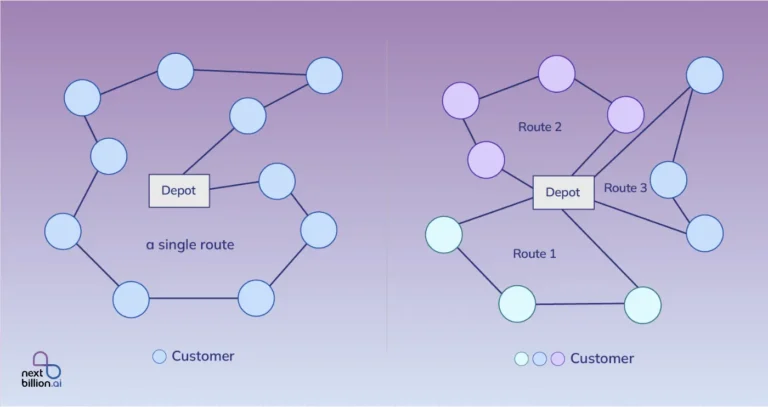
  • 30% to 50% Reduction in Stockouts: By eliminating missed delivery windows and dynamically adjusting routes to real-time order surges, high-velocity stockout events drop dramatically.

  • 15% to 25% Reduction in Fleet Mileage & Fuel Consumption: Optimized stop sequencing and truck-specific route guidance eliminate unnecessary transit miles and idling.

  • 30% Savings in API & Logistics Tech Overhead: Replacing pay-per-call mapping services with NextBillion.ai’s flexible pricing model directly lowers recurring operational costs.

  • Higher DEX Dock Adherence: Precision ETA calculations powered by real-time traffic data improve dock arrival accuracy to over 98%, virtually eliminating rejected deliveries.

Conclusion: Eliminating Out-of-Stocks as a Competitive Advantage

In the modern beverage ecosystem, winning consumer loyalty happens directly at the retail display. Even the most compelling marketing campaigns, premium formulations, and aggressive trade promotions fail to generate revenue if the product shelf sits empty when a consumer is ready to purchase. In an industry where up to 75% of stockouts lead to brand switching or abandoned purchases, logistics reliability directly dictates market share.

Eliminating out-of-stocks is no longer just an operational goal, it is a core revenue driver. By moving away from rigid, legacy “master routes” and adopting dynamic, multi-constrained VRP solvers, beverage distributors can transform fleet execution from a volatile cost center into a predictable, high-yield competitive advantage. Optimizing for multi-dimensional payload limits, strict DEX delivery windows, driver work rules, and real-time traffic updates ensures that high-velocity SKUs consistently reach store shelves before inventory depletes.

With enterprise spatial platforms like NextBillion.ai, logistics engineers and fleet managers gain the technical infrastructure, high-throughput API performance, and constraint flexibility needed to solve these complex distribution puzzles at scale. By embedding intelligent routing algorithms into daily dispatch workflows, distributors can protect margins, maximize drop density, build stronger retail partnerships, and guarantee that products are always on the shelf ready for purchase.

To see how AI-driven spatial intelligence can eliminate stockouts across your distribution network, book a Demo with NextBillion.ai today.

About Author

Prabhavathi Madhusudan

Prabhavathi is a technical writer based in India. She has diverse experience in documentation, spanning more than 10 years with the ability to transform complex concepts into clear, concise, and user-friendly documentation.

Ready to get started?

Table of Contents