



Table of Contents
Not every mile driven contributes to business efficiency. Unplanned routes and unnecessary travel can significantly impact productivity and increase operational costs. Among these inefficiencies, deadhead miles remain one of the most overlooked contributors.
Businesses operating in field services and logistics often face operational bottlenecks due to deadheading. It can silently drive up fuel costs and add unnecessary complexity to logistics operations.
With a strong focus on improving logistics efficiency and maximizing productivity, NextBillion.ai Route Optimization Software has introduced its new Deadhead Miles feature. In this blog, let’s understand what deadhead mile means, how the newly launched deadhead feature powered by NextBillion.ai works, and how businesses can use it to minimize empty miles and optimize their field operations.
What is a Deadhead Mile in Trucking and Logistics?
A deadhead mile refers to any distance a vehicle travels without carrying goods, serving customers, or completing a job. In simple terms, it’s non-productive travel. This generally happens when a vehicle is moving empty, either returning after a completed job or repositioning itself for the next assignment.
In simple terms, deadhead miles contribute to non-revenue, non-productive travel. While it is often unavoidable in real-world operations, it directly impacts efficiency by consuming fuel, driver time, and resources without generating any value.
Let’s try to understand this with an example. A technician completes a service call in one location and travels to another job without performing any work in between. Those traveled miles are considered deadhead miles. Similarly, in logistics, when a truck returns empty after a delivery or moves to a pickup point without cargo, those miles are classified as deadhead miles.
Deadhead miles lead to higher operational costs and lower asset utilization, making its reduction a key priority for businesses aiming to improve route efficiency and overall productivity.
NextBillion.ai’s Deadhead Miles Optimization Feature: An Overview
To help businesses gain better control over non-productive travel, NextBillion.ai has introduced the Deadhead miles optimization feature within its route optimization capabilities. This feature enables organizations to measure and limit deadhead miles. It helps in significantly reducing the empty travel that occurs before the first job or after the last job in a planned route.
With this capability, businesses can define constraints around how much deadhead is acceptable in a particular route plan. The optimization engine then takes these limits into account while generating routes, ensuring that vehicles spend more time on productive tasks rather than unnecessary travel.
By incorporating deadhead miles considerations directly into route planning, NextBillion.ai allows stakeholders to build more efficient schedules, reduce wasted mileage, and improve overall resource utilization. This makes the feature especially valuable for logistics and field service operations where minimizing empty miles can directly impact cost, efficiency, and service quality.
How the Deadhead Optimization Feature Works: Step-by-Step Guide
Understanding how the Deadhead optimization feature works can help you better control non-productive travel and build more efficient routes. Here’s a simple step-by-step breakdown:
Step 1: Define Your Jobs and Locations
Start by adding all your service jobs, delivery points, or tasks along with their locations, time windows, and requirements. This forms the foundation of your route plan.
Step 2: Configure Vehicles and Start/End Points
Set up your fleet by defining vehicle details, including start and end locations (depots), working hours, and capacities. Deadhead mile is typically calculated before the first job and after the last job in a route.
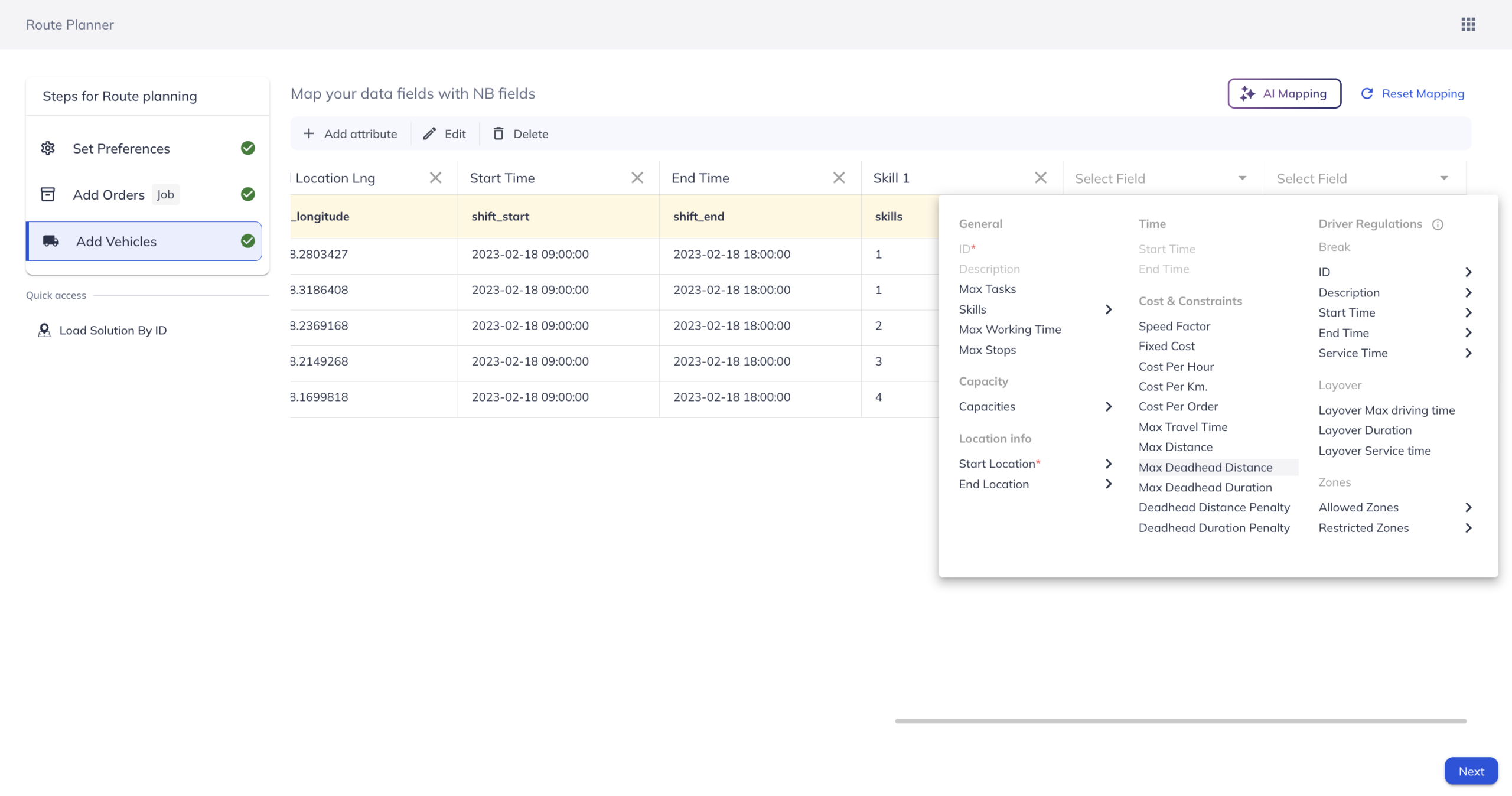
Step 3: Set Deadhead Miles Constraints
Define acceptable limits for deadhead miles or duration. This tells the system how much empty travel is allowed, helping ensure routes stay efficient. There are 4 constraints that you can use for each vehicle to reduce deadhead miles for them:
- Max Deadhead Distance – Sets the maximum distance a vehicle can travel empty (without tasks) between jobs or depot legs.
- Max Deadhead Duration – Limits the maximum time a vehicle can spend on empty travel between assignments.
- Deadhead Distance Penalty – Adds a cost to longer empty travel distances, encouraging the optimizer to reduce non-revenue miles.
- Deadhead Duration Penalty – Applies a cost to time spent on empty travel, pushing the system to minimize idle driving time.
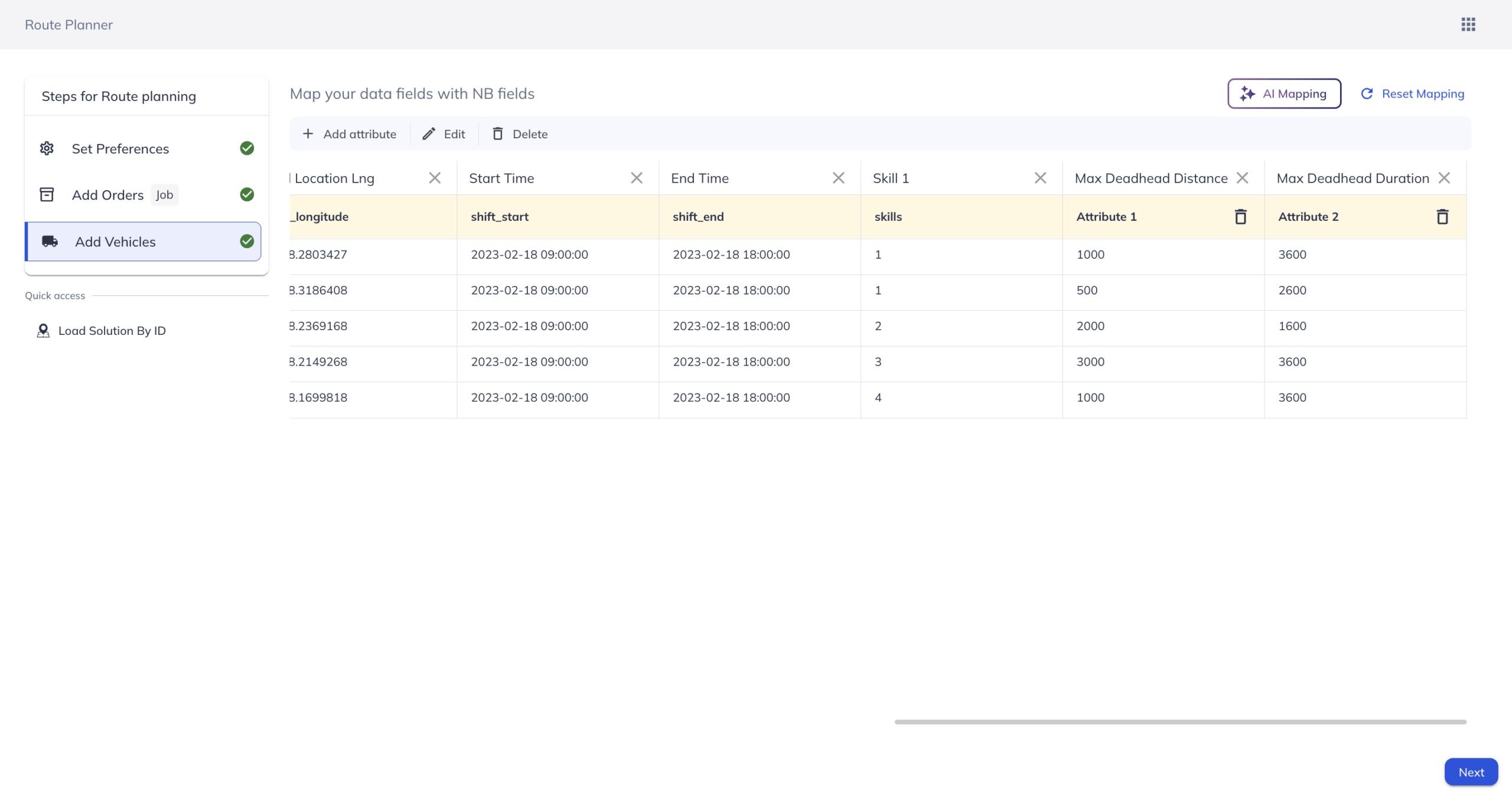
Step 4: Run Route Optimization
Once all inputs are configured, run the optimization. The system automatically considers deadhead constraints along with other factors like time windows, skills, and priorities to generate efficient routes.
Step 5: Analyze Deadhead Miles in Results
Review the generated routes to see how much distance and time is spent on the deadhead. This layer level visibility helps identify inefficiencies and opportunities for improvement in the route plan.
Step 6: Refine and Optimize Further
Adjust constraints, job allocation, or depot locations to further reduce deadhead. Focusing on these inputs can help achieve better route efficiency and lower operational costs.
By following these steps, logistics businesses can effectively minimize Deadhead miles, improve resource utilization, and ensure more productive field operations.
Read the detailed document here.
How the Deadhead Mile Optimization Feature Improves Operational Efficiency
The Deadhead optimization feature plays a vital role in improving operational efficiency by minimizing non-productive travel across routes. By setting limits on deadhead miles and duration, businesses can ensure that vehicles spend more time completing jobs and less time traveling empty.
With better visibility into deadhead segments, stakeholders can identify inefficiencies in route planning and make smarter decisions around job allocation, depot placement, and scheduling. This leads to optimized routes, reduced fuel consumption, and improved utilization of field resources.
By incorporating deadhead constraints directly into route optimization, the system ensures that efficiency is built into every plan. This can result in faster service delivery, lower operational costs, and more productive field teams, ultimately driving better overall performance.
Key Use Cases of the Deadhead Mile Optimization Feature
The Deadhead optimization feature is valuable across multiple industries where route efficiency and resource utilization are important. Here are some key use cases:
Last-Mile Delivery
Delivery vehicles frequently return empty after completing routes. By reducing deadhead miles, businesses can optimize delivery cycles and lower fuel costs.
Logistics & Fleet Management
Fleet operators can use deadhead constraints to reduce empty miles, improve asset utilization, and increase overall fleet efficiency.
Multi-Depot Operations
Businesses operating from multiple depots can use this feature to optimize vehicle start and end points, reducing unnecessary travel before the first job and after the last.
Field Service Operations
Technicians often travel long distances between jobs or return empty after completing tasks. The Deadhead optimization feature helps minimize idle travel, ensuring more time is spent on productive work.
Home Services (HVAC, Plumbing, Electrical)
Service providers managing multiple appointments across locations can use this feature to reduce gaps between jobs and improve daily job completion rates.
Healthcare & On-Site Services
For industries like home healthcare or inspection services, minimizing unnecessary travel helps maximize the number of visits per day while reducing operational costs.
By applying the Deadhead miles optimization feature across these use cases, businesses can significantly reduce costs, improve productivity, and streamline field operations.
Conclusion
Deadhead miles may seem like a small part of your logistics operations, but its impact on costs and efficiency can be significant. Unchecked empty miles not only increase fuel expenses but also reduce the overall productivity of your field teams.
With the introduction of the Deadhead optimization feature, NextBillion.ai provides businesses with the ability to measure, control, and minimize non-productive travel as part of their route planning process. By incorporating deadhead constraints into optimization, organizations can build smarter routes, improve resource utilization, and deliver more efficient operations.
As field service and logistics continue to grow in complexity, adopting solutions that address hidden inefficiencies like deadhead is key to staying competitive and scaling effectively.
To know more about the deadhead mile optimization feature, feel free to get on a call with our experts.
Ready to get started?
Request a DemoTable of Contents
Subscribe to our Newsletters
Get the best practices for route planning & optimization, delivered to your inbox.
Subscribe