


Route Optimization API
Optimize routing, task allocation and dispatch
Distance Matrix API
Calculate accurate ETAs, distances and directions
Directions API
Compute routes between two locations
Navigation API & SDK
Turn by Turn Instructions for Drivers & Technicians
Route Optimization Software
Plan optimized routes with 50+ Constraints
Product Demos
See NextBillion.ai APIs & SDKs In action
AI Route Optimization
Learns from Your Fleet’s Past Performance
Platform Overview
Learn about how Nextbillion.ai's platform is designed
Road Editor App
Private Routing Preferences For Custom Routing
On-Premise Deployments
Take Full Control of Your Maps and Routing
About Us
Our story, vision
and mission
Contact Us
Reach out to us for any product- or media-related queries
Write to us at

Table of Contents
What happens when a tool built to guide one driver is used to coordinate an entire fleet?
At first glance, map apps and route optimization software may seem similar because both calculate routes. However, the underlying mathematics, decision scope, constraint modeling, and cost intelligence differ fundamentally. Map applications solve single-trip shortest path problems, while route optimization software solves complex combinatorial logistics problems across multiple vehicles, stops, and operational constraints. One optimizes navigation. The other optimizes operations.
Read the full blog below to understand the technical, operational, and strategic differences in detail.
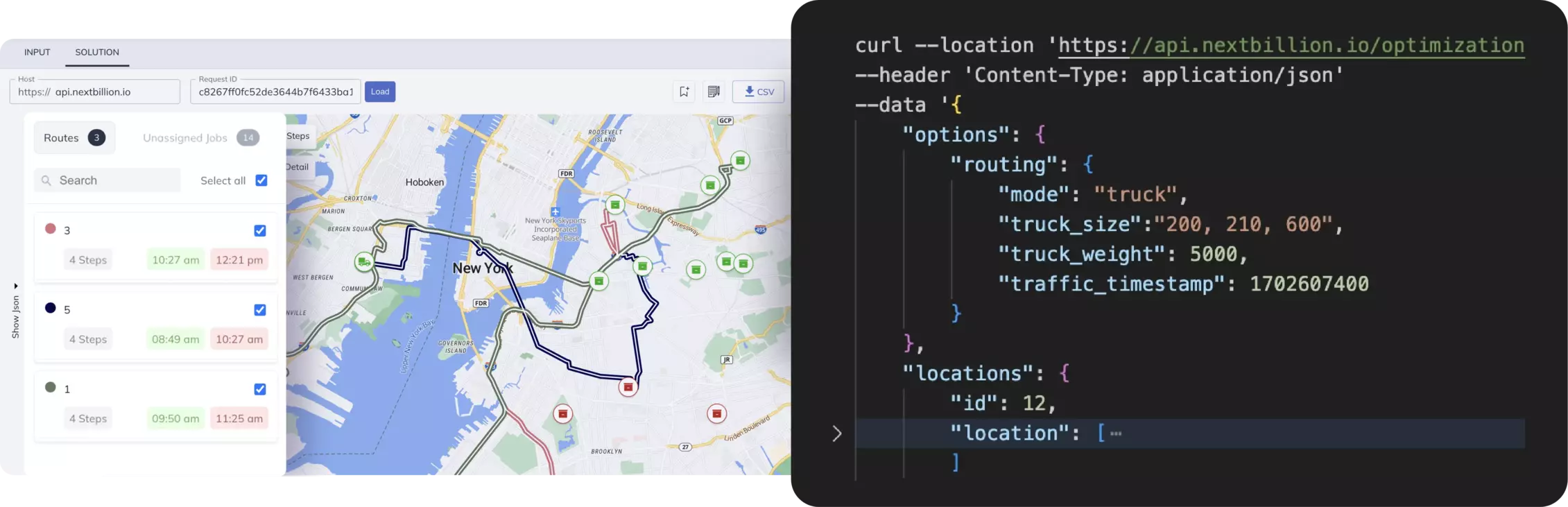
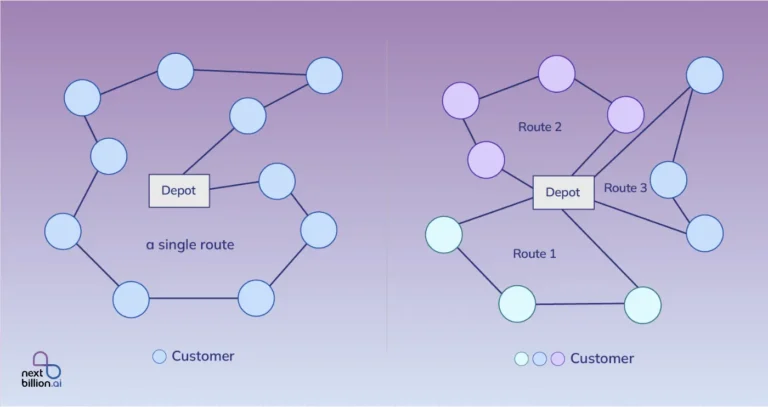
Route optimization software is a fleet-level computational engine. It formulates, analyzes, and then selects the most efficient routing arrangement across several vehicles and stops, as well as operating constraints. It is used in large-scale combinatorial logistics where decisions depend on each other, and a cost trade-off exists between time, distance, labor, fuel, and service performance.
In contrast to a single query shortest path between any two coordinates, as in the case with navigation systems, route optimization systems solve well-structured variants of the Vehicle Routing Problem, including:
These systems are structured through a layered optimization architecture that encompasses:
Millions of possible stop combinations are assessed through the system by way of cost functions that include operational and financial weighting.
The following sections describe the core features of route optimization software.
Routes are generated at the fleet level rather than for individual drivers. Stop allocation optimizes geographic clustering, capacity balancing, depot proximity, and workload distribution to prevent underutilization and route redundancy.
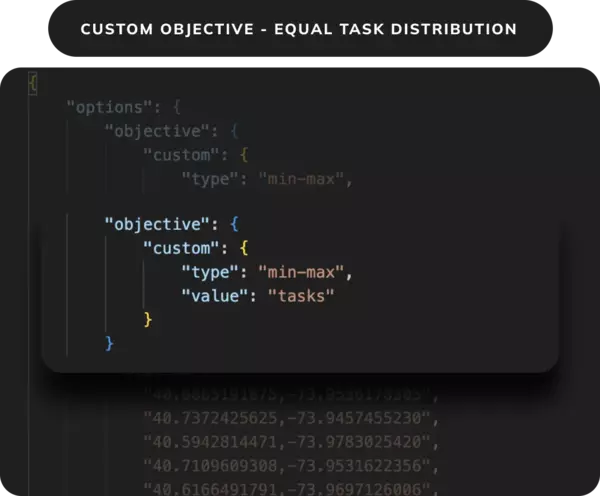
The mathematical model encodes vehicle capacity, driver shift limits, labor regulations, service durations, priority classification, and regulatory restrictions. This organized encoding eradicates the use of manual conflict resolution during execution.
Hard constraints enforce strict delivery intervals. Soft constraints impose weighted penalties for minor deviations. The solver focuses on SLA compliance within the global cost objective.
The objective function incorporates fuel consumption models, wages given to drivers, the cost of idling time, overtime exposure, and maintenance considerations. Ancillary choices are financially oriented as opposed to distance-oriented.
Recalculation of fleets takes place in cases of traffic disruption, sudden stop additions, or order cancellations. The system optimizes travel time matrices and recalculates impacted routes without breaching constraint feasibility.
Combined GPS and telematics feeds offer monitoring of route adherence, deviation alerts, dwell time tracking, and real-time ETA of arrivals. Automation is triggered by exception thresholds.
Structured KPIs produced by post execution analytics include:
Navigation reactivity switches to quantifiable operational control.
Here is a step-by-step breakdown of how route optimization software works in real-world operations:
Optimization of routes starts with organized data consumption by enterprise systems. The inputs to the operational methods include delivery addresses, vehicle specifications, driver schedules, time windows, fuel parameters, and historical traffic data, which are gathered and normalized.
Addresses are geocoded into latitude and longitude values, service times are checked, and capacity attributes are standardized. Anomaly detection, deduplication, and geospatial clustering detect flaws in the inputs and make them more reliable. The basis of proper optimization is clean and structured data.
After the data is proven to be valid, business rules are translated into mathematical constraints. Vehicle weight and volumetric capacity constraints are encoded to prevent overloading. Driver shift regulations impose strict limits on working hours.
Arrival intervals are limited by time windows. Weighted penalty parameters are given to priority shipments. Regulatory limitations, such as axle limits or restricted roads, become part of the feasibility model. These constraints define the allowed solution space and remove routing configurations that are not permitted by operational policies.
The system specifies optimization objectives in a systematic cost function. Goals usually include reducing total travel distance, fuel consumption, and labor hours, minimizing late deliveries, balancing workload between vehicles, and maximizing asset utilization. Objectives are given weighted coefficients in accordance with business priorities. The optimization engine considers combinations of routes based on this composite cost model.
The routing engine uses large-scale optimization algorithms to screen and assess route permutations. Vehicle Routing Problem solvers, heuristic solvers, metaheuristic solvers, and Mixed Integer Linear Programming solvers produce and optimize feasible solutions. The solver reshapes candidate route setups in comparison to the predefined objective function and chooses the lowest cost solution that fulfills all constraints.
Optimized routes are sent to execution systems via APIs and mobile applications. Stop sequences, ETAs, workload assignments, and dispatch platforms synchronize with driver devices. The route optimization algorithm transforms computing output into executable field instructions.
Telematics during execution updates travel time matrices through traffic data feeds in real time. In case of disruptions such as congestion, cancellations, urgent insertions, or breakdowns, the system recalculates impacted route segments and maintains constraint feasibility. This adaptive process ensures continuity of operations without manual replanning.
Once the route is completed, performance metrics such as on-time delivery rate, route adherence ratio, fuel variance, idle time percentage, and cost per stop feed back into the system. Past execution records optimize ETA forecasts and cost elements. The system operates in continuous refinement, improving forecast accuracy and operational stability over time.
Current route optimization systems are not improved map engines. They are computational decision systems based on mathematical optimization, distributed systems engineering, and predictive intelligence that are used to coordinate fleets at scale. The following are the fundamental technologies behind enterprise-grade route optimization.
Routing engines treat transportation networks as directed weighted graphs, with nodes depicting depots, delivery points, or intersections, and edges depicting traversable road segments with weights such as distance, travel time, toll cost, or fuel consumption.
In contrast to consumer navigation systems that find a single shortest path query, enterprise platforms find structured variants of the Vehicle Routing Problem, such as:
Due to factorial growth in the number of possible stop sequences, optimization engines use a layered solver architecture. These combine constructive heuristics for quick initial solutions, local search improvement, tabu search, genetic algorithms, simulated annealing, and Mixed Integer Linear Programming, where computationally feasible.
Before complete optimization is performed, constraint propagation, graph pruning, and feasibility filtering reduce the search space. This allows scalable exploration of millions of route permutations without compromising operational constraints.
Enterprise logistics does not rely on average or static travel time assumptions. Accurate prediction of the time of arrival requires learning from actual execution data.
Current systems train supervised machine learning models on large-scale telematics datasets, including:
Gradient boosting frameworks, ensemble models, and deep neural networks enhance edge weight estimation and travel time prediction. Continuous retraining pipelines update models whenever new execution data enters the system.
This allows ETA models to respond to seasonal demand variations, urban infrastructure development, changes in traffic behavior, and regional growth trends.
Enterprise routing incorporates live traffic intelligence into the optimization lifecycle instead of relying on reactive rerouting alone.
Traffic intelligence feeds ingest data from:
These APIs refresh travel time matrices and edge weights during route execution. Partial reoptimization activates automatically when predicted delays exceed tolerance limits or SLA risk increases.
The system reoptimizes affected route segments while maintaining global fleet feasibility, capacity limits, and service time windows.
Distributed computation and resilient system architecture are required to optimize routes at enterprise scale.
Modern platforms deploy containerized microservices across distributed cloud clusters to enable:
Secure RESTful APIs align optimization outputs with driver applications, ERP systems, warehouse management systems, billing engines, and customer notification platforms.
Routing becomes an integrated enterprise workflow rather than a standalone calculation engine.
Advanced route optimization systems include demand modeling prior to daily route generation.
Time series models, gradient boosting systems, and deep learning architectures process:
Forecast outputs support proactive decisions regarding fleet allocation, vehicle staging, driver scheduling, and depot balancing.
Optimization shifts toward proactive orchestration, where fleet capacity is planned in advance based on expected demand, and operational variability is minimized.
Map apps are consumer-grade geospatial navigation systems. They are designed to calculate the best possible route between two coordinates using graph theory, real-time positioning, and large-scale mapping infrastructure. At a systems level, they represent transportation networks as directed weighted graphs in which road intersections are nodes and road segments are edges. Weights on each edge represent travel time, distance, historical speed distribution, or congestion intensity.
Routing decisions in map applications are made using shortest path algorithms such as Dijkstra or A star that minimize cost functions typically based on time or distance. This architecture is optimized for single-trip computation and individual mobility. It does not include multi-vehicle coordination, capacity balancing, or enterprise-level constraint modeling.
Here is how route optimization software fundamentally differs from traditional map applications in real-world operations:
Map applications are most efficient for a single trip that has one origin and one destination, as they mainly try to guide an individual driver through the fastest or shortest path. The calculation is discrete, and it fails to take into consideration the effect of one routing decision on other vehicles within the system.
Route optimization software compares a variety of vehicles, stops, depot assignments, and operational constraints in a single mathematical problem. It allocates stops at any time, ensures an even spread of route distance, limits congestion, minimizes total fleet distance, and stays within compliance limits.
Example: A grocery delivery firm operates 12 vans that handle 180 orders per day. When a map app is used, each driver sequence stops separately, which results in overlapping routes and an imbalanced workload. Using route optimization software, orders are geographically clustered, vehicle capacity is considered, and workload is evenly distributed among all 12 vans.
Winner: Route Optimization Software.
Map apps solve shortest path problems using graph traversal algorithms such as Dijkstra or A star, minimizing time or distance for a single route query. Route optimization software solves advanced combinatorial logistics problems such as Capacitated VRP, VRP with Time Windows, Pickup and Delivery Problems, and Multi Depot VRP. The solution space increases factorially as the number of stops increases, which requires heuristics, metaheuristics, and structured optimization solvers.
Example: A field service company schedules 30 technician visits per day. The number of possible stop sequences reaches billions. A map app cannot assess such complexity. Route optimization software analyzes feasible combinations and automatically selects a cost-effective and time-compliant sequence.
Winner: Route Optimization Software.
Map applications reduce travel time or travel distance for a single trip. They do not consider financial trade-offs or operational penalties. Route optimization software generates multi-objective cost functions that combine fuel consumption curves, driver wages, idle time costs, overtime exposure, SLA penalties, and imbalance in asset utilization. All factors are weighted according to business priorities.
Example: A logistics company faces strict penalties for late deliveries. A map application proposes the quickest path for one vehicle. Route optimization software assigns a slightly longer route to avoid congestion later in the day, preventing multiple SLA violations across the fleet.
Winner: Route Optimization Software.
Map apps fail to encode enterprise-level constraints such as vehicle weight capacity, cubic volume limits, EV battery range, driver shift limits, regulatory restrictions, or delivery time windows. They only confirm that a road path exists. Route optimization software represents these constraints mathematically as inequalities and time-indexed conditions within the optimization model. Infeasible solutions are automatically screened out before execution.
Example: A pharmaceutical distributor requires temperature-controlled trucks with limited payload and strict time constraints. A map application suggests a quick route without verifying vehicle suitability. Route optimization software allocates only compliant vehicles and enforces time limits.
Winner: Route Optimization Software.
Map applications generate routes for each driver without centralized control. Route optimization software synchronizes fleet-wide movement by dynamically reallocating stops to prevent overlapping service areas, reduce empty miles, and maximize route density. It considers depot proximity and driver availability within a single orchestration layer.
Example: In municipal waste collection, five trucks operate in neighboring areas. Map applications guide each truck individually. Route optimization software redesigns route boundaries to reduce cross-district overlap and total fuel usage.
Winner: Route Optimization Software.
During disruptions, map applications reroute individual drivers based only on traffic reports. Route optimization software performs partial reoptimization of affected routes while maintaining global feasibility across all vehicles and preserving SLA compliance.
Example: A vehicle breaks down during delivery. A map app cannot redistribute remaining stops. Route optimization software automatically reassigns incomplete deliveries to nearby vehicles without violating capacity or time windows.
Winner: Route Optimization Software.
Map applications rely mainly on GPS and traffic feeds that provide ETA updates and simple route tracking. Route optimization platforms integrate with ERP systems, warehouse management systems, telematics platforms, billing engines, and customer communication systems. They generate structured performance indicators such as cost per stop, on-time delivery rate, route compliance ratio, idle time ratio, and asset utilization rate.
Sample: A distribution company requires monthly reporting on fuel variance and SLA performance. Map applications provide route history only. Route optimization software produces strategic planning dashboards and exportable analytics.
Winner: Route Optimization Software.
Map applications scale to millions of users but operate on single-trip logic. They do not support thousands of coordinated stops or multi-depot fleet operations. Route optimization software scales using distributed cloud infrastructure, hierarchical clustering algorithms, and parallel solvers to manage factorial growth in route permutations.
Scenario: An online delivery company increases daily deliveries from 50 to 2,000 stops across six depots. Map applications become inefficient, and manual coordination increases. Route optimization software computes optimal fleet-wide plans within an acceptable processing time.
Winner: Route Optimization Software.
Here are the key differences that clearly distinguish route optimization software from traditional map applications:
Dimension | Map Apps | Route Optimization Software |
Problem Type Solved | Shortest path between one origin and one destination | Vehicle Routing Problem across multiple vehicles and stops |
Optimization Scope | Single vehicle, single trip | Multi-vehicle, multi-stop, multi-constraint |
Objective Function | Minimize travel time or distance | Minimize total operational cost, including fuel, labor, and penalties |
Constraint Handling | No encoding of capacity, shifts, or SLAs | Mathematical modeling of capacity, time windows, shifts, and regulations |
Fleet Coordination | Independent driver level routing | Centralized fleet-wide stop allocation and workload balancing |
Cost Modeling | No financial weighting | Fuel curves, labor hours, idle time, overtime, SLA penalties |
Dynamic Reoptimization | Reroutes the individual driver based on traffic | Reoptimizes affected fleet routes while preserving global feasibility |
Performance Analytics | Basic ETA and trip tracking | Structured KPIs such as cost per stop, asset utilization, and SLA compliance |
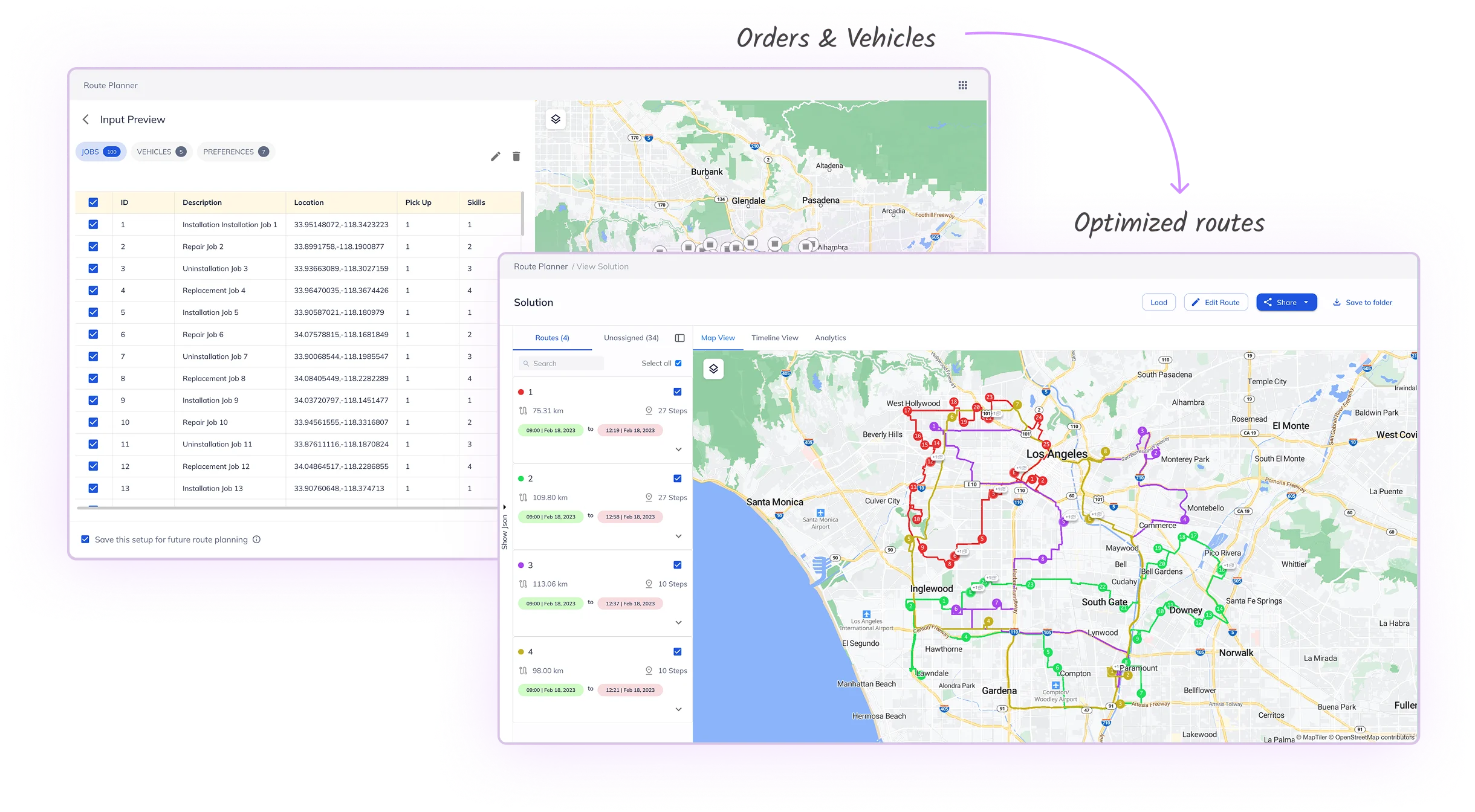
Here is how NextBillion.ai powers scalable, constraint-aware, and API driven fleet optimization for modern logistics operations.
NextBillion.ai accommodates variations of the Vehicle Routing Problem, which include capacitated routing, time windows, multi-depot coordination, and pickup and delivery sequencing. Thousands of stops are processed by the engine in a single mathematical calculation, and the workload is balanced among vehicles while the minimum total fleet distance and operational cost are achieved.
The platform is flexible and offers routing and optimization APIs, which enable businesses to establish vehicle capacity, driver shifts, service time windows, geofencing policies, and regulatory limitations. The APIs are implemented into dispatching systems, warehouse systems, and ERP systems so that they interface smoothly without the need to reconstruct them.
NextBillion.ai accepts live traffic feeds, telematics data streams, and execution updates to update travel time matrices. In case of disruptions, the system carries out partial reoptimization and retains global feasibility and SLA compliance across the fleet. This provides continuity of operations without human intervention.
NextBillion.ai is built on distributed cloud infrastructure, thus enabling horizontal scaling across large stop volumes and multi-depot networks. Parallel computation engines process route permutations efficiently and maintain low-latency performance even in high-density logistics environments. Secure RESTful APIs synchronize routing outputs with driver applications, analytics dashboards, and financial systems to achieve end-to-end operational visibility.
Route optimization software functions as a fleet level decision intelligence system that transforms routing from simple navigation into structured operational control. It encodes capacity limits, time windows, shift rules, and regulatory requirements, while simultaneously modeling fuel costs, labor exposure, SLA penalties, and asset utilization within a unified optimization framework.
While map applications support individual drivers effectively, enterprise logistics environments require combinatorial optimization, real time constraint enforcement, predictive ETA modeling, and measurable performance analytics to sustain efficiency, compliance, and profitability at scale.
If your operations are expanding beyond single trip navigation, explore how NextBillion.ai delivers scalable, API driven route optimization built specifically for enterprise fleets.
Route optimization encodes time windows, service durations, depot cutoffs, and fleet dependencies into a single mathematical model. It validates feasibility before dispatch and recalibrates with live execution data. This reduces arrival variability, improves first attempt delivery rates, and stabilizes operations during demand fluctuations.
Accurate geocoded addresses, validated vehicle capacities, realistic service times, and updated driver shift data are essential. Poor data leads to infeasible or inefficient routes. Enterprises apply validation, anomaly detection, and geospatial clustering before optimization.
Modern systems model multiple depots within a unified solution space and incorporate load balancing and transfer constraints. Dynamic vehicle assignment reduces empty miles and improves network wide asset utilization.
Yes. Enterprise platforms provide RESTful APIs that integrate with ERP, warehouse, transportation management, telematics, and billing systems. This ensures routing aligns with operational and financial workflows without replacing existing infrastructure.
Key metrics include reduced cost per stop, lower fuel variance, improved on time delivery rate, higher asset utilization, and reduced overtime. Over time, planning effort decreases and SLA risk declines, delivering both operational and financial gains.
Bhavisha Bhatia is a Computer Science graduate with a passion for writing technical blogs that make complex technical concepts engaging and easy to understand. She is intrigued by the technological developments shaping the course of the world and the beautiful nature around us.