

5 Ways to Use Fuel Data to Optimize Your Fleet

5 Ways to Use Fuel Data to Optimize Your Fleet

Published: June 30, 2026

Fuel is one of the largest and most variable costs in fleet operations. Whether you manage delivery vans, long-haul trucks, service fleets, or specialized logistics vehicles, every gallon or liter burned affects your margins, your service efficiency, and your overall competitiveness. What makes fuel especially important is that it is not just a cost to monitor after the fact, but it is a performance signal that can reveal how efficiently your fleet is operating in real time.

Many fleets collect fuel records, telematics data, and maintenance logs, but only a fraction turn that information into actionable decisions. That is a missed opportunity. When used properly, fuel data can help you find inefficient routes, reduce idle time, improve driver behavior, detect vehicle issues earlier, and make better planning decisions across the entire operation. In other words, fuel data is not only about tracking consumption; it is about unlocking smarter fleet management.

In this article, we will explore five practical ways to use fuel data to optimize your fleet. Along the way, we will also look at how routing intelligence and optimization platforms such as NextBillion.ai can help fleets turn raw operational data into measurable savings.

fuel data

Why fuel data matters in fleet management

At a basic level, fuel data tells you how much energy your vehicles are consuming. But at a strategic level, it tells you much more. It can show whether routes are too long, whether vehicles are underperforming, whether drivers are following efficient practices, and whether maintenance issues are quietly increasing operating costs.

This matters because fuel spend is rarely driven by just one factor. In most fleets, it is the combined result of route selection, stop density, traffic conditions, vehicle load, driver behavior, vehicle condition, and dispatch timing. If you treat fuel as a standalone expense, you only see the bill. If you analyze it as an operational signal, you can identify the root causes behind rising costs and inefficiencies.

Fuel data is also useful for sustainability initiatives, compliance reporting, and long-term planning. Fleets that reduce fuel consumption often see benefits beyond cost savings, including lower emissions, better vehicle uptime, and more predictable operations. That is why fuel analytics has become a core part of modern fleet optimization. 

A strong fuel strategy also supports compliance, sustainability, and operational planning. That makes fuel data useful not only for cost control, but also for improving emissions reporting and long-term fleet performance.

The following points shows you 5 different ways of using fuel data to optimize your fleet:

1. Identify fuel-inefficient routes

One of the most valuable uses of fuel data is route analysis. Not all routes that look efficient on a map are actually efficient in the real world. A route may be shorter in distance but still consume more fuel because of traffic congestion, too many stops, steep terrain, poor road conditions, frequent braking, or restricted vehicle access.

By comparing fuel consumption across completed routes, fleet managers can identify which paths consistently drain more fuel than others. That insight is especially useful for fleets managing complex delivery patterns, multi-stop schedules, or specialized vehicles. If the same vehicle burns significantly more fuel on one route than another, that is a signal worth investigating.

A practical way to use this data is to compare route fuel cost against distance, duration, and stop count. This gives you a clearer picture of actual efficiency. A route that is 10% shorter may still be less efficient if it adds 20% more fuel consumption due to traffic or stop-and-go driving.

Ask yourself:

  • Which routes produce the highest fuel usage per mile?

  • Are certain neighborhoods, zones, or corridors consistently inefficient?

  • Do some routes become inefficient at specific times of day?

  • Are we optimizing for travel time but ignoring fuel burn?

Answering those questions can lead to better routing decisions. In many cases, route redesign alone can produce meaningful fuel savings without changing vehicles or driver teams.

This is also where advanced route optimization becomes especially valuable. NextBillion.ai is designed to help fleets move beyond generic navigation and build route plans that reflect real operational constraints. For fleets with delivery complexity, vehicle restrictions, or fuel-sensitive operations, that kind of intelligence can make a major difference.

2. Reduce idling and stop-and-go waste

Idling is one of the most overlooked sources of fuel waste in fleet operations. A vehicle may not appear to be doing much while waiting at a dock, sitting in traffic, or idling during a delivery delay, but it is still consuming fuel. Over time, those minutes add up to a substantial cost.
stop idling
Fuel data can help you pinpoint where idling happens most often. When paired with telematics or GPS records, it becomes possible to identify high-idle zones, recurring wait locations, or time windows where vehicles routinely sit without moving. This is especially useful in industries where dispatch timing, loading delays, and delivery appointments affect efficiency.

Once you know where idling occurs, you can take targeted action. That may include:

  • Adjusting dispatch schedules.

  • Improving dock appointment coordination.

  • Reordering stops to reduce wait times.

  • Training drivers on idle-reduction practices.

  • Reworking routes to avoid known congestion points.

This is a highly practical optimization area because idle reduction often delivers quick wins. Unlike major infrastructure changes, it can sometimes be addressed through smarter planning alone.

It also creates a great management conversation. Instead of asking, “Why is our fuel bill high?” you can ask, “Where are we burning fuel without moving freight or serving customers?” That simple shift leads teams toward operational improvement rather than generic cost-cutting.

3. Connect fuel data with driver behavior

Driver behavior has a direct impact on fuel consumption. Harsh acceleration, aggressive braking, speeding, excessive engine revving, and prolonged idling all increase fuel use. The same route driven by two different drivers can produce noticeably different fuel results.
driver behavior
This is why fuel data should be reviewed alongside driver performance metrics. When those data sets are combined, fleet managers can see whether fuel inefficiency is caused by the route itself or by how the vehicle is being operated. That distinction matters, because the solution could be coaching, route adjustment, or both.

Driver-focused fuel analysis can help you:

  • Identify high-consumption driving patterns.

  • Build driver coaching programs based on real data.

  • Reward efficient driving behavior.

  • Reduce wear and tear on vehicles.

  • Improve safety as well as fuel economy.

The best approach is not to use data punitively, but constructively. Drivers are more likely to improve when they understand that the goal is efficiency, safety, and smoother operations rather than surveillance. Fuel data works best when it supports a culture of improvement.

You might, for example, compare two drivers completing similar routes in similar vehicles. If one consistently uses more fuel, the gap may point to acceleration habits, route timing, or unnecessary idle time. That gives managers a specific conversation starter instead of a vague concern.

This level of operational visibility is especially useful for fleets that rely on multiple drivers across different regions. Over time, it can help standardize performance and reduce the variability that often drives hidden fuel waste.

4. Detect maintenance problems earlier

A sudden or gradual increase in fuel consumption can be a warning sign that something is wrong with the vehicle. Problems such as underinflated tires, engine inefficiencies, clogged filters, sensor issues, or drivetrain wear can all reduce fuel economy before they become obvious in other ways.
Detect maintenance problem
Fuel data is valuable because it can reveal these issues early. If a truck begins consuming more fuel than similar vehicles doing the same work, maintenance teams can investigate before the problem becomes a breakdown or a major repair. In this sense, fuel analytics supports preventive maintenance.

This is particularly important for fleets with high utilization rates. In those operations, a small problem can quickly become expensive if it increases fuel use across many trips. By monitoring fuel trends over time, fleet managers can spot anomalies early and prioritize maintenance based on data rather than guesswork.

Useful questions include:

  • Is this vehicle consuming more fuel than its peers?

  • Has fuel consumption changed after a service event?

  • Are tire issues or engine problems affecting efficiency?

  • Are recurring routes suddenly costing more fuel than before?

The benefit here is not just lower fuel use. Better maintenance also means fewer breakdowns, fewer missed deliveries, better vehicle uptime, and lower total cost of ownership. Fuel data becomes a diagnostic layer that helps you maintain fleet health more intelligently.

In a well-managed fleet, maintenance, routing, and fuel analysis should work together. When they do, teams can move from reactive repairs to proactive optimization.

5. Improve planning and operational control

Fuel data is also a planning tool. It can improve budgeting, forecasting, dispatch planning, and broader operational decision-making. When you know how much fuel different vehicle types, routes, or service zones typically consume, you can plan more accurately and avoid surprises.
Improve planning and operational control
This matters because fleet operations are dynamic. Traffic, delivery density, seasonal demand, and vehicle assignment all influence fuel use. If your planning team has access to historical fuel trends, they can make better decisions about route design, vehicle selection, and workload distribution.

Fuel data can improve:

  • Budget forecasting – Helps set realistic, territory-specific margin limits

  • Route scheduling – Identifies time slots where stop-and-go patterns skyrocket costs

  • Vehicle assignment – Matches asset size, cargo load, and powertrain efficiency to the terrain

  • Customer service planning

  • Sustainability reporting

It also helps fleets compare performance over time. Are fuel costs rising because of longer routes, more idle time, greater congestion, or less efficient vehicle use? Without data, those answers are hard to isolate. With it, you can connect operational changes to business outcomes.

For fleets that operate in fuel-sensitive sectors such as delivery, retail distribution, beverage, agriculture, or fuel transport, this kind of insight is especially valuable. It helps teams align operational decisions with cost control and service expectations.

This is another area where a solution like NextBillion.ai adds value. When route planning is built on optimization logic rather than simple shortest-path navigation, you can better control how fuel data translates into action. That means smarter route plans, better vehicle utilization, and a stronger link between planning and actual performance.

How to turn fuel data into action

Collecting fuel data is only the first step. The real value comes from using it to make decisions. A useful fuel optimization process usually follows four stages.

First, collect accurate data from telematics, fuel cards, GPS systems, maintenance logs, and route records. The more complete the data, the more reliable your insights will be.

Second, analyze patterns over time. Look for vehicles, routes, drivers, and time windows that consistently show higher fuel consumption. One bad trip is noise; repeated patterns are signals.

Third, identify root causes. Is the issue traffic, idling, routing, behavior, maintenance, or vehicle type? The answer determines what action to take.

Fourth, test and refine. Make route changes, train drivers, adjust schedules, and monitor whether fuel use improves. Optimization is not a one-time project; it is an ongoing process.

Interactive check-in:

  • Do you know which route costs your fleet the most fuel?

  • Can you identify your highest-idling stop?

  • Are you comparing drivers on similar routes?

  • Do you have a clear view of which vehicles are underperforming?

If not, that may be the perfect place to start.

Why smarter routing tools matter

Fuel data tells you where inefficiency exists. Routing intelligence helps you fix it. That distinction is important because many fuel problems begin long before the vehicle starts moving. If the route itself is poorly designed, fuel waste is almost inevitable.

Generic navigation tools are often not enough for fleet operations. Real-world logistics involves vehicle restrictions, multi-stop sequencing, delivery windows, access rules, and route-specific constraints. Fleets that operate oversized freight, specialty cargo, or complex delivery networks need routing systems that reflect those realities.

NextBillion.ai is built for these kinds of operational challenges. It helps fleets create route plans that are more aligned with business constraints and delivery requirements. For teams trying to reduce fuel use, that means better decisions at the planning stage, where a lot of savings are won or lost.

If your fleet is serious about lowering fuel costs, improving delivery efficiency, and getting more value from operational data, smarter routing should be part of the strategy.

Interactive checklist:

Use this quick checklist to see where your fleet stands:

  • Do you know which routes use the most fuel?

  • Do you track idle time by vehicle or route?

  • Do you compare fuel efficiency across drivers?

  • Do you monitor fuel trends for maintenance issues?

  • Do your route plans reflect real-world delivery constraints?

If you answered “no” to several of these, your fleet likely has room for improvement. The good news is that fuel optimization usually starts with visibility. Once you can see the problem clearly, you can begin solving it.

NextBillion.ai features that support fleet fuel optimization

When you connect fuel metrics to execution, the platform’s core routing infrastructure acts as a direct cost-control center. NextBillion.ai isn’t a simple out-of-the-box navigation application; it is an AI-powered, map-agnostic location infrastructure built to resolve modern fleet margins.

Advanced Route Optimization Engine

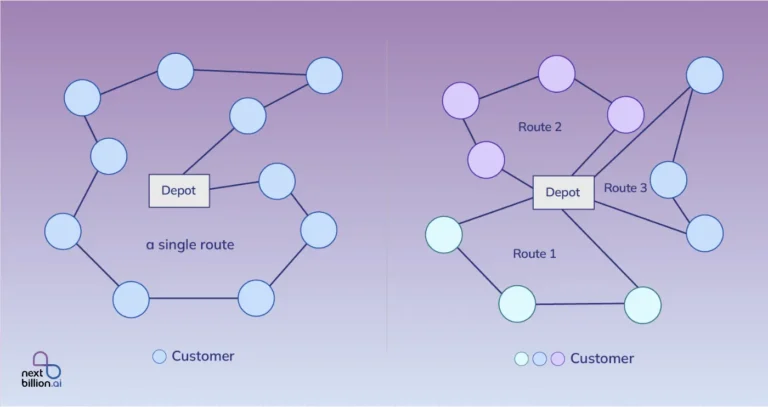
The Route Optimization API is purpose-built to tackle heavy multi-stop scheduling problems. Instead of relying on raw point-to-point lines, the platform handles up to 10,000 stops in a single request while processing over 50 hard and soft constraints. This includes capacity matching, tight delivery time windows, dynamic shifts, and task prioritization. By sequencing variables instantly, it cuts down on unnecessary empty miles—directly slashing fuel consumption before your wheels even turn
advanced route optimization

Decentralized Custom Map Layers (MapFusion)

Standard mapping solutions suffer from static data blind spots. NextBillion.ai’s proprietary MapFusion architecture allows fleets to edit base maps directly. You can map out private roads, mark custom entry/exit gates for warehouses, enforce hard avoidances (such as construction or safety zones), and prioritize your preferred fueling networks.
Decentralized Custom Map Layers

Comprehensive Truck & Permit-Aware Routing

Commercial operations cannot afford passenger-vehicle map assumptions. NextBillion.ai allows logistics managers to design highly custom vehicle profiles matching structural height, length, width, exact axle configurations, and hazardous cargo classes.

  • Permit-Aware Controls: The routing logic factors in bridge height limits, weight caps, and local municipal restrictions.

  • Custom Speed Profiles: It leverages your historical telematics data to construct realistic travel matrices, removing unexpected detours and sharp turns that trigger fuel-heavy downshifts and idling.

Native Telematics & Ecosystem Integration

NextBillion.ai integrates deeply with industry-leading telematics networks like Samsara, Motive, and Geotab. By pairing Geotab GO devices or Samsara vehicle telemetry directly with NextBillion.ai’s Distance Matrix API (supporting up to 5000×5000 matrix sizes), fleet managers can cross-validate real-time engine metrics alongside expected path execution.

Flexible Pricing Infrastructure

NextBillion.ai provides a highly adaptable commercial framework designed to fit your specific fleet structure and budgeting preferences. To keep operational costs predictable as your business grows, you can choose from multiple structured options: usage-based API pricing, asset-based models, or order-volume pricing. This flexibility ensures that your mapping expenses align precisely with your active hardware counts, delivery volumes, and scaling metrics.

Conclusion

Fuel data is one of the most powerful, yet underutilized, strategic assets in modern fleet management. When treated merely as a line item on a monthly expense report, its true value remains locked away. However, when analyzed as a live operational signal, it transforms into a multi-dimensional diagnostic tool. It uncovers hidden waste, empowers driver coaching programs, informs proactive maintenance schedules, and shines a light on structural routing inefficiencies. Ultimately, the fleets that build long-term resilience and maximize their margins are those that treat fuel data as an active decision-making tool rather than a historical archive.

Succeeding in today’s highly competitive logistics landscape requires moving beyond basic data collection. Having thousands of data points from fuel cards and telematics devices is only half the battle; the real victory lies in having the mapping infrastructure capable of turning those insights into execution.

This is where NextBillion.ai bridges the gap between raw operational data and measurable on-road savings. By pairing your historical fuel insights with an AI-powered, custom routing engine, the platform transforms theoretical efficiency into optimized paths, minimized empty mileage, and improved asset utilization. Whether you are navigating tight delivery windows, complex truck-specific road restrictions, or massive multi-stop dispatches, NextBillion.ai provides the precision, scalability, and control needed to drive down total cost of ownership (TCO) and support sustainable growth.

Ready to see how intelligent routing can transform your bottom line? Book a Demo with NextBillion.ai today.

FAQs

Fuel data includes information about fuel consumption, fuel purchases, mileage, idle time, and vehicle performance. It helps fleet managers identify inefficiencies and control operating costs.

Fuel data can reveal wasteful routes, excessive idling, poor driving habits, and maintenance issues. By correcting these problems, fleets can reduce fuel consumption and improve efficiency.

Route optimization helps fleets choose better paths, reduce unnecessary mileage, avoid congestion, and sequence stops more efficiently. This directly lowers fuel use.

Fuel data can signal early vehicle problems when consumption rises unexpectedly. That allows maintenance teams to fix issues before they become costly breakdowns.

NextBillion.ai helps fleets handle complex routing needs, delivery constraints, and vehicle-specific requirements. That makes it a strong fit for turning fuel data into smarter route decisions.

About Author

Prabhavathi Madhusudan

Prabhavathi is a technical writer based in India. She has diverse experience in documentation, spanning more than 10 years with the ability to transform complex concepts into clear, concise, and user-friendly documentation.

Ready to get started?

Table of Contents