

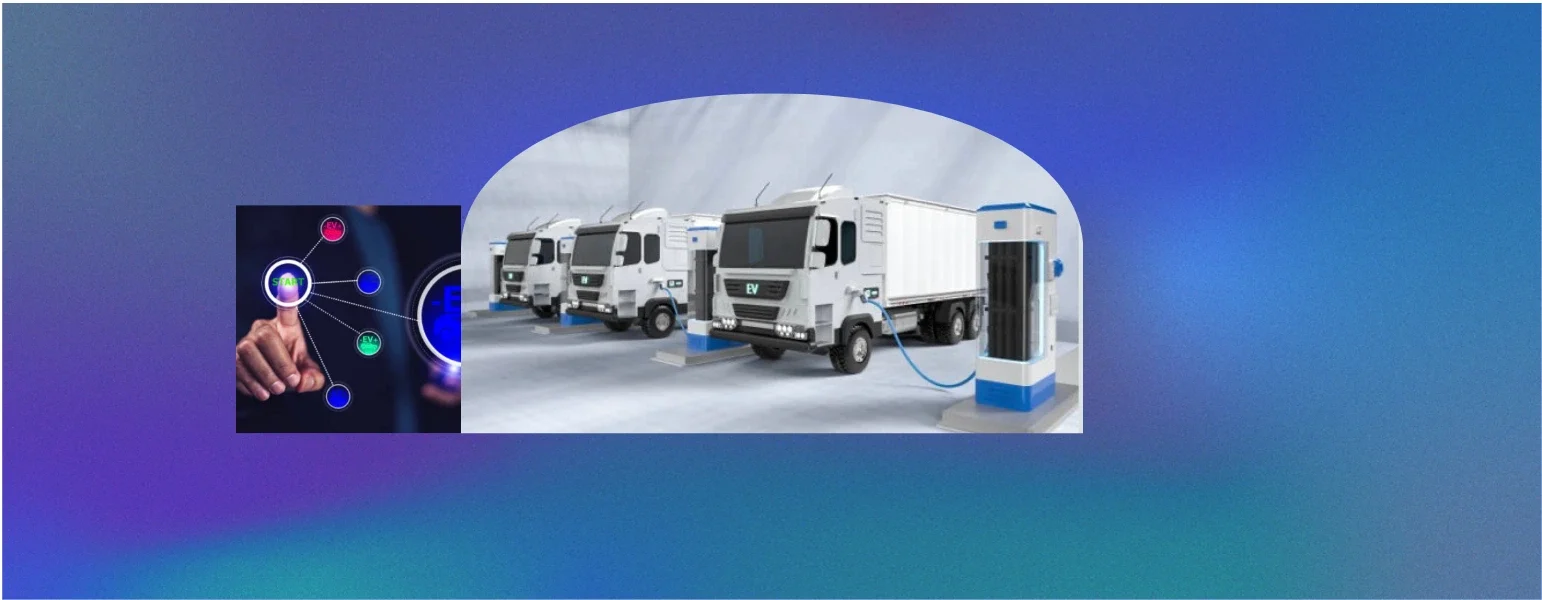
EV Routing for Fleets

EV Routing for Fleets: Charging Constraints, Range Anxiety, and Optimization

Published: May 20, 2026

EV Routing for Fleets helps electric vehicle operators plan routes that account for battery range, charging stops, and real-world conditions like traffic, load, and weather. It makes fleet operations more efficient by reducing downtime, avoiding range issues, and keeping vehicles on schedule.
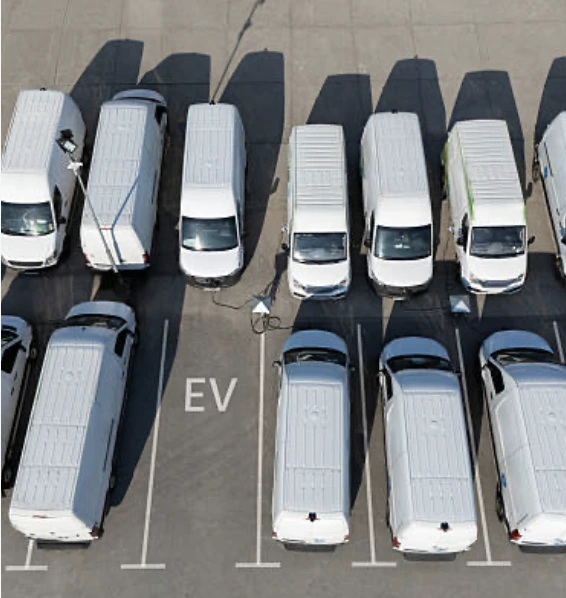
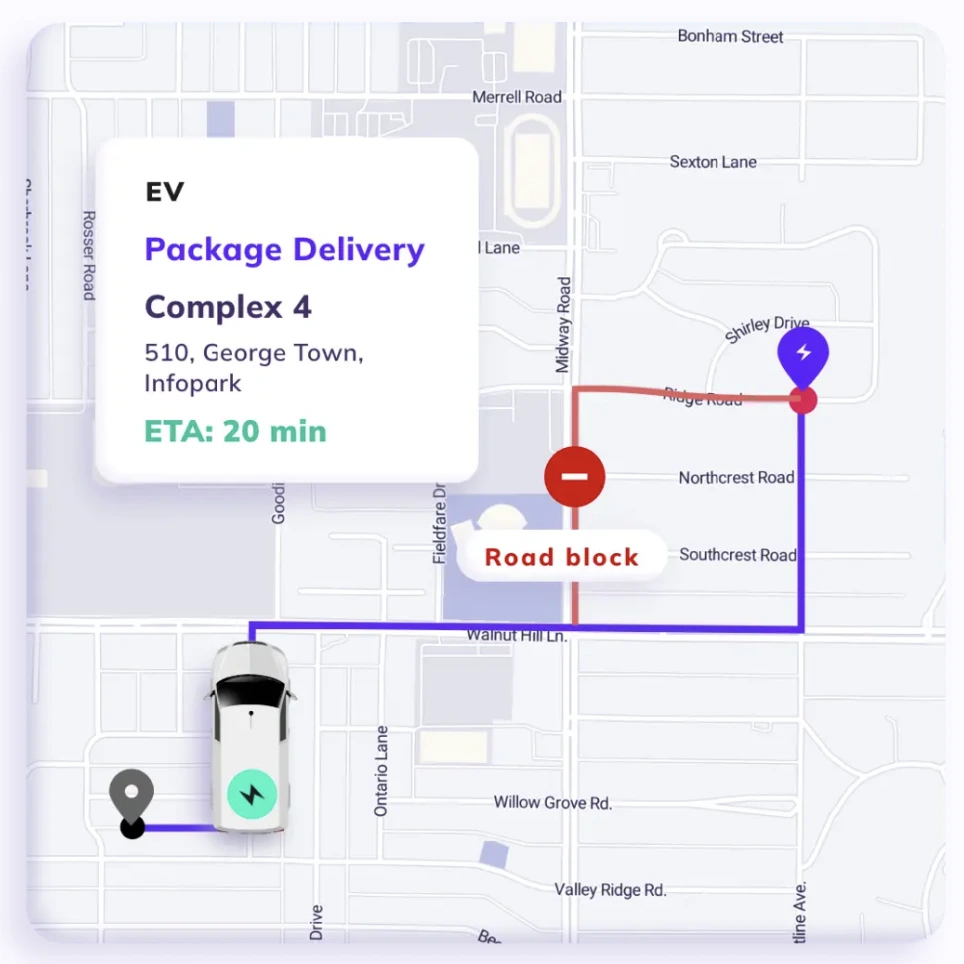
EV
Electric vehicle adoption is changing fleet operations in a way that goes far beyond replacing fuel pumps with charging plugs. For enterprise fleets, EV transition is not a simple hardware upgrade; it is a planning transformation. The moment a fleet begins operating electric vehicles at scale, every dispatch decision starts carrying an energy constraint, every route becomes a balance between time and battery usage, and every charging stop becomes part of the operating model rather than an occasional exception.

That is why EV routing for fleets is fundamentally different from traditional route planning. In a gasoline or diesel fleet, route optimization mostly revolves around distance, traffic, delivery windows, driver availability, and sometimes vehicle capacity. In an EV fleet, those same factors still matter, but they are no longer enough. Route planners also need to model state of charge, energy consumption, charger availability, charging speed, elevation, weather, payload, and the cumulative effect of multi-stop sequencing. The result is a far more complex optimization problem that demands a more intelligent routing system.

For enterprises struggling with the EV transition, this complexity can feel overwhelming. The difficulty is not just “Can the vehicle make the trip?” It is “Can the vehicle complete all assigned stops, in the required order, with enough battery to finish, while minimizing downtime and avoiding unnecessary charging?” That is the real question behind successful EV fleet deployment.

This article goes deep into multi-stop EV fleet optimization, battery-aware routing, charging stop optimization, range prediction, and elevation impact. It also explains why single-route EV navigation is not enough for enterprise logistics, and why route optimization platforms like NextBillion.ai are especially relevant for organizations trying to scale electric fleet operations with confidence.

Why EV Fleet Routing is Different from Standard Fleet Routing

The biggest mistake many organizations make when electrifying a fleet is assuming that the existing routing process will still work with only minor adjustments. In reality, EV routing introduces constraints that change the logic of every planning decision. The vehicle can no longer be treated as a simple delivery asset with enough fuel to handle most routes. It must be treated as an energy-managed machine with a limited and variable operating envelope.

With combustion vehicles, refueling is fast, widespread, and operationally predictable. A vehicle can usually be filled in minutes, and almost any fuel station is usable. EV charging is much more complicated. Charging takes time, charger access is not guaranteed, not every charger is compatible with every vehicle, and charging speed can vary dramatically. That alone changes the design of the route. A route that is efficient in terms of miles driven may be inefficient or even infeasible in terms of battery used.

Enterprise fleets also tend to run multi-stop routes. That means the battery must be managed across a chain of stops, not just one origin-to-destination trip. Each stop changes the remaining state of charge, and each leg of the route affects the feasibility of the next one. This is why EV routing needs to be planned as a sequence of dependent decisions, not isolated trips.

The practical effect is clear: EV fleets require optimization systems that understand both logistics and energy. Without that, dispatchers are left using rough estimates, manual overrides, or conservative buffers that waste capacity and reduce vehicle utilization.

The Enterprise EV Transition Challenge

Many enterprises begin their EV journey with a pilot program. They electrify a few vehicles, assign them to shorter or predictable routes, and measure performance. That is a reasonable starting point, but it usually reveals only part of the challenge. The true difficulty emerges when the fleet expands and route variability increases.

At a small scale, a dispatcher may be able to hand-plan routes and monitor charging manually. At enterprise scale, that approach quickly becomes unsustainable. Route planners must deal with dozens or hundreds of vehicles, many stops, customer time windows, changing traffic patterns, uneven charger access, depot power constraints, and mixed vehicle capabilities. Once EVs are part of the fleet, every one of those variables affects route feasibility.

This is where many enterprises experience transition friction. They may have the right vehicles, but not the right routing logic. They may have chargers, but not enough planning intelligence to use them efficiently. They may have route optimization software, but not software that understands battery state or charging constraints well enough to support real-world electric operations.

The result is often range anxiety at the organizational level. Dispatchers hesitate to assign EVs to longer routes. Operations teams build extra buffers into every schedule. Vehicles are underused, charging is overused, and the fleet fails to realize the full economic value of electrification.

The solution is not more manual oversight. The solution is better optimization.

Why Single-Route EV Navigation is Not Enough

A lot of EV routing tools are designed around the idea of a single trip. They estimate whether a vehicle can travel from point A to point B based on battery range and maybe suggest a charger if the route exceeds the available energy. That approach may be acceptable for consumer navigation, but it is far too limited for enterprise fleet operations.
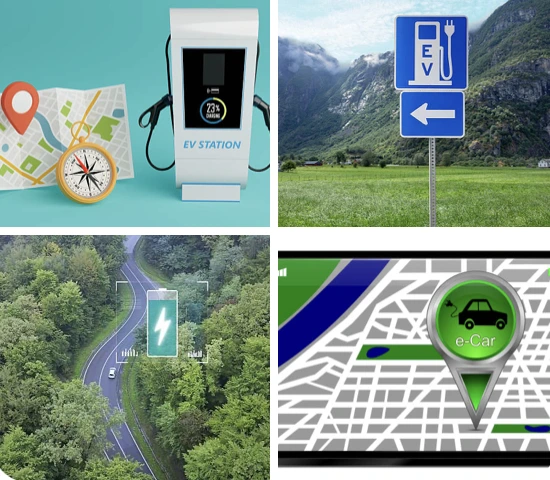
single route ev navigation
A fleet does not operate in single trips. It operates in route blocks, service windows, shift schedules, and multi-stop assignments. That means the system must optimize not only the immediate trip but the entire sequence of tasks for the day. A vehicle that can technically complete one route may not be the best vehicle for that route if it will leave the driver stranded before the final stop of the shift. A charging stop that looks harmless on a single route may disrupt later assignments and reduce fleet-wide productivity.

Single-route navigation also fails to capture the opportunity cost of decisions. Suppose one vehicle is assigned to a route with a charging stop in the middle of the day. That may be fine in isolation. But what if a different vehicle with a larger battery could have completed the same route without charging, freeing the first vehicle for a more demanding assignment? That type of tradeoff only appears in multi-stop, multi-vehicle optimization.

Enterprise EV routing has to answer broader questions:

  • Which vehicle should take which set of stops?

  • In what order should the stops be visited?

  • Which routes can be completed without charging?

  • Which routes need a charging stop, and where?

  • How much battery reserve should be preserved for contingencies?

  • How do traffic, weather, and elevation affect the answer?

Those questions require a route optimization engine, not just navigation.

The Core Pillars of EV Route Optimization

Charging Stop Optimization


Charging stop optimization is one of the most important parts of EV fleet planning because charging directly affects route time, vehicle uptime, and service reliability. It is not enough to know where chargers are located. The system must know which charger is appropriate for the vehicle, whether it is available, how much time charging will take, and how that stop affects the rest of the route.

In practice, charging optimization is a balancing act. A faster charger may be available, but it may require a detour. A slower charger may be closer, but it might not add enough charge to make the route feasible. A depot charger may be ideal overnight, but it may not help a vehicle that needs energy mid-route. The best choice is rarely obvious unless the full route and battery state are modeled together.

Charging stops should be optimized around total operational cost, not just charging convenience. That means evaluating:

  • Detour distance.

  • Charging time.

  • Charger compatibility.

  • Charger reliability.

  • Queue risk.

  • Depot power limits.

  • Downstream delivery commitments.

  • Remaining battery reserve after charging.

When charging is planned well, it becomes almost invisible to the customer. The fleet stays on schedule, vehicles remain productive, and dispatchers can trust that EVs will work as intended. When charging is planned poorly, it creates delays, missed windows, and extra labor costs.
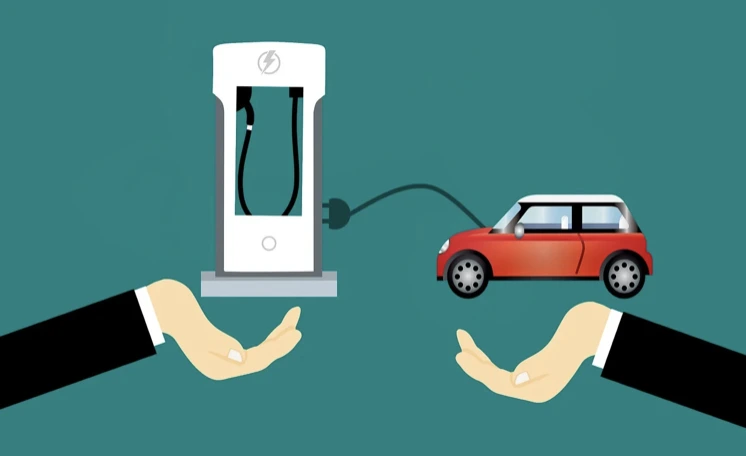
ev charhing
A strong optimization engine should be able to insert charging stops only when needed, choose the best available charger, and adjust the route sequence so that charging supports the schedule instead of disrupting it.

Battery-Aware Routing

Battery-aware routing is the foundation of reliable EV fleet optimization. It means using battery state as a real routing variable instead of assuming a fixed vehicle range. This is critical because EV range is not a static number. It changes with speed, payload, elevation, temperature, stop frequency, and traffic conditions.

A battery-aware routing system should estimate energy use for each leg of a trip and update the remaining state of charge as the route progresses. It should know not just whether the vehicle can start the route, but whether it can finish the route after completing every assigned stop. That difference is essential.

For example, a vehicle may be rated for 220 miles of range. But if it is heavily loaded, traveling in cold weather, and operating in stop-and-go traffic across hilly terrain, the usable range may be much lower. A route that appears safe on paper can fail if the optimizer does not account for those real-world conditions.

Battery-aware routing also helps with dispatch confidence. When route planners can see battery estimates leg by leg, they can make better assignments and reduce unnecessary safety buffers. That improves fleet efficiency and makes EV adoption more practical at scale.

Range Prediction and Elevation Impact

Range prediction is one of the hardest problems in EV routing because the vehicle’s energy use depends on route conditions rather than just distance. This is why route-specific prediction is more useful than generic range assumptions.

Elevation is a major factor. Climbing hills consumes more energy, especially when the vehicle is carrying cargo. Descending can recover some energy through regenerative braking, but that recovery is only partial. A route that crosses multiple elevation changes can consume far more battery than a route of similar length on flat roads.

Traffic also matters. A congested urban route can use more energy than a faster suburban route because repeated acceleration and braking increase demand. Idle time, low-speed movement, and stop frequency all contribute to energy consumption in ways that a simple mileage calculation cannot capture.

Payload also affects range. A vehicle carrying heavier goods uses more energy than the same vehicle running light. This matters a great deal for logistics fleets because the load often changes by route, by stop sequence, or even by time of day.

Weather adds yet another layer. Cold temperatures can reduce battery efficiency and increase HVAC demand. Hot temperatures can also affect thermal management. Rain and wind may influence driving behavior and energy demand as well. For fleet operators in real environments, these factors are not theoretical. They are part of daily operational reality.

A sophisticated route engine should therefore combine historical fleet data, vehicle characteristics, route geometry, elevation profiles, and live traffic signals to estimate range more accurately. That is what makes prediction useful rather than approximate.

Managing Range Anxiety in Enterprise Operations

Range anxiety is often discussed as a driver concern, but in fleet operations it is really a trust problem. Dispatchers, fleet managers, and operations leaders need to trust that the route will work. If they do not trust the routing system, they will compensate by adding unnecessary buffers, avoiding EV assignment on demanding routes, or sending vehicles to charge too early.

That behavior is understandable, but it is not efficient. Excess buffers reduce productivity. Early charging reduces utilization. Conservative assignment rules keep EVs away from the routes where they might actually deliver the most value.

The way to reduce range anxiety is through predictive confidence. If the routing system can model battery use accurately, account for terrain and traffic, and recommend the correct charging strategy, then planners can operate with less fear and more precision. Range anxiety disappears when the business can rely on the data.

For enterprise fleets, that confidence is not optional. It is the difference between experimentation and scalable deployment.

Multi-Stop EV Fleet Optimization

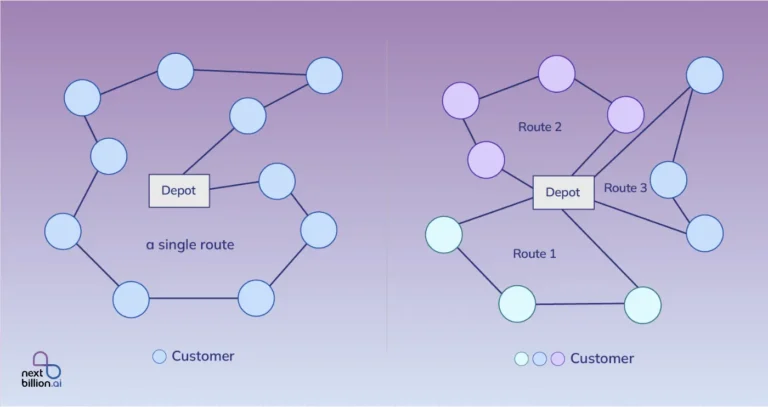
Multi-stop EV fleet optimization is where the real value lies. This is not simply about identifying the shortest route. It is about creating route plans that satisfy multiple constraints at the same time. The optimizer has to balance distance, energy, charging, time windows, vehicle capabilities, and route structure across a fleet of vehicles.

The challenge becomes much more interesting when a route contains many stops. Every added stop changes the battery profile of the trip. Every charging event affects the time available for later deliveries. Every assignment decision affects the feasibility of other routes in the fleet. This is why multi-stop EV routing is a classic optimization problem with strong operational implications.

A good multi-stop optimizer should be able to:

  • Assign orders to the right vehicles.

  • Sequence stops to reduce energy use.

  • Insert charging stops only when necessary.

  • Reassign stops if a route becomes infeasible.

  • Account for time windows and service priorities.

  • Balance workload across the fleet.

  • Minimize charging downtime and detours.

The goal is not to eliminate charging altogether. The goal is to make charging part of the route plan rather than a disruption. In many cases, the route can be improved dramatically simply by changing the stop order or shifting one delivery to another vehicle. That flexibility is one of the main benefits of real optimization.

Why Route Sequencing Matters More for EVs

With EVs, stop order can have a major effect on feasibility. In a combustion fleet, sequencing matters mostly for distance and time efficiency. In an EV fleet, sequencing affects energy consumption directly.

For example, if a route begins with the steepest segment, the vehicle may consume a large amount of energy early and leave less battery for the rest of the day. If the same route is reordered so that the vehicle handles flatter, closer stops first and the hill segment later, the energy profile may improve. In some cases, the route can even eliminate the need for a charging stop.

Stop sequencing also interacts with charging locations. A vehicle may need a mid-route recharge, but the best time to charge may depend on the order of the stops. The optimizer needs to know whether charging before a difficult segment is better than charging after it, and whether an alternate stop order can avoid the charge entirely.

This is exactly why EV routing cannot be solved well by simple map directions. The optimal route is not just about where to go. It is about when to go there and what the battery state will be when you arrive.

Operational Strategies for Electric Fleets

Depot Charging, Public Charging, and Hybrid Strategies

Enterprise fleets rarely depend on a single charging model. Most use a combination of depot charging and public charging, often with different vehicles relying on different parts of the system.

Depot charging is generally the most predictable option. Vehicles can be charged overnight or during defined idle periods, and fleet managers can control usage more easily. However, depot charging depends on installed infrastructure and electrical capacity. If too many vehicles need power at once, the depot can become a bottleneck.

Public charging adds flexibility. It allows vehicles to extend their route range and complete more demanding assignments. But public charging introduces uncertainty. Chargers may be occupied, broken, or slower than expected. They may require detours that increase total route time. They may also create inconsistent service if availability changes throughout the day.

The best strategy is often hybrid. Depot charging handles planned energy recovery, while public charging supports route extension when necessary. An EV routing platform should be able to model both and choose among them based on operational need.

This is a key advantage of a more advanced route optimization platform: it can treat charging as part of the route logic rather than a separate manual decision.

Charging Speed and Vehicle Productivity

Charging speed has a direct impact on productivity. A vehicle that spends less time charging can spend more time serving customers. That sounds obvious, but it has deep implications for fleet planning.

A fast charger can restore a vehicle quickly, but it may be located farther away or require more infrastructure investment. A slower charger may be more accessible but may not fit a tight schedule. The optimizer should compare total trip cost, not just charging time in isolation.

Charging speed also affects dispatch strategy. A vehicle with faster charging capability may be assigned to more demanding routes because it can recover energy more quickly between assignments. A vehicle with slower charging may be better used on routes with predictable depot return or long dwell time.

For enterprise fleets, charging speed is therefore not just a technical parameter. It is a planning constraint that influences utilization, labor efficiency, and vehicle assignment.

Managing Fleet Heterogeneity and Mixed Vehicle Assignment

Most enterprise fleets are not made up of identical vehicles. During the transition period, they may include several EV models with different battery sizes, charging rates, and range capabilities. Even within a single class, real-world performance may differ based on condition, payload, or route type.

That means one route should not be assigned to “a vehicle” in the abstract. It should be assigned to the right vehicle based on the route’s energy profile. A long route with limited charging availability may require a larger battery or faster charger compatibility. A dense urban route with many stops may be better served by a smaller, more maneuverable EV. A high-turnover route with mid-day charging opportunities may favor a vehicle with faster charging.

This kind of assignment logic matters because it increases fleet productivity. It helps enterprises use each asset where it performs best. It also makes EV adoption more scalable because the fleet becomes more adaptable to different route types.

Elevation-Aware Routing in The Real World

Many teams underestimate how much topography affects EV performance. In flat cities, a route may be easy to predict. In hilly or mountainous areas, route planning becomes much more sensitive to road grade.

Elevation-aware routing should understand the vertical profile of the route, not just the horizontal distance. A short route with severe climbs can consume more battery than a longer route that stays flat. This is one reason why EV routing must be map- and terrain-aware rather than just distance-aware.

For fleets operating across mixed geography, route planning should incorporate elevation into the energy model. It should know where the steep segments are, how they affect battery draw, and whether they occur early or late in the route. A difficult climb near the end of a route is more dangerous than the same climb near the beginning if the battery reserve is already low.

This type of detail is where route intelligence creates real value. It prevents the hidden costs of overly optimistic planning.

The Role of Historical Fleet Data

Historical data is one of the most valuable inputs in EV fleet optimization. Every completed route produces useful information about real energy consumption, charging behavior, stop duration, and traffic exposure. Over time, this data can be used to make better predictions.

A mature EV routing system should learn from actual fleet performance. It should compare estimated range against actual range, identify patterns by route type, and refine future planning based on the results. This becomes especially important when routes are repeated daily or weekly, because the system can build a much better model of what is operationally normal.

The benefit of historical data is confidence. It gives dispatchers a more realistic view of what each vehicle can handle. It helps planners identify routes that consistently consume more energy than expected. It also reveals which charging locations are most practical under real operating conditions.

In the long run, historical data is what transforms EV routing from an estimate-driven process into a reliable operating system.

How Enterprises Reduce EV Routing Risk

The first step in reducing EV routing risk is to treat EV planning as a specialized workflow, not a side task. That means integrating battery constraints, charging logic, and multi-stop sequencing into the core routing process.

The second step is to build route flexibility. If a route becomes infeasible, the system should be able to reassign stops or adjust the charging plan quickly. Static planning is too fragile for EV operations because conditions change during the day.

The third step is to create route classes and operating rules. Not every EV should take every route. Some routes may be suitable only for vehicles with larger batteries or faster charging. Others may be ideal for EVs because they are short, predictable, and easy to recharge overnight.

The fourth step is to use data continuously. Route performance should be reviewed regularly so the planner can improve predictions and reduce future uncertainty. EV routing improves as the system learns.

Why Optimization Matters Economically

The financial case for EV routing optimization is easy to miss if you focus only on energy cost. Yes, EVs may reduce fuel spend. But if routes are planned poorly, the gains can be offset by charging delays, low utilization, missed service windows, and extra labor.

Optimization improves economics by making the fleet more productive. It helps vehicles complete more stops with fewer interruptions. It reduces unnecessary detours to chargers. It lowers manual planning effort. It can even extend the useful range of existing vehicles by aligning route structure with battery reality.

For enterprises, the economic question is not “Can EVs drive these routes?” It is “Can EVs drive these routes efficiently enough to support our service model?” Optimization is the answer to that question.

Why NextBillion.ai is a Strong Fit

NextBillion.ai is well positioned for enterprises that need serious routing optimization rather than simple directions. While general-purpose maps provide basic directions, NextBillion.ai is built for the high-performance demands of enterprise EV logistics. By combining its Route Optimization API with real-time telematics and weather data, the platform transforms battery constraints into predictable operational variables. Whether it’s managing multi-dimensional vehicle capacities for cold-chain delivery or providing range-aware routing that accounts for elevation and payload, NextBillion.ai ensures that the transition to electric fleets is backed by data, not guesswork.

NextBillion.ai extends multi-stop fleet optimization with explicit EV features so charging stops, charger compatibility, and range constraints are part of the route plan rather than an afterthought. The platform integrates range-aware EV routing and charger stop planning into the Route Optimization workflow to ensure vehicles complete assigned stops without unexpected recharges.

By adopting the following features, you can map all of your challenges that you may face:
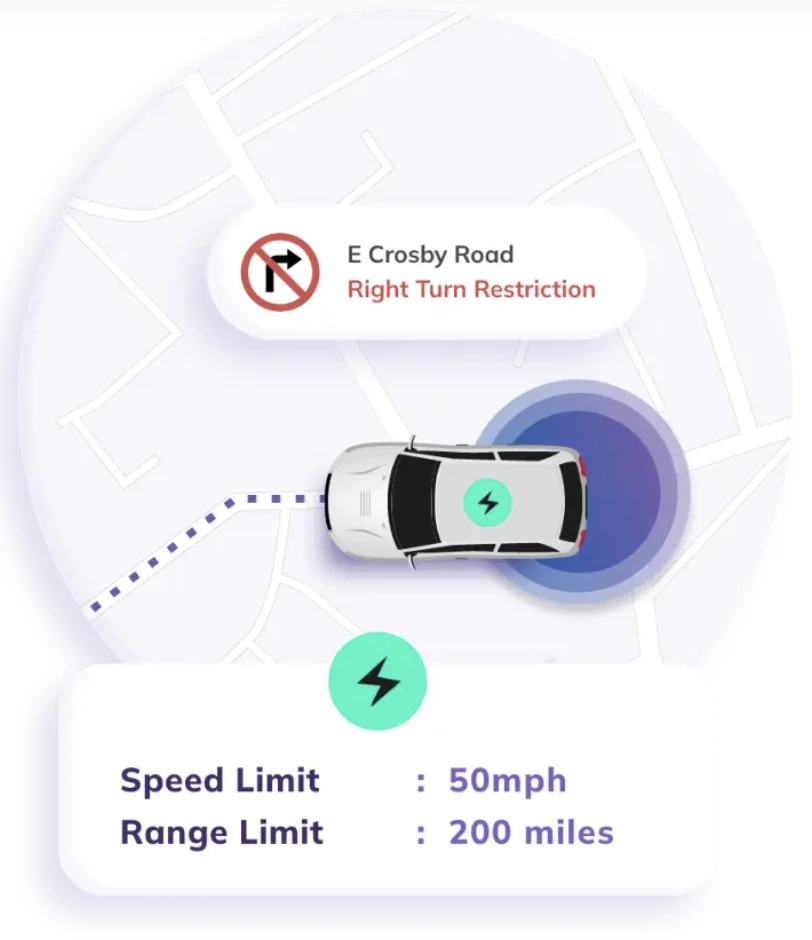
  • Smart charging stop integration: NextBillion.ai can insert charging stops only when needed and choose chargers that match vehicle compatibility and operational constraints, reducing unnecessary detours and downtime.

restriction

  • Range-aware routing and capacity modeling: The engine supports range-aware EV routing and factors like vehicle capacity and load into route assignment so planners see per-leg energy effects instead of a single “miles” estimate.

  • Depot + public charging strategies: The platform supports mixed charging strategies (depot and public), letting optimization choose between predictable depot charging and opportunistic public charging based on schedule and availability.

  • Route Optimization API: Use this when you need cross-vehicle, multi-stop sequencing that is time-window and SLA-aware while also supporting EV constraints (charger compatibility, needed charge, and recharging insertion). This is the core API for assigning vehicles, sequencing stops, and inserting charging events.

  • Distance Matrix & Directions APIs: Supply accurate distance/ETA and route geometry (including ETA models tuned to vehicle profiles) so energy estimates per leg are more reliable than simple mileage. Use these to compute leg-level consumption and ETA-sensitive decisions.

  • Smart charging stop planning NextBillion.ai explicitly calls out “smart charging stop integration” and “range-aware EV routing,” which are the product-level features you would cite when explaining automated charger selection and insertion.

complex delivery

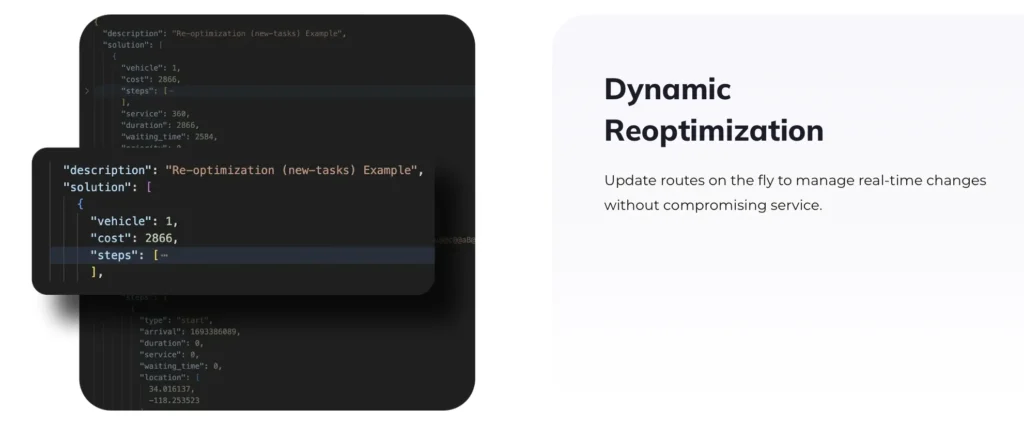
  • Dynamic reoptimization / SLA-at-risk alerts: These last-mile features let the system re-sequence or reassign stops if a charging event or delay threatens later commitments, directly addressing the “reassign stops if a route becomes infeasible” requirement.

dynamic reoptimization

  • Capacity-aware planning & mixed-fleet support: The platform handles multi-vehicle fleets with different vehicle types and capacities, letting you match routes to the best EV by battery size/charging speed.

  • Use the Route Optimization API to create a planning job that includes per-vehicle battery capacity and charging compatibility attributes; include charger POIs as potential stops with metadata (max power, connector types, reliability score). NextBillion.ai’s Route Optimization endpoint is the natural place to encode these constraints. Refer here for more information on APIs.

  • Use Distance Matrix / Directions to precompute leg distances, ETAs, and road geometry (for elevation-aware energy models) and feed per-leg energy estimates into the optimizer so charge insertions are placed where they minimize operational cost. Refer here for more information on APIs.

  • Enable Dynamic Reoptimization so the system can swap stops or insert a nearer charger when live telemetry shows unexpected energy use or charger queues; the last-mile product describes dynamic re-sequencing and SLA-aware alerts that support this behavior.

Conclusion

The transition to an electric fleet is a journey that moves from hardware to software. While the initial challenge is acquiring the right vehicles, the long-term success of an enterprise fleet depends entirely on the intelligence of its routing system. As we have explored, standard navigation is insufficient for the high-stakes world of logistics; true efficiency requires a platform that views battery levels, charging availability, payload, and elevation not as obstacles, but as integrated variables in a single optimization equation.

By adopting battery-aware routing and multi-stop optimization, organizations can effectively eliminate range anxiety and maximize the ROI of their EV investment. Platforms like NextBillion.ai provide the necessary technical infrastructure through specialized Route Optimization and Distance Matrix APIs to turn these complex constraints into a competitive advantage.

Ultimately, EV routing for fleets isn’t just about getting from point A to point B; it’s about building a scalable, predictable, and sustainable operational model. With the right optimization tools in place, the question is no longer “Can our EVs handle the route?” but “How much further can our fleet go?”

Ready to see how intelligent routing can transform your electric fleet operations? Book a demo with NextBillion.ai today to explore our EV-specific optimization solutions.

About Author

Prabhavathi Madhusudan

Prabhavathi is a technical writer based in India. She has diverse experience in documentation, spanning more than 10 years with the ability to transform complex concepts into clear, concise, and user-friendly documentation.

Ready to get started?

Table of Contents