

- BLOG
Most Efficient Route Planner for High-Performing Fleets
Published: April 30, 2026
Route Optimization API
Optimize routing, task allocation and dispatch
Distance Matrix API
Calculate accurate ETAs, distances and directions
Directions API
Compute routes between two locations
Driver Assignment API
Assign the best driver for every order
Route Optimization Software
Plan optimized routes with 50+ Constraints
Product Demos
See NextBillion.ai APIs & SDKs In action
AI Route Optimization
Learns from Your Fleet’s Past Performance
Platform Overview
Learn about how Nextbillion.ai's platform is designed
Road Editor App
Private Routing Preferences For Custom Routing
On-Premise Deployments
Take Full Control of Your Maps and Routing
Table of Contents
What makes a route planner truly efficient for modern fleet operations? It is not just about finding the shortest path. As delivery volumes grow and constraints become more complex, fleets need systems that can balance speed, accuracy, cost, and real-time adaptability. Choosing the right route planner is no longer optional; it directly impacts operational performance and scalability.
Explore the full blog to discover how to choose the most efficient route planner for your fleet and optimize operations at scale.
A system with advanced optimization, real-time flexibility, and scalable infrastructure to manage multi-stop operations with high-performing fleets is the most efficient route planner. It is more than just simple routing, as it takes into account constraints, predictive intelligence, and updates routes to make them efficient and practical in real-world situations.
A route planner is computational software that computes optimal routes and sequences of stops that vehicles are supposed to follow by solving routing problems in the real-world. It accepts geocoded positions, delivery priorities, time windows, vehicle capacities, and road network information as inputs. It precisely applies the algorithm of graph theory and Vehicle Routing Problem (VRP) variants.
A well-organized route planner reduces distance, time, and fuel consumption functions with the assistance of heuristics, metaheuristics, and more and more AI-based models, and ensures feasibility. The state-of-the-art route planners integrate the real-time traffic data, proactive ETA, and on-the-fly rerouting, and offer scalable and adaptable route planning to high-volume, multi-stop fleet operations.
Below are the topmost benefits that make route planners essential for high-performing fleet operations:
A route planner is a computerized system that automates the complicated route design process, where fleets can create optimized plans in seconds rather than hours. It maximizes delivery throughput by avoiding unnecessary travel and eliminating redundant travel without adding extra resources. It guarantees even distribution of workloads in vehicles and reduces idleness, resulting in a smoother workflow.
This degree of automation eliminates the need to rely on manual planning. It reduces human error and standardizes decision-making. A route planner eventually enables high-performing fleets to remain consistent despite growth in the volume of deliveries and the complexity of operations.
Route planners save a lot of money through the minimization of distance travelled, fuel consumed, and vehicle deployment. Fleets can reduce fuel costs and maintenance costs by reducing unnecessary trips and ensuring that routes are allocated efficiently. Better planning will also minimize overtime and labor inefficiency, resulting in better cost control.
These savings compound over time, enhancing profitability and return on investment. In the case of high-performing fleets, cost optimization is not only about saving money but also about getting maximum output from available resources without reducing the quality of service.
Route planners enhance the degree of reliability and consistency in delivery with proper route sequencing and constraint-based planning. They provide time window compliance and service-level agreements to minimize delays and missed deliveries. Combination with real-time data makes it possible to adjust dynamically and make sure that disruptions are addressed.
Predictable ETA also improves communication with customers by creating trust and transparency. In the case of high-performing fleets, the regular and predictable performance of the delivery plays a crucial role in ensuring customer satisfaction and competitive advantage.
Route planners can be scaled without problems as the fleet size and the volume of the delivery increase. They are able to process thousands of orders and vehicles without performance loss and hence they are suitable in the event of expanding operations. The system is flexible to various fleet types, operational limitations and geographical areas. This scalability means that businesses do not have to redesign their routing infrastructure to accommodate their expansion, so route planners are a long-term investment to meet the changing logistics demands.
Modern route planners allow the use of historical and real-time data to enhance the accuracy of the planning process. They can give information about the performance of the routes, the time of delivery, and the bottlenecks of the operations, which allows teams to make effective decisions. Predictive analytics also improves planning, as it predicts demand trends and possible delays. This change in the intuition-driven to data-driven decision-making enables the high-performing fleets to keep on optimizing operations, enhancing efficiency, and sustainability of competitive advantage in the complex logistics environment.
Here are the top factors in the checklist that define the most efficient route planner for fleet operations:
An efficient route planner must manage real-world limitations that encompass delivery time windows, vehicle capacity, shifts of the drivers, and SLAs. It must be able to support multi-stop and multi-depot routing, and all the routes generated should be operationally viable. Routes can seem good on paper without powerful constraint modeling, but can fail on the road.
An effective system captures business rules in a robust manner and enforces operational and regulatory boundaries. It also gives preference to the handling of orders and exception management. This reduces delivery failures and improves reliability and consistency in large-scale, complex fleet operations.
The core of any route planner lies in its optimization engine. It must apply VRP-based models with heuristics and metaheuristics to produce near-optimal solutions on a large scale. The system has to strike a balance between the speed and quality of the solution and be able to generate efficient routes even with large fleets.
The more sophisticated planners also include hybrid strategies, which involve deterministic logic but include AI-based improvements. High-quality optimization minimizes traveling distance, fuel usage, and operating expenses while enhancing delivery schedules. It also provides repeatable and consistent performance across various situations.
Modern fleet operations require route planners that can adapt to dynamic conditions. The system should support real-time traffic updates, order changes, delays, and cancellations. Dynamic rerouting helps make changes without recomputation so that the execution is not severely disrupted. It must also focus on urgent deliveries and redistribution of work in case of disruption. This flexibility is vital towards sustaining service levels, minimizing downtime and having operations that are efficient even in the most volatile and dynamic environments.
Accurate ETAs are both critical to the operational planning and customer satisfaction. An effective route planner uses past data, real-time traffic data, and prediction algorithms to deliver quality and constantly updated ETAs. It must be dynamic in the sense that it alters estimates as conditions evolve in the course of execution. Predictive intelligence will facilitate the anticipation of delays, scheduling optimization, and proactive communication with customers.
The route planner must deal with growing quantities of orders and fleet size without a decrease in performance. It is expected to sustain high throughput processing, parallel computation, and optimization of low latency even at high loads. Scalability helps make sure that the system is efficient as the operations increase into different cities or regions. A properly designed architecture can support peak demand scenarios, seasonal spikes, and enterprise-level deployments with utmost precision. It executes all this without affecting speed or accuracy.
A good route planner must be able to connect with other existing systems like ERP, WMS, TMS, and driver applications. It should provide strong APIs, SDKs, and webhooks to facilitate easy exchange of data and automation. Integration also makes sure that routing decisions are coordinated with order management, inventory, and dispatch workflows. This minimizes human intervention, enhances consistency of data, and provides end-to-end visibility throughout the logistics ecosystem.
Realistic route planning requires accurate mapping and geospatial intelligence. It should be connected with reputable map providers and be able to calculate the distance, travel time, and route accurately. It should take into consideration road limitations, traffic flow, turning limitations, and local peculiarities. Geofencing, zone-based routing, and location clustering are also supported on advanced systems. Geospatial accuracy is high, so that the routes are not only optimized but also practical and can be implemented in real-life situations.
The planner is expected to allocate orders to vehicles intelligently according to capacity, type, availability as well as operational constraints. Efficient allocation reduces idle time, achieves a balance in workloads, and also maximizes asset utilization in the fleet. It must also be in favor of heterogeneous fleets so that the correct vehicle is employed to perform the correct task. This increases efficiency, minimizes operational wastage and boosts overall productivity without the need to expand the fleet size.
Intuitive dashboards, clear route visualization, and real-time tracking capabilities are a few key ingredients of a good route planner. Dispatch teams must have the capability to track the movement of the fleet, detect bottlenecks, and respond promptly to problems. It must also provide actionable information, warnings, and reporting. Good visibility guarantees superior operation control, team coordination, and efficient and swift decision-making that is informed by data.
Finally, the route planner should offer transparent pricing models and flexible configuration options. It must be business-oriented, either by charging on a pay-as-you-scale basis or by customizing it to business requirements. The system must enable businesses to turn features on or off, according to need. The flexibility and cost-effectiveness guarantee maximum value, and the solution will be sustainable and flexible with the changing operational requirements.
Below are the most widely used route planners for optimizing fleet operations at scale:
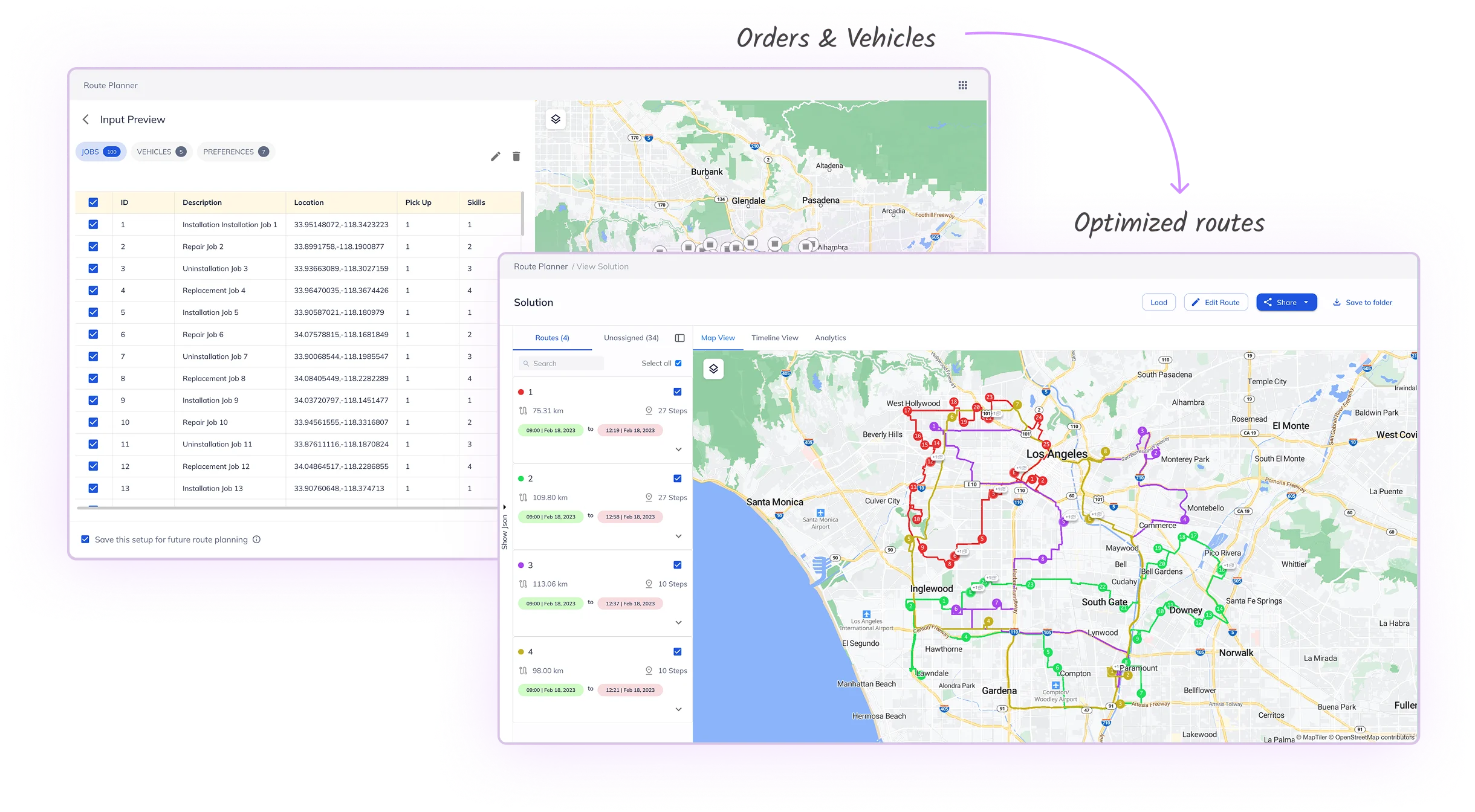
NextBillion.ai is an efficient routing system that can be used in large, sophisticated fleet management. It provides highly customizable APIs, sophisticated constraint management and real-time optimization. The platform has features of multi-stop routing, dynamic rerouting, and high-volume processing, which make it applicable to enterprises that deal with different logistics networks. Its powerful geospatial and flexibility enable businesses to customize routing logic to meet specific business requirements that enable precision and scalability in challenging environments.
Google Maps Platform offers high-quality routing and mapping services that are well-covered worldwide and display live traffic information. It finds extensive application in simple route planning, navigation and distance determination. Although it has powerful APIs and is easy to integrate, its optimization features are not that strong in comparison with dedicated route planners. It is most appropriate to use in applications that need mapping and navigation over the complicated and constraint-intensive fleet optimization.

OptimoRoute is a user-friendly route planning solution focused on delivery and field service operations. It has functionalities like route optimization, order tracking, and driver management, with a user-friendly interface. It is appropriate for small to mid-sized fleets seeking an easy-to-use solution and fast deployment. However, its customization and scalability might be constrained for highly complex enterprise-level requirements.
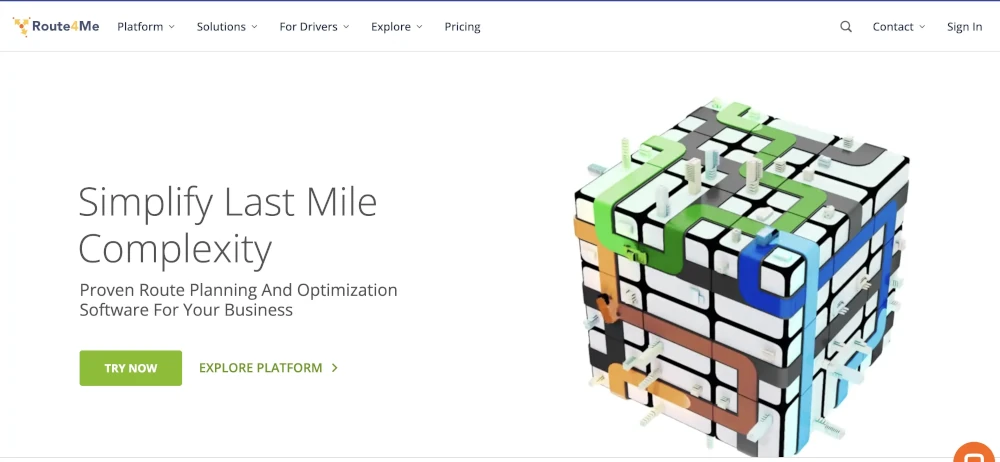
Route4Me is an extensive route optimization software that has multi-stop routing, real-time tracking, and route analytics. It is tailored to suit companies that want to enhance the efficiency of delivery and low costs of operation. The platform is user-friendly and functional enough, which is why it can be used by expanding fleets. It also offers mobile applications to drivers and workflow connection facilities.
Mapbox Optimization API offers routing and optimization options that are flexible and have powerful geospatial visualization options. It enables developers to create custom routing solutions that can control map styling and routing logic. Although it provides good performance and customization, it may need more development than ready-to-use platforms do. It is most appropriate in teams that seek to develop custom routing systems that have robust mapping integration.
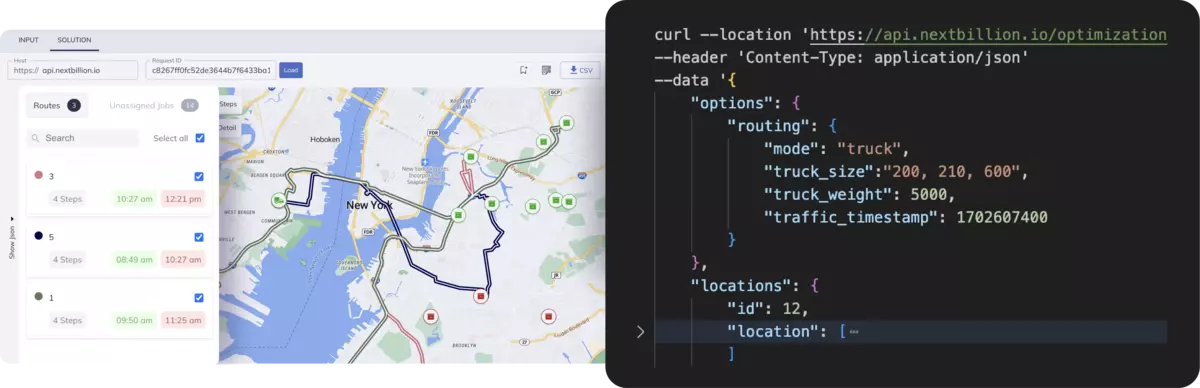
Let us now explore how to evaluate a route planner using a practical, real-world approach that ensures both technical performance and operational reliability:
The route planner has to be tested in controlled conditions with actual operational data before it can be fully adopted. Pilot tests must recreate real-life delivery conditions, such as peak loads, different geographies, and different combinations of constraints. This assists in revealing the behavior of systems under stress, optimization latency and integrating gaps with current tools. It also enables teams to assess usability, route quality and alignment of execution. An effective pilot will make sure that the solution is technically effective and operationally feasible at scale.
Assess how the route planner has affected operational costs by monitoring the use of fuel, number of driver hours, distance of route and the use of the vehicle. An analysis of performance before and after implementation gives a clear picture of efficiency improvement. Indirect savings that include fewer cases of delivery failures and increased productivity are also worth measuring. Measuring these benefits assists in justifying investment and also makes sure that the system provides real business value as opposed to theoretical optimization.
Evaluate the predictive accuracy of the delivery times based on the comparison between the estimated and actual delivery times in a variety of situations and routes. This test must cover peak traffic conditions, various areas and densities of delivery. Large ETA values indicate a good predictive model and good routing logic. It also has a direct effect on customer experience, since regular and correct ETAs enhance communication and trust. Constant ETA deviation monitoring is used to improve the system as time goes on.
Make sure that the route planner is tested using all appropriate constraints, including delivery time windows, vehicle capacities, driver schedules, and priority orders. The system must be tested for its ability to produce routes that are viable and fully comply with these constraints without breaking them. Real-world testing confirms that the planner is capable of handling operational complexity and edge cases, such as tight SLAs or mixed fleets. This is an important step to ensure that optimized routes can be implemented in real-life situations.
In addition to optimization, it is also important to evaluate the level at which the route planner is integrated with the existing systems like order management, ERP and driver applications. Stress test the end-to-end data flow, such as input ingestion, route generation, and execution feedback. The system must facilitate smooth communication with APIs, real-time updates, and less human interference. Close integration guarantees continuity of operations, decreased friction in workflows and allows the route planner to be a component of a unified logistics ecosystem and not an isolated tool.
Our platform is a full-fledged route optimization platform that seeks to solve the intricacies of contemporary fleet operations. With sophisticated algorithms, real-time data processing and extremely customizable APIs, we will allow businesses to plan, run, and optimize routes with accuracy. Our solution is designed to manage large-scale and multi-stop situations, but with efficiency, accuracy, and operational visibility, which is why it is a secure option in high-performing logistics systems.
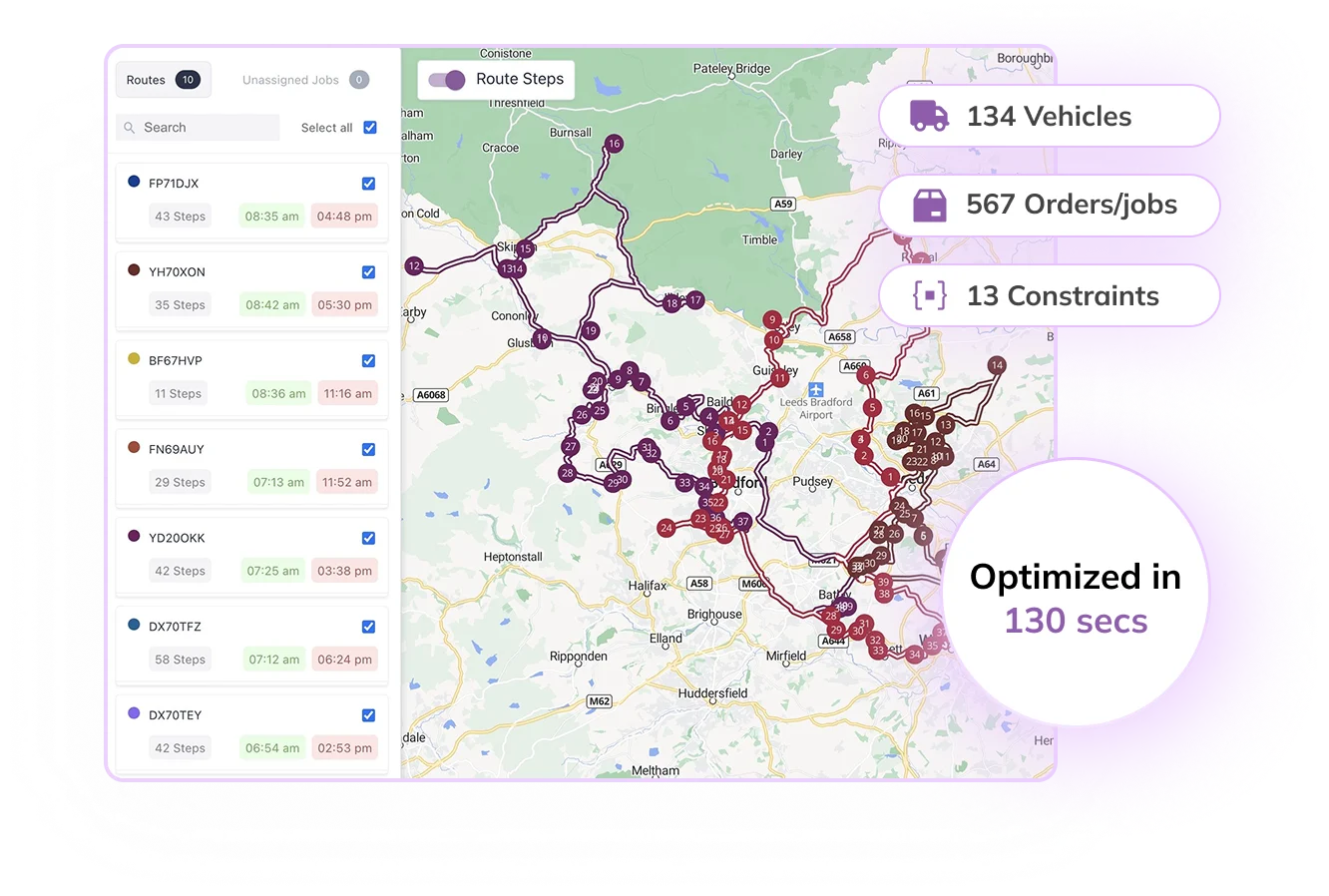
Our routing platform is powerful and capable of supporting multi-stop fleet routing with high accuracy and performance. Our solution also allows the use of advanced constraint-based routing, which allows efficient planning between various depots, types of vehicles, and delivery conditions. Our system can scale and provide precision to the complicated logistics environments by being able to process large quantities of orders.
Our APIs are highly customizable, enabling businesses to specify routing logic, according to their unique business requirements. Our system works perfectly with the existing systems like ERP, TMS, and driver applications, and data flow across the logistics ecosystem is uninterrupted. This flexibility enables organizations to flex the solution to their workflows without breaking.
Our proficiency in optimizing the route dynamically is made possible through a continuous integration of real-time information like the state of traffic, updates of orders, and the position of the driver. Our platform is a real-time tracked and visible platform via dashboards and APIs that enable teams to track operations and react swiftly to disruptions. This guarantees efficiency and reliability of routes during execution.
Our architecture is founded on high-performance infrastructure, which provides us with high-performance routing decisions even when the workload is high. We have a low-latency optimization system that is highly available and consistent in performance at large datasets and peak demand conditions. This dependability is essential to time-sensitive operations where the business can continue to operate at the same level, prevent disruptions, and have confidence in scaling its fleet operations without negatively affecting efficiency or accuracy.
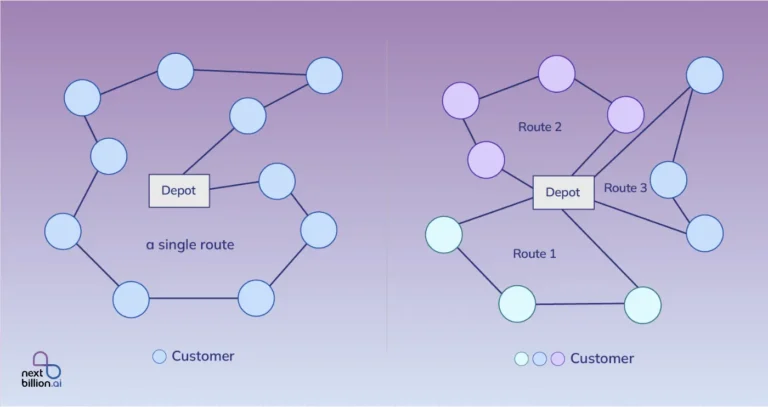
Choosing the most efficient route planner is not just a technical decision but a strategic one that directly impacts cost, scalability, and customer experience. With the increase in the complexity of fleet operations, manual planning or simple tools are no longer viable. An efficient route planner facilitates optimization by the use of data, real-time scalability, and scale. When considering the main aspects of constraints, optimization quality, and integrations, businesses can choose the solution that not only enhances efficiency but also contributes to the development of operations and their stability in the long term.
Scale smarter and route better with NextBillion.ai’s advanced, customizable route optimization platform. Connect with us to know more.
An efficient route planner must strike a stable balance between constraint management, quality of optimization, real-time flexibility, and scalability. It has to come up with viable paths in the actual world conditions and minimise cost, time, and resources.
The algorithms employed by most route planners are Vehicle Routing Problem (VRP) and heuristics, metaheuristics such as genetic algorithms, and Artificial Intelligence (AI) models.
Yes, modern route planners allow dynamic rerouting according to traffic information, order modifications, delays, and new delivery requests, which optimizes all throughout the execution.
They plan the routes in ways that minimize the distance traveled, the amount of fuel used, and the time wasted and enhance the use of the fleet and the avoidance of unnecessary trips.
Pilot tests, cost saving measurement, ETA accuracy testing, real constraint testing, and system integration should be performed by businesses before full-scale adoption. These are the prerequisites that will help you get the most out of the route planner implementation process.
Bhavisha Bhatia is a Computer Science graduate with a passion for writing technical blogs that make complex technical concepts engaging and easy to understand. She is intrigued by the technological developments shaping the course of the world and the beautiful nature around us.