


Route Optimization API
Optimize routing, task allocation and dispatch
Distance Matrix API
Calculate accurate ETAs, distances and directions
Directions API
Compute routes between two locations
Navigation API & SDK
Turn by Turn Instructions for Drivers & Technicians
Route Optimization Software
Plan optimized routes with 50+ Constraints
Product Demos
See NextBillion.ai APIs & SDKs In action
Location Reasoning AI
Help your AI agents answer location-based questions
AI Route Optimization
Learns from Your Fleet’s Past Performance
Platform Overview
Learn about how Nextbillion.ai's platform is designed
On-Premise Deployments
Take Full Control of Your Maps and Routing
About Us
Our story, vision
and mission
Contact Us
Reach out to us for any product- or media-related queries
Write to us at

Table of Contents
Are delivery teams really struggling with traffic, or are they trying to solve logistics problems using a navigation tool? For many growing delivery companies, Google Maps works well at first, but cracks start to appear as daily routes become denser, customer expectations tighten, and operational rules multiply. What once felt simple turns into manual planning, constant adjustments, and missed efficiencies. This is the point where delivery complexity outgrows point-to-point navigation and demands systems built for planning, compliance, and scale.
Continue below to understand why delivery companies outgrow Google Maps and how smarter route optimization transforms daily delivery operations.
Did you know?
The global last-mile delivery market is expected to reach approximately USD 340.56 billion by 2032, reflecting rapid growth driven by e-commerce and on-demand delivery.
The complexity does not increase proportionately to the size of delivery operations. Each stop further limits the capacity of vehicles, the availability of customers, the working hours of drivers, and the service promise. What starts as a straightforward routing issue soon turns out to be an operational planning problem that involves balancing between efficiency, compliance, and reliability simultaneously.
The tools designed exclusively to navigate do not make decisions regarding these interrelated variables, which is why increasing delivery organizations inevitably face planning bottlenecks, increasing costs, and mixed service delivery results.
Here are the fundamental reasons why delivery companies expand more than Google Maps:
Google Maps is designed as a real-time navigation and mapping system with an emphasis on individual mobility and not operational planning. Its routing engine is based on priority of travel efficiency by use of road networks, live traffic signals, and past congestion trends. The platform excels at reactive, in-the-moment guidance but fails to simulate upstream business constraints, downstream delivery obligations, and cross-route dependencies that constitute logistics operations.
Here are the core capabilities Google Maps is designed to deliver:
Single Origin to Single Destination Routing
Google Maps applies graph-based shortest-path algorithms that are mixed with the weighting of traffic to calculate the best routes between one start point and one endpoint. This model works well for personal navigation but assumes each trip is independent and unconstrained by external operational rules.
Basic Multi-Stop Routing (Manual Stop Assignment)
The platform enables users to add multiple stops and uses distance-based reordering, which is simple. Nonetheless, it does not distinguish between stops. It assumes that they are equal and interchangeable without any regard to the priority of delivery, service time, load effect, or downstream constraints at the route.
Traffic-Based ETA Calculation
Live traffic feeds, historical speed data, and incident reports are used to calculate ETA. Although suitable for determining drive time, ETAs fail to consider other non-driving aspects like loading delays, service time at stops, or waiting time because of delivery windows.
Turn-by-Turn Navigation
Detailed navigation instructions are continuously updated based on vehicle position and road conditions. This reduces cognitive load for drivers but operates purely at the execution layer after routes have already been defined.
Real-Time Rerouting Based on Traffic Conditions
In case of congestion, accidents, or closures, Google Maps reroutes in real time to reduce delays. Such changes enhance driving efficiency, but they are independent decisions that do not reallocate work, reassign stops, or maintain delivery commitments across a fleet.
Consumer navigation focus
Google Maps is architected around consumer-scale usage patterns, where each route request is treated as an isolated event. Its data models, algorithms, and interface design are optimized for immediate response and simplicity rather than persistent operational state. This approach works well for individual trips but does not retain contextual awareness across multiple routes, drivers, or planning cycles.
Individual driver experience optimization
The platform emphasizes real-time usability for a single driver in motion. Features such as lane guidance, voice prompts, hazard alerts, and automatic rerouting are designed to reduce decision effort while driving. Optimization occurs at the micro level, improving moment-to-moment driving efficiency rather than macro-level planning outcomes.
Visual route comparison for ad hoc decisions
Google Maps enables users to visually compare alternate routes using map overlays that highlight distance, duration, and traffic intensity. These comparisons support quick, manual decision-making but rely entirely on human judgment. There is no underlying optimization engine evaluating downstream impact on schedules, resources, or service commitments.
Google Maps is not a working planning system, but a navigation engine. Its design is efficient at individual route optimization and does not consider the networked constraints and goals of operations of scale in delivery. These shortcomings make it incapable of supporting logistics planning, as explained below.
Fleet-level planning
Google Maps lacks a central planning layer that can be used to organize multiple vehicles, drivers, and routes at the same time. The route requests are calculated independently, and there is no common state or knowledge of how other routes in the fleet are organized, constrained, or dependent. This does not allow for optimizing a fleet and workload balancing.
Operational constraints
The routing engine does not represent physical, temporal, and regulatory constraints, including vehicle load constraints, service times at stops, loading and unloading sequences, and working hours of drivers. Consequently, routes can be feasible on a map, but not in practice in actual delivery circumstances.
Delivery rules and SLAs
Routing decisions do not include business rules like delivery windows, priority orders, service-level agreements on a contractual basis, and penalty thresholds. Google Maps evaluates routes based on travel time and traffic alone and cannot determine whether a route satisfies customer commitments or contractual obligations.
Optimization across multiple vehicles and depots
The platform does not have global optimization logic, which considers all vehicles and depots as one system. It is unable to plan stops in a strategic location on routes, equalizing workloads. It reduces the amount of overall fleet miles and even optimize the choice of depots, all of which are essential to efficient and scalable delivery operations.
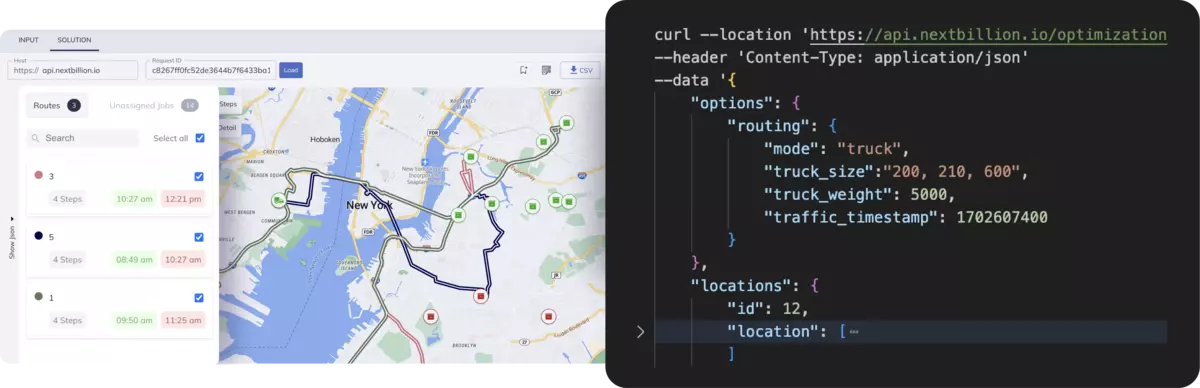
Here is how route optimization turns complex delivery requirements into efficient, compliant, and executable delivery plans.
Constraint-based routing validates routes against real-world operational limits before optimization begins. Here are the key constraints that determine whether a delivery route is operationally valid.
Vehicle capacity and load limits
The constraint-based routing models the physical constraints of every vehicle, such as weight, volume, pallet constraints, and compartment constraints. Orders are allocated when the cumulative load is within acceptable limits so as to avoid overloading and minimise the chances of mid-way failures. This makes routes possible before implementation as opposed to being fixed after the fact.
Stop count and delivery rules
The routing engine imposes maximum stop limits per vehicle, length of stay in a stop, delivery priorities, and special handling requirements. These regulations avoid overcrowding of routes, consider realistic service time, and ensure operational policies are observed in the planning process.
Ensures operationally valid routes, not just shortest paths
In contrast to the distance or time-based optimization of the navigation tool of navigation, constraint-based routing considers feasibility as a preliminary step. The generated routes meet all the specified constraints, and plans are generated that can be implemented without any manual intervention or last-minute adjustments.
Time window optimization is used to make sure the delivery schedules are in accordance with the customer availability and service commitments before the routes are determined. It is time-accurate and not merely distance-efficient. Below are the key timing factors that shape reliable delivery schedules.
Customer delivery windows
The time window optimization uses customer availability ranges as part of the route calculations. Each stop is scheduled within its allowable time frame, ensuring that arrivals align with customer readiness rather than forcing drivers to wait or rush.
Service-level commitments
Priorities, routing logic, and delivery promises are incorporated into routing logic. The system checks the routes to determine their proficiency to fulfill the service commitments prior to the finalization of plans, which minimizes the chances of fines or customer dissatisfaction.
Prevention of early arrivals and late deliveries
The optimizer sequences and assigns buffer time to prevent early arrivals that bring about idle time as well as late arrivals that violate commitments. It results in smoother schedules and more predictable route execution.
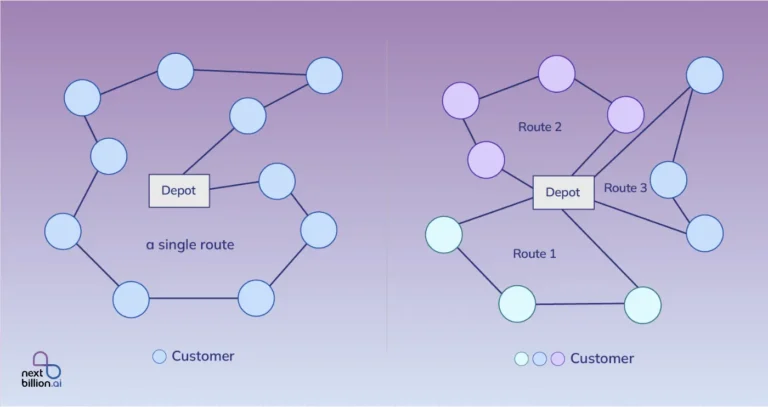
Advanced multi-stop optimization is aimed at sequencing and allocating stops to the entire fleet and not at optimization of routes separately. Here are the key optimization dimensions that drive multi-stop efficiency.
Optimized stop sequencing across fleets
Complex algorithms are used to calculate the most effective sequence of stops to use in each route based on millions of potential combinations. Optimization takes into account the travel time, service duration, and the downstream impact instead of minimizing the distance between successive stops.
Multi-vehicle and multi-depot planning
Routes are planned across all available vehicles and depots simultaneously. The system decides which depot should serve each stop and which vehicle should handle each delivery, minimizing total travel distance and improving asset utilization.
Balanced workloads and reduced fuel consumption
The route optimization helps in the even distribution of stops among the vehicles so that the individual drivers are not overloaded while others go to waste. Balanced routes minimize over-driving, decrease the amount of fuel used, and enhance the efficiency of the fleet in general.
HOS and driver compliance make sure that routes are in compliance with labor rules and safety standards prior to implementation. Planning includes compliance as opposed to compliance as an afterthought.
Following are the compliance factors that shape legally executable routes.
Driver working hours and mandatory breaks
Hours of service rules are built into route calculations, including shift start times, maximum driving hours, and required rest periods. Routes are structured to remain compliant without forcing drivers to rush or exceed limits.
Legal driving limits
Automatic enforcement of regional and jurisdiction-specific regulations is done. The system guarantees that the routes will comply with the daily and weekly driving limits, decreasing the risk of fines and regulatory infractions.
Reduced compliance and safety risks
By embedding compliance rules into planning, organizations reduce driver fatigue, improve safety outcomes, and minimize legal risk. Adherence is an automatic process instead of a process involving enforcement.
Zone and territory management are the methods of delivery organization based on geographical areas to enhance efficiency and consistency. The routes are planned on the basis of specific areas of operation instead of an ad hoc basis.
Listed below are the geographic controls that improve route structure.
Zone-based delivery assignments
The assignment of deliveries is made based on the predetermined geographic areas, which means that drivers do not have to work in areas that they are not familiar with. This enhances the predictability of routes and minimizes unnecessary traveling to far regions.
Depot and territory alignment
The routes are coordinated with the most suitable depot or operating base. It minimizes deadhead miles, enhances start and end-of-day performance, and enables scalable network design.
Elimination of cross-zone inefficiencies
Optimization helps to avoid the overlap of vehicles by avoiding unnecessary cross-zone routes and minimizes unnecessary travel. This results in cleaner route structures and improved performance of delivery.
Dynamic re-optimization keeps routes valid as conditions change throughout the day. It allows delivery plans to adapt without breaking constraints or service commitments. Here are the capabilities that enable real-time adaptability.
Real-time response to delays and disruptions
The dynamic re-optimization constantly checks the route execution and recalculates plans in case of delays. Traffic accidents, vehicle failure, or unforeseen service delays cause intelligent changes instead of manual replanning.
New order insertion and cancellations
The system has the capability of adding new orders to the running routes or canceled stops without disrupting the whole plan. The changes are tested in terms of their viability and their effects, and then implemented.
Continuous route integrity throughout the day
Re-optimization maintains compliance, time windows, and workload balance despite the change in conditions. Routes are operationally sound between planning and execution, and they provide consistent service even with uncertainty in daily operations.
Here is an example that clearly illustrates how AI-powered route optimization outperforms manual planning and navigation-based tools in real delivery operations:
Consider a delivery operation that must complete 25 stops in a single day using 3 vehicles, each with a fixed carrying capacity. Several customers require deliveries strictly between 10 AM and 1 PM, and all drivers must operate within legal working hour limits. The planning task is not just about finding roads, but about assigning the right stops to the right vehicles while respecting capacity, timing, and labor constraints.
Overall, Google Maps helps drivers execute a route efficiently once it exists. It does not help planners design delivery routes that are compliant, capacity-aware, time-bound, and optimized across an entire fleet.
AI-powered route optimization software replaces manual, experience-based planning with algorithmic decision making. Instead of planners spending hours sequencing stops by hand, the system automatically generates routes using advanced optimization models that evaluate thousands of possible combinations in seconds. This significantly reduces planning time while improving consistency and accuracy.
As delivery operations scale, routing stops being a navigational task and becomes a computational and operational challenge. Managing thousands of stops, multiple vehicles, strict customer commitments, and regulatory constraints requires systems that can reason across the entire delivery network. AI-enabled route optimization solutions are meant to resolve this complexity by transforming business policies and real-life limitations into operational delivery plans.
NextBillion.ai is specifically designed to solve the routing problems of a large scale that emerge in the operation of modern deliveries. It is not like navigation tools, but it is designed to manage the dense stop networks, the delivery window, regulatory limitations, and the ongoing changes in operations during the day.
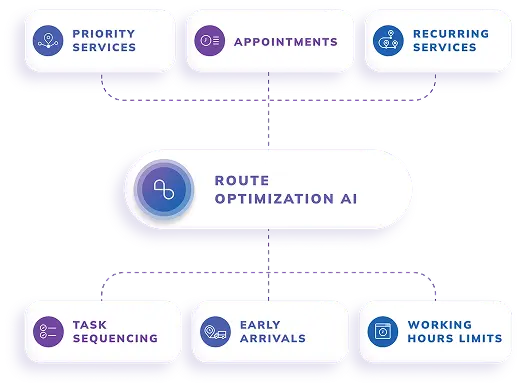
The platform simulates the real business constraints that include vehicle capacity, order size, service time, driver working hours, zone restrictions, and depot assignments. The optimization engine considers feasibility and efficiency together, so that all the routes obtained are operationally valid and implementable.
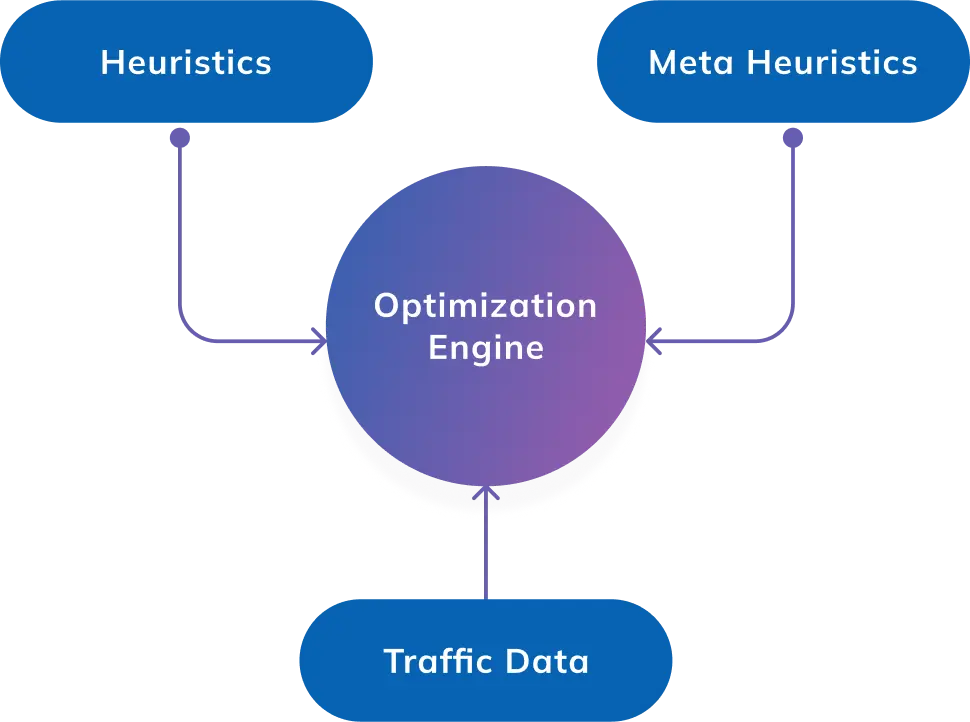
NextBillion.ai does not optimize a route on a per-vehicle basis, but instead on a fleet-wide basis. It plans wisely the distribution of stops to various vehicles and depots, workloads, and overall driving, fuel, and labor expenses.
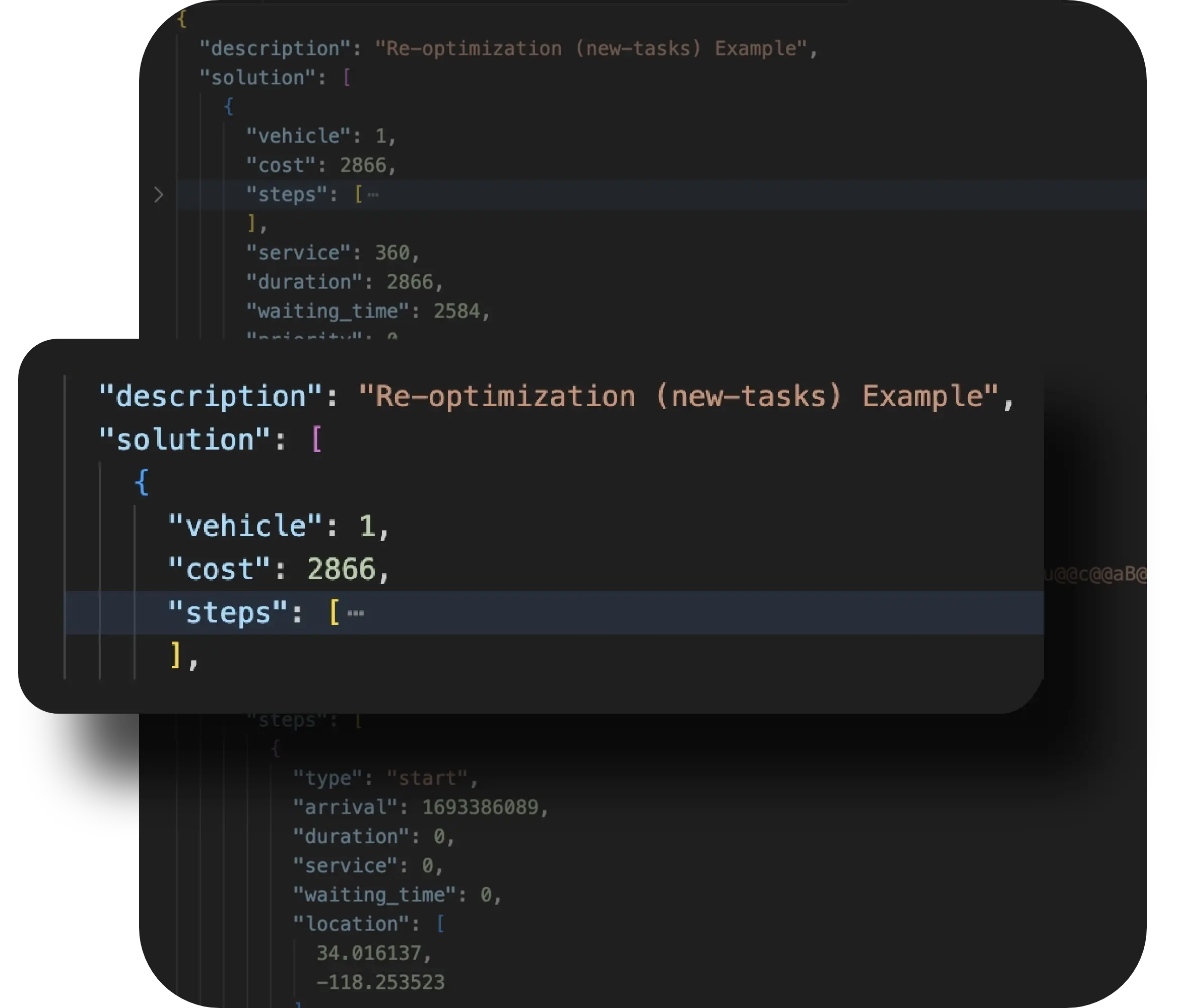
Delivery conditions rarely stay static. NextBillion.ai optimizes the routes automatically based on traffic delays, failed deliveries, order cancellations, and new job inserts, and maintains compliance and service guarantees.
Designed as an API-first platform, NextBillion.ai integrates seamlessly with order management systems, fleet management tools, and driver applications. This enables organizations to introduce intelligent routing in the current workflows without disruptive changes in the system.
NextBillion.ai transforms manual planning and navigation-driven routing with AI-driven optimization. It allows delivery companies to increase the number of stops per day to tens and thousands with the same efficiency, compliance, and quality of service.
Here are the primary software options delivery companies can use as routing complexity and operational scale increase:
AI-Powered route optimization platforms are specifically designed to address difficult routing problems with sophisticated algorithms like constraint programming, heuristics, and large-scale combinatorial optimization. They consider thousands to millions of route combinations and consider the capacity of vehicles, service time, time constraints, driver hours, geographical limitations, and real-time traffic lights.
AI-based optimizers are frequently implemented as standalone planning engines, which are connected to the existing order management, dispatch, and driver applications. This is why they suit organizations that require profound planning knowledge but do not require them to overhaul their operational stack.
Fleet management systems are geared towards execution-layer control and not planning intelligence. They offer real-time tracking of vehicles, messaging of drivers, geofencing, telematics integration, and performance monitoring. Dispatch modules assist in the allocation of routes and tracking the progress. Routing logic tends to be rule-based or distance-driven. These systems are good in visibility, accountability, and control of operations, but use route optimization platforms when the complexity of planning is involved.
Transportation management systems and last-mile delivery platforms have an end-to-end workflow, which covers order intake, routing, dispatch, billing, proof of delivery, and analytics. They are set to handle large volumes and multi-leg transport networks. Although integrated solutions offer centralized control and reporting, their routing functions are diverse. Most enterprise-level systems embed, or integrate with, dedicated optimization engines in order to address the complicated final-mile constraints.
The most appropriate option is standalone route optimization. It is selected when the complexity of routing is high, delivery rules are rigid, and the organization already has the systems of order management and execution. Integrated platforms are better where the teams require fewer system integrations and are prepared to compromise some routing flexibility in favor of unified workflows. The choice is usually determined by the business driver of either planning intelligence or system consolidation.
Google Maps is a great app for navigation, but delivery businesses require much more than directions. As stop density, customer commitments, and compliance requirements increase, planning becomes a complex operational challenge rather than a navigational one. AI-based route optimization helps delivery teams transition from manual, reactive route planning to predictive, scalable, and cost-effective operations. It also ensures that all routes are viable, compliant, and aligned with business objectives, even as delivery volumes grow.
Discover how Nextbillion.ai helps delivery companies go beyond navigation and into true operational intelligence. Nextbillion.ai enables enterprises to build scalable, compliant, and cost-effective delivery plans using enterprise-grade route optimization APIs, flexible constraint modeling, and real-time re-optimization capabilities, while seamlessly integrating with existing systems and scaling alongside your business.
Google Maps is useful to facilitate simple navigation for individual motorists, but not fleet management. It does not have centralized planning, vehicle capacity modeling, driver compliance enforcement, and workload balancing across many vehicles, which are necessary in the management of large delivery fleets.
Route optimization software can automate stop assignment, route sequencing, capacity utilization, delivery time window planning, driver hours of service compliance, territory allocation, and real-time route adjustments when disruptions occur.
Yes, even small and mid-sized fleets are benefiting from route optimization as soon as the daily routes are characterized by several stops, time investments, or limited resources. With increasing operations, automation saves time in planning, decreases fuel and labor expenses, and improves on-time delivery performance.
Manual planning raises the chances of missed delivery timeframes, over-carrying vehicles, overtime of drivers, lawbreakings, and unsteady degrees of service. It also results in a rise in operational expenses due to ineffective routing choices.
The lack of planning results in unbalanced routes, unnecessary driving time, increased working hours, and frequent changes of routes. This decreases the productivity of the driver, augments fatigue, and has an adverse impact on retention and safety.
Organizations typically see improvements in on-time delivery rates, cost per stop, fuel efficiency, vehicle use, route compliance, driver productivity, and customer satisfaction indicators.
The time required to implement is dependent on the size of the fleet and the complexity of the system, but in the majority of cases, organizations can implement route optimization software in a few weeks. The first profits are usually made fast because planning gets automated and routes are always optimized.
Bhavisha Bhatia is a Computer Science graduate with a passion for writing technical blogs that make complex technical concepts engaging and easy to understand. She is intrigued by the technological developments shaping the course of the world and the beautiful nature around us.