


Route Optimization API
Optimize routing, task allocation and dispatch
Distance Matrix API
Calculate accurate ETAs, distances and directions
Directions API
Compute routes between two locations
Navigation API & SDK
Turn by Turn Instructions for Drivers & Technicians
Route Optimization Software
Plan optimized routes with 50+ Constraints
Product Demos
See NextBillion.ai APIs & SDKs In action
AI Route Optimization
Learns from Your Fleet’s Past Performance
Platform Overview
Learn about how Nextbillion.ai's platform is designed
Road Editor App
Private Routing Preferences For Custom Routing
On-Premise Deployments
Take Full Control of Your Maps and Routing
About Us
Our story, vision
and mission
Contact Us
Reach out to us for any product- or media-related queries
Write to us at

Table of Contents
What if freight permits could be approved in minutes instead of days? In an industry where time wastage translates to revenue loss and customer dissatisfaction, AI and Large Language Models (LLMs) are transforming the way freight permit processing is performed. These technologies are turning compliance into a competitive edge in the operations of the modern logistics business. They are automating the paperwork, simplifying the interpretation of complicated regulations, and providing smarter route decisions.
Are you willing to discover how AI and LLMs are transforming freight permit processing and what it will do to your business? Read the full blog to explore the future of smarter, faster logistics compliance.
Did you know?
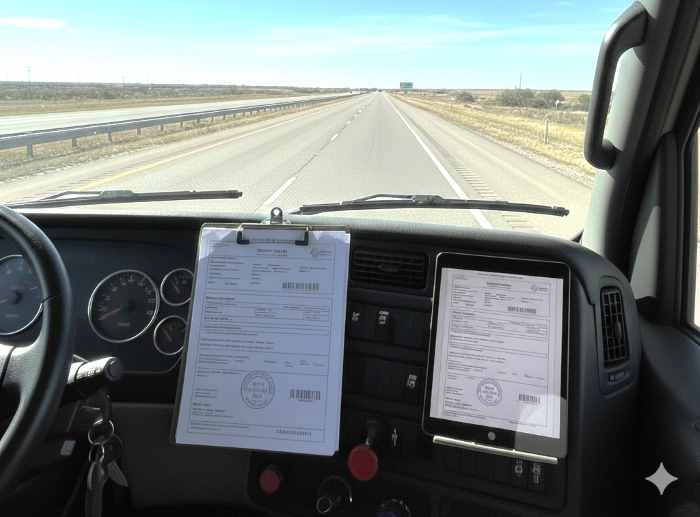
Artificial Intelligence (AI) in logistics can be described as the application of more sophisticated computational models. These models can absorb information, identify trends, and make predictions or decisions in order to streamline the complex operations of supply chains. In contrast to conventional software, AI systems enhance themselves by comparing past shipment history, allowing for results, routes, and regulatory limitations. In freight, AI is used in demand forecasting, route planning, compliance checks, fraud detection, and increasingly, to permit processing workflows where accuracy and speed are critical.
Large Language Models (LLMs) are a particular category of AI models that are trained on large amounts of text in the form of massive corpora using deep learning architectures like transformers. LLMs are technically multi-layer neural networks with attention that can be trained to understand permit applications, emails, regulations, and unstructured documents by capturing context in long textual sequences. LLMs can be used in freight permit processing to read regulatory text on DOT websites. They can extract important fields from free-text requests, auto-complete permit forms, summarize multi-state regulations, and be used as a chatbot by dispatchers and carriers.
Comparing AI with rule-based automation, the difference is in flexibility and smartness. Rule-based systems follow predefined “if-then” logic, for example, if load width > X, then require permit Y. While reliable for static scenarios, they struggle with regulatory variability, unstructured data, and exceptions across jurisdictions.
AI-based systems, on the other hand, learn based on patterns in the data and can be generalized to new situations. Machine learning models estimate the probability of approval, identify anomalies, and adapt to rule changes. In contrast, LLMs are able to understand ambiguous language and solve edge cases, which are not possible with strict rules.
Here are the top benefits of AI in freight permit processing:
The primary benefit of AI is not just faster processing, but the transformation of permit operations into an intelligent system that learns and adapts over time. Machine learning models are fed with historical permit data, rejection causes, route performances, and regulatory modifications to form representations of the behavior of the permitting ecosystem. This allows the system to stop performing activities and start modeling the dynamics of compliance itself. It helps constantly refine the interpretation of constraints, workload priorities, and decision allocation on high-volume pipelines.
Freight permitting is a highly unpredictable phenomenon. Jurisdictions, exceptions, and real-life circumstances are all dynamic. AI brings in probabilistic reasoning to this environment by approximating the likelihoods of approval, violation risk, or rework cost, instead of only having binary checks. This is technically done by AI-powered ensemble models and Bayesian techniques that measure confidence. The outcome is a system that is able to rank alternatives, bring out borderline cases, and direct human attention where the uncertainty is greatest.
Oversize and overweight permitting involves solving high-dimensional problems where axle spacing, gross weight, bridge tolerances, route geometry, time windows, and seasonal rules interact nonlinearly. Latent relationships between these variables are learned in AI models, and the optimization engines are able to search solution spaces that would be infeasible for manual or rule-only systems. This enables platforms to suggest compliant but globally optimized configurations and routes that are operationally efficient and risk-averse.
AI systems benefit from closed-loop learning, where outcomes: approvals, rejections, corrections, and enforcement events are fed back into training pipelines. This is technically continuous model retraining and concept drift management to ensure that the model remains relevant as regulations and infrastructure change. The permit platform is a learning organism. Over time, it becomes more accurate, faster, and stronger without necessarily having to rewrite the rules.
Here are the top benefits of LLMs in freight permit automation. They highlight how language intelligence enhances compliance, decision-making, and operational efficiency.
LLMs are competent at summarizing large and discontinuous regulatory text in a coherent and contextual form. Rather than viewing regulations as fixed rules, LLMs acquire the semantic structure of legal language, exceptions, dependencies, and intent. This enables systems to reason across regulations in the form of knowledge graphs that are coded in embeddings, and one can then dynamically reason about the interaction between multiple rules with respect to a particular load, route, and jurisdiction.
The fact that LLMs act as cognitive translators is one of their greatest advantages. They encode human intent, which is written in natural language, into machine-executable forms, and decode system outputs into human-understandable forms. This two-way mapping minimizes the semantic distance between operators and complicated automation, allowing human beings to communicate with compliance systems at the meaning, as opposed to the syntax level.
LLMs generate context between emails, applications, past permits, DOT manuals, and internal policies. They are grounded by retrieval-augmented generation, and they construct situational awareness, which is a reflection of expert reasoning, by dynamically assembling the relevant knowledge at inference time. This enables permit platforms to give explanations like why a configuration is in violation of a rule, not that it is, which is essential to trust and take corrective action.
LLMs are used as abstraction layers that separate business intent and technical implementation. They plan extraction services, validation engines, route solvers, and submission APIs with natural language reasoning, with the help of tool-calling and agent frameworks. This allows workflows to be dynamically assembled instead of being coded in stone. They also permit systems to be more resilient to change and can evolve more easily as regulations and processes change.
Since LLMs are trained and based on domain data, they are repositories of organizational knowledge. They absorb institutional knowledge that would otherwise only exist in human experts. With time, they encode decision-making patterns, exceptions, and best practices. They form a kind of collective cognitive memory that spreads expertise throughout the enterprise and reduces reliance on individual experts.
The most notable applications of AI and LLMs to freight permits processing are:
The incoming shipment requests are evaluated with the help of AI systems prior to the creation of formal permits. Through load configurations, origin and destination pairs, past rejection trends, and jurisdictional subtleties, models are able to instantly know whether a load is permit-ready or needs to be redesigned. This use case shifts intelligence upstream, preventing incomplete or non-compliant requests from ever entering the permit workflow and reducing downstream rework.
Freight movements are usually interstate or inter-regional, and each of them has its own regulations, limits, and exceptions. These fragmented regulations can be synthesized into a unified compliance perspective of a particular trip using LLMs. The system ensures that overlapping constraints are harmonized, conflicts are identified, and a harmonized interpretation is created to direct end-to-end permit planning across borders, rather than considering each jurisdiction in isolation.
In cases where the permits are below the normal range, e.g., super loads or unusual axle arrangements, AI can compare the case to previous cases. The system proposes resolution strategies, documentation support, or alternative settings that led to approval in the past by grouping similar past permits and outcomes. This turns edge cases into data-driven decisions rather than purely manual judgment.
The AI models take the permit operations to a higher level of proactive control by learning the temporal patterns of the historical volumes, processing times, approval delays, and exception rates. These systems produce forward-looking workload forecasts by relating the demand for permits to seasonality, infrastructure projects, weather volatility, and cycles in the freight market. This makes it possible to do dynamic capacity planning, smart queue prioritization, and active SLA management, in which resources are assigned not only by volume, but also by estimated complexity and risk.
LLMs serve as active regulatory watchdogs, consuming and processing bulletins, updates to DOT, legal notices, and policy releases as they come in. Beyond the superficial change detection, they put new language in context against the current statutes and existing interpretations of the same to determine practical impact.
In combination with historical permit performance data, AI models can approximate the impact of new limits or enforcement practices. They can estimate how these changes affect approval rates, routing feasibility, and cost structures.
AI allows a virtual replica of the authorizing environment, in which the hypothetical loads, routes, and schedules can be subjected to actual regulatory and infrastructural limitations. The exploration of multi-dimensional what-if scenarios is possible by simulating axle configurations, alternate paths, departure windows, and jurisdiction sequences.
Logistics teams can explore these scenarios easily. The system enables immediate visualization of trade-offs among feasibility, cost, risk, and time.
The LLMs bring together a single cognitive interface to fragmented permit systems, data stores, and workflows. Using natural language interaction, users are able to query status, request analyses, start simulations, or take actions without moving around different tools. The LLM is technically an orchestration layer which interprets intent, calls backend services, and synthesizes responses.
AI systems are automatically created to form end-to-end decision lineage, which interconnects extracted inputs, validation results, applied rules, model scores, and final approvals into a sensible audit graph. The structured trace is then converted into human-readable narratives that are not only an explanation of what decision was made, but also why.
This makes explainability a part and parcel of the permit lifecycle and generates compliance artifacts, not as an afterthought. The outcome is a justifiable, transparent system, which favors audits, dispute resolution, and regulatory trust scale.
AI-based portals externalize intelligence to carriers and other partners so that they can communicate directly with permit logic instead of having to deal with manual intermediaries. These platforms will take the user through feasibility tests, document submission, troubleshooting, and clarifying requirements with the in-built validation and real-time feedback. This is conceptually a decentralization of compliance with central governance. It enhances the quality of data at the point of origin and turns partners into active members of the permit intelligence ecosystem.
Aggregation of permit histories across corridors, equipment types, and jurisdictions reveals latent structural attributes of freight movement. It includes the revelation of chronic bottlenecks, recurring constraint zones, and infrastructure vulnerability, as identified by AI. This intelligence can help organizations re-architect routing plans and drive investments in fleets. It helps modify customer commitments and even present data-driven cases to regulators to upgrade infrastructure, transforming compliance data into strategic capital.
Here is a step-by-step guide to implement AI and LLMs in freight permit processing. It outlines the key phases to move from planning to scalable, intelligent automation.
This step determines the limits of operation and thought of the system. Organizations involve mapping all the intake channels, decision points, and exception paths and matching them with quantifiable outcomes to determine what is meant by the term intelligence in their context. This conceptually forms the objective function that will be optimized by the AI system upon which all subsequent design and training will be based.
In this case, raw operational history is converted to a single semantic basis. A canonical data model is the core of various sources to a common representation of loads, vehicles, routes, and jurisdiction. It is this abstraction layer that enables AI and LLMs to be able to reason across heterogeneous data consistently, and is the foundation of learning as well as interoperability.
This move establishes the moral and business agreement of the system. Governance structures identify the way models are developed, the manner in which decisions are justified, and the management of risk. In a conceptual sense, it makes the intelligence accountable so that it does not exceed the accountability limits. Thus, the system is credible to the regulators, customers, and internal stakeholders.
The intake layer transforms the non-computer-friendly chaos in the real world into a machine representation. This pipeline, with the addition of OCR, layout understanding, and entity extraction alongside confidence scoring and provenance, makes this the sensory system of the platform. It determines the perception of reality by the system and the extent of uncertainty that it can cover before human intervention.
This forms the legal structure of the platform. Deterministic rules represent uncompromising limits within which AI is allowed to function. Theoretically, it isolates that which should not be compromised and that which may be streamlined to achieve safe coexistence between strict adherence and creative intelligence.
At this point, the system starts to think in a probable way. Predictive models measure uncertainty concerning the outcomes, enabling the platform to devote attention and intervention. This conceptually changes binary logic decision-making to risk-conscious orchestration.
This action relates intelligence to the real world. The routing engines that are informed with constraint information enable the system to assess how abstract rules are reflected in the actual infrastructure. It becomes a spatially sensitive platform, which can reason about compliance both geographically and over time.
In this case, language intelligence is pegged on truth. Grounded LLMs are reasoning and interaction layers which can explain, summarize, and guide without hallucinating. This in concept, instantiates regulatory knowledge as a living cognitive layer into the platform.
This action makes cooperation between human skills and machine intelligence formal. Review workflows to make sure that ambiguity is transformed into learning material, which forms a continuous improvement loop. Ideally, human beings are not overrides, but trainers of the system.
Integration turns intelligence into action. The integration of AI into the transactional systems will make the platform a subset of the operational nervous system of logistics. It allows the closed-loop execution of the process between planning and approval to shipment.
The implementation of AI in freight permit operations can only bring full value when the intelligence is introduced into the digital core of logistics. Transportation Management Systems (TMS), permit platforms, ERPs, and telematics tools constitute this backbone and already coordinate the execution of freight.
Current AI systems unveil REST and event-driven APIs so that permit intelligence can be invoked directly through shipment creation within the TMS. In the case of a planned load, AI services to check feasibility, extract data, risk score, and permit initiation may be invoked automatically by the TMS. This is conceptually an intelligent extension of the TMS, in which compliance is a native feature and not a downstream add-on feature.
AI is a semantic interoperability bridge between enterprise systems. ERP offers customer, billing, and asset information, GPS feeds offer real-time location and movement information, and permit platforms regulate regulatory interactions. Through the correlation of these streams, AI allows making context-specific decisions, including the adjustment of permits in reference to live route deviations or the coordination of compliance actions with business objectives. This converts the piecemeal system information to a singular operational frame.
With cloud-native AI architectures, it is possible to scale elastically, update models continuously, and collaborate across regions in real time. Workflows of permit can be managed as microservices in which extraction, validation, routing, and submission are independent of each other but coordinated by exchanging messages in the cloud. This allows processing to be done from monolithic systems to adaptive, always-on compliance pipelines conceptually.

AI platforms should impose the use of encryption at rest and in transit, role-based access control, tenant isolation, and the secure data segments among carriers and partners. Theoretically, this makes intelligence scale without increasing the attack surface. It helps maintain trust and make data-driven automation possible.
Governance models determine the training, updating, monitoring, and auditing of models. This consists of model and prompt versioning, decision recording, explainability layers, and documented fallback processes. In the case of LLMs, transparency would allow tracing the results to sources and reasoning. In theory, the concept of governance makes AI a responsible decision maker.
The AI systems should not only be in compliance with the data protection requirements but also with the transportation compliance requirements. It includes auditability, record retention, and traceable decision logic. It can be designed in such a way that creating regulator-ready artifacts is the default behavior of AI to help ensure that automation reinforces compliance posture instead of posing regulatory risk.

Here are the leading challenges and limitations of AI in permit processing.
Here are the leading technologies that power intelligent, automated, and compliant freight permit processing.
Technology | Purpose | Key Capabilities | Impact |
Machine Learning | Predict outcomes | Risk scoring, approval prediction, workload forecasting | Faster decisions, fewer reworks |
Large Language Models | Understand regulations | Document parsing, summaries, chat interfaces | Higher automation, better UX |
Rules Engines | Enforce hard limits | Jurisdiction rules, dimensions, axle checks | Guaranteed compliance |
OCR & Vision | Digitize documents | Scan and form extraction | Zero manual entry |
Geospatial Intelligence | Enable route compliance | Bridge clearances, road restrictions | Permit-ready routing |
Routing Engines | Optimize paths | Multi-constraint route solving | Lower risk and cost |
Predictive Analytics | Anticipate demand | SLA and volume forecasting | Proactive planning |
Simulation Engines | Test scenarios | What-if load and route analysis | Better planning |
AI Agents | Automate workflows | Portal submissions, follow-ups | Near-autonomous processing |
Conversational AI | User interface | Natural language queries and actions | Single command center |
Data Pipelines | Feed models | Ingestion, normalization | Higher accuracy |
Feedback Loops | Improve models | Outcome-based retraining | Self-learning systems |
Cloud Infrastructure | Run at scale | Elastic compute, microservices | High availability |
Security & Governance | Ensure trust | Access control, audit trails | Regulatory defensibility |
API Integration | Connect systems | TMS, ERP, GPS connectivity | End-to-end automation |
The next-generation platforms will shift to self-directed compliance engines capable of consuming new regulations, revising rules, retraining models, and modifying workflows with limited human intervention. These systems will constantly monitor regulatory and functional variations. They will reprogram themselves, producing living compliance systems as opposed to fixed software.
AI will anticipate permit requirements before loads are finalized by learning patterns across customer demand, equipment usage, and network constraints. Systems will not respond to shipment requests. Instead, they will actively suggest compliance designs and routes during the planning process. They will directly incorporate compliance into upstream logistics decision-making.
LLMs integrated with speech interfaces will enable hands-free interaction for drivers, dispatchers, and field operators. Users will be able to ask about permit status, constraints, or routing implications in real time, making compliance intelligence accessible at the point of operation rather than only in back offices.
The agentic AI systems will be able to interact with government portals and apply, clarify, follow up on approvals, and adjust to changes in the portal. These agents will handle multi-step processes independently, eliminating manual portal work, and permitting near real-time work across jurisdictions.
Here is how to choose the right AI freight permit solution. These guidelines help you evaluate options and select a platform that fits your operational and strategic needs.
Key Features to Look For
Search end-to-end features such as intelligent intake, document processing, and rules engines. Also, look for features such as compliant routing, predictive risk scoring, LLM-based reasoning, auditability, and API-first integration. Conceptually, the solution should act as a unified intelligence layer rather than a collection of disconnected tools.
Vendor Evaluation Checklist
Assess the vendors in respect to domain expertise, model explainability, regulatory foundation, data security, scalability, model integration maturity, model governance, and alignment to roadmap. Strong solutions do not just show technical competence but also profound knowledge of freight compliance complexity.
Build vs Buy Decision
Customization and control are provided through building, although it would need a long-term investment in data science, infrastructure, and regulatory maintenance. The purchasing option increases speed to value using tried and tested platforms but can reduce flexibility. In theory, the selection will be based on whether compliance intelligence is a differentiator or a capability that needs to be procured by a specialized provider.
NextBillion.ai provides the geospatial intelligence and routing infrastructure that makes AI and LLM-driven freight permit automation practical at scale. We can help permit platforms transition to route-based intelligence by integrating high-fidelity maps, constraint-based routing, and real-time APIs.
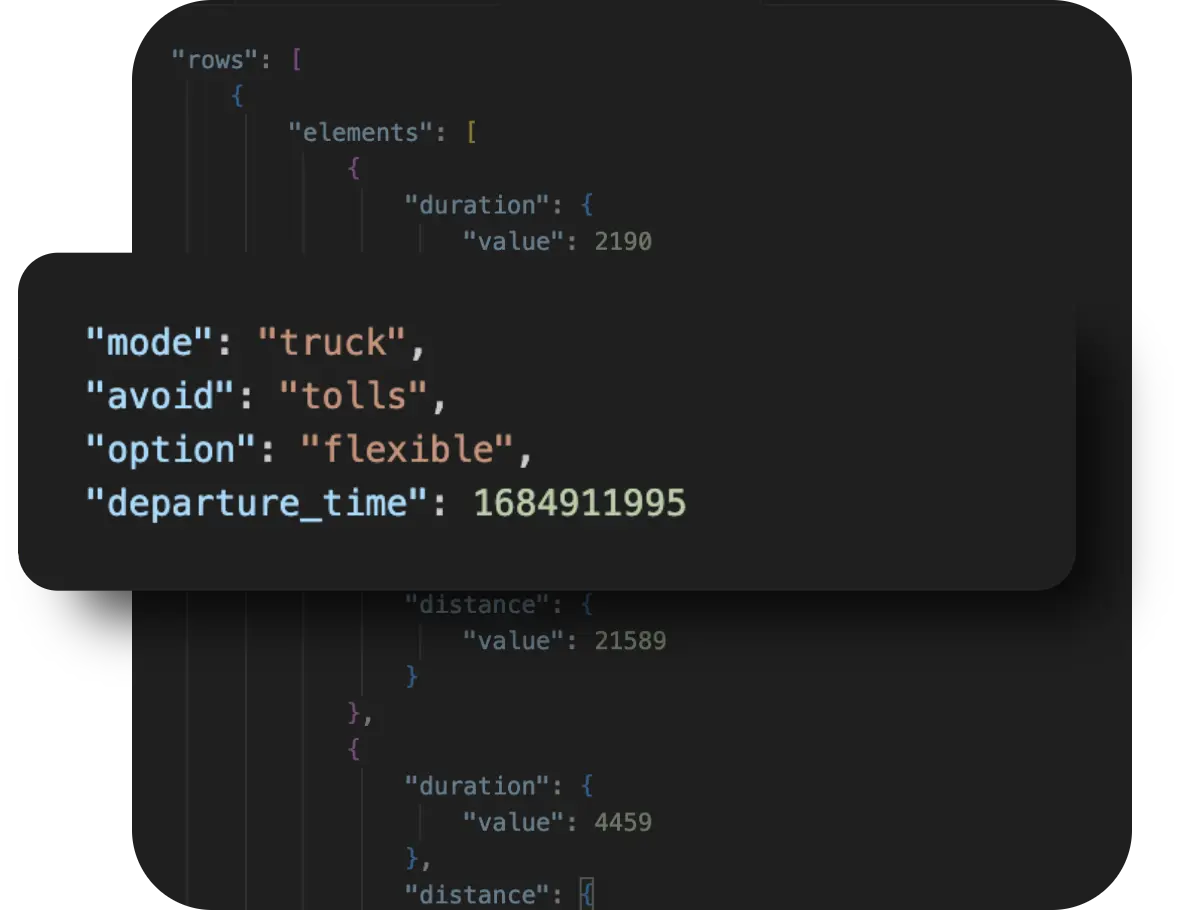
Freight permitting is fundamentally a routing problem under strict physical and regulatory constraints. NextBillion.ai’s routing engines support custom vehicle profiles, axle configurations, height, width, weight, bridge clearances, and road restrictions. This enables AI systems to calculate permit-compliant paths that are based on the real-world infrastructure and not necessarily the shortest paths. It makes maps conceptually compliance-aware decision engines.

AI models are based on proper spatial context to assess feasibility. NextBillion.ai adds road attributes, turn restriction, tolls, construction zones, and dynamic closures to permit workflows. Combined with AI risk scoring and LLM reasoning, this geospatial layer allows systems to know not only whether a load is compliant, but where and why constraints arise during a route.
NextBillion.ai provides API-only routing, distance matrix, geocoding, and map services which are compatible with TMS, ERP, and permit management software. This enables the creation of shipment in a TMS to immediately generate compliant route analysis and allow feasibility checks. Conceptually, it embeds location intelligence directly into operational workflows, making compliance a real-time capability rather than a batch process.
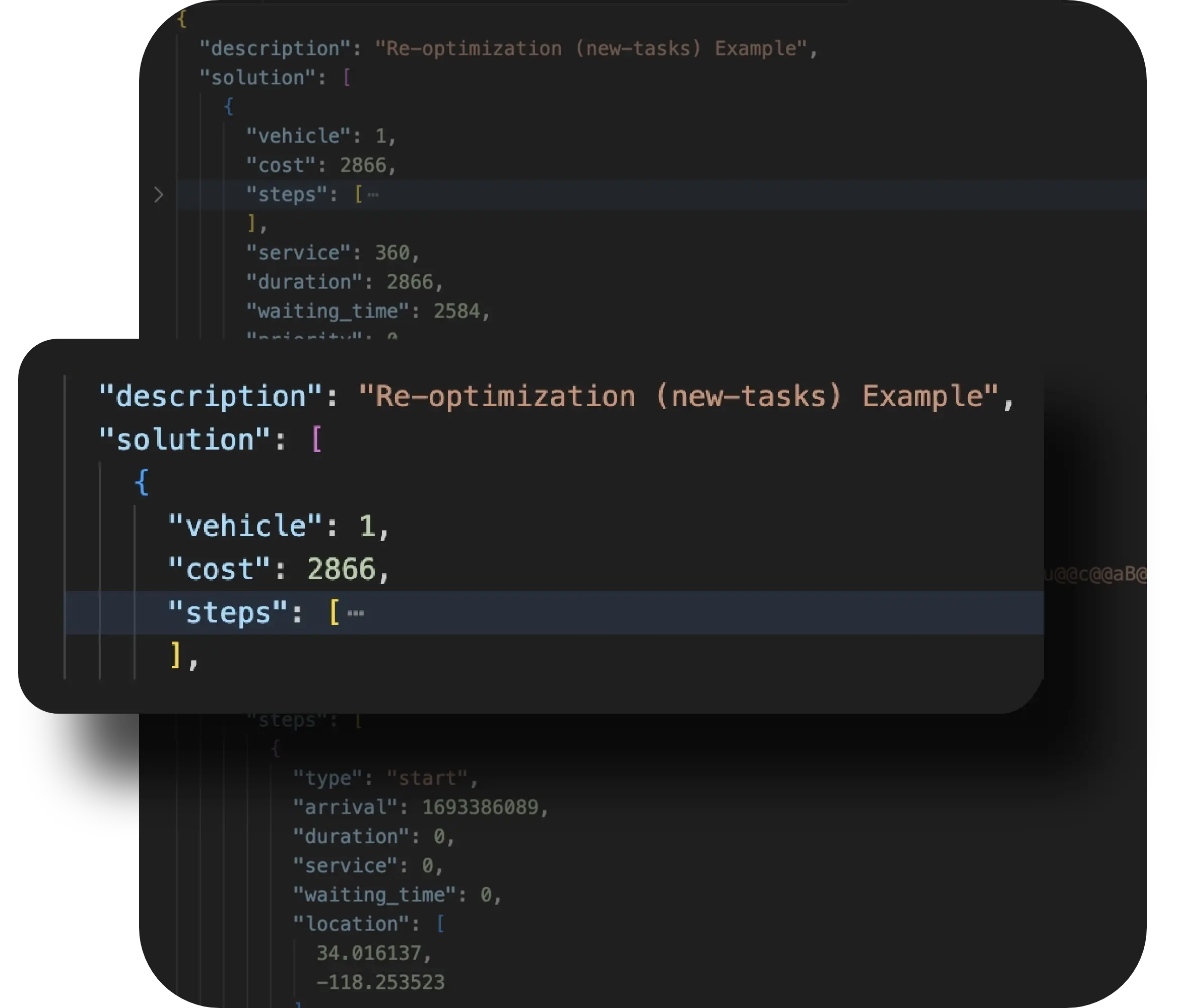
Freight routes change due to weather, traffic, construction, or enforcement updates. We make dynamic rerouting possible within constraints, which means that AI systems can re-evaluate permit validity in the case of deviations. This facilitates adaptive compliance whereby permits are constantly adjusted to actual implementation as opposed to planned permits.
Built for high-throughput, low-latency use cases, NextBillion.ai’s cloud-native architecture supports large-scale permit simulations, what-if scenarios, and real-time routing calls across regions. This elasticity is critical for AI platforms that must evaluate thousands of routes, configurations, and scenarios during peak planning cycles.
LLMs can reason about regulations and intent, but they need grounded spatial data to avoid abstract answers. Using route outputs, constraint explanations, and map-based attributes as inputs to LLMs, permit systems are capable of producing natural language explanations like why a bridge clearance is not granted or why a corridor is closed. This connects language intelligence with geospatial truth.
With NextBillion.ai, maps are no longer passive visuals. They become active infrastructure that powers compliant routing, scenario simulation, and regulatory reasoning. For AI-driven freight permit platforms, this means turning geospatial data into a core layer of compliance intelligence.
AI and LLMs are redefining freight permit processing by turning compliance into an intelligent, adaptive, and proactive capability. These technologies allow operations to go beyond automation into actual operational intelligence, whether it is probabilistic decision-making and high-dimensional optimization, conversational interfaces, and predictive planning. With the increasing complexity of logistics networks and the dynamic nature of regulations, organizations that integrate AI-based compliance into their fundamental work processes will become faster, resilient, and decisively competitive in contemporary freight operations.
Ready to introduce AI-driven, route-conscious compliance to your permit processes? Learn how NextBillion.ai provides the geospatial intelligence and constraint-aware routing to make AI-based freight permit automation scale. Get in touch with NextBillion.ai today to see how you can transform permits into a real-time compliance advantage.
AI automates data extraction, validation, and risk checks, reducing permit approval timelines from days to minutes.
LLMs interpret regulations, extract information from unstructured documents, and explain compliance decisions in natural language.
Yes, AI and LLMs harmonize regulations across jurisdictions, identifying conflicts and ensuring end-to-end permit compliance.
When combined with deterministic rules, governance controls, and human review, AI delivers high accuracy and audit-ready compliance.
AI predicts approval risks, flags non-compliant configurations early, and recommends optimized routes and load adjustments.
Bhavisha Bhatia is a Computer Science graduate with a passion for writing technical blogs that make complex technical concepts engaging and easy to understand. She is intrigued by the technological developments shaping the course of the world and the beautiful nature around us.