B2B delivery operations are becoming increasingly complex. Rising customer expectations, fluctuating demand, global supply chain disruptions, multi-warehouse networks, and diverse vehicle fleets have pushed enterprises to rethink how they plan, optimize, and execute deliveries.
Unlike B2C, B2B delivery is structured, contract-driven, SLA-bound, and heavily dependent on predictable, high-volume movement of goods between manufacturers, distributors, suppliers, stores, and last-mile hubs. Any inefficiency, even a minor route deviation or warehouse bottleneck quickly snowballs into missed SLAs, increased costs, and dissatisfied partners.
This guide breaks down the technical strategies, architectural considerations, and workflow enhancements that organizations can adopt to significantly improve B2B delivery efficiency.
Standardize and Centralize Delivery Data
B2B deliveries thrive on data consistency. Fragmented or outdated data leads to:
Capture attributes like vehicle capacity, fuel type, refrigeration, access restrictions.
EV routing capabilities
Account for charging cycles, battery ranges, and power constraints.
Load optimization tools
Optimize pallet, carton, or SKU placement at the planning stage.
Better utilization = fewer vehicles on the road + higher delivery density.
Provide Real-Time Visibility and ETA Accuracy
B2B clients expect predictability, not guesswork.
High-precision ETAs
Combine live traffic, historical patterns, and real-time telemetry.
Order-level and stop-level visibility
Track every milestone: picked, en-route, arrived, delivered.
Proactive alerts
Notify stakeholders about exceptions before they escalate.
True visibility prevents SLA breaches and strengthens customer trust.
Integrate Reverse Logistics and Returns
B2B operations involve:
backhauls
returnable packaging
pallet returns
reverse shipments
Integrate these into outward routes to maximize efficiency and reduce dead mileage.
Harness the Power of AI & ML for Continuous Optimization
AI can transform B2B delivery efficiency with:
Predictive demand forecasting
Prevent stockouts or overstocking.
Pattern detection
Identify inefficiencies like chronic delays or problematic locations.
Autonomous route improvement
The system learns from each iteration and refines the next-day plan.
Where NextBillion.ai Fits In: A Modern Mapping & Routing Engine Built for B2B Logistics
After applying structural and operational improvements, the next step is choosing the right technical engine that can support them. This is where NextBillion.ai stands out.
NextBillion.ai offers a complete suite of AI-driven mapping, routing, and delivery optimization capabilities tailored for complex, enterprise-grade B2B logistics.
NextBillion.ai Capabilities for Improving B2B Delivery Efficiency
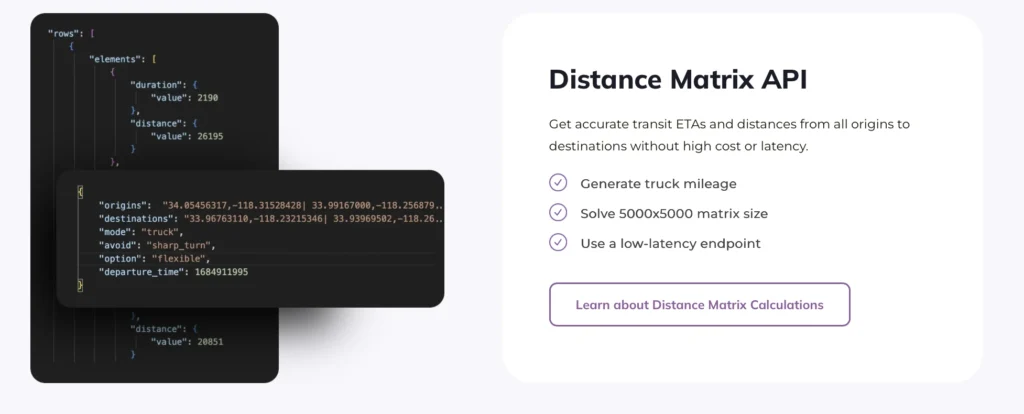
Routing & Directions API: Compute the shortest or fastest route between an origin and a destination for cars, motorcycles, trucks (or other vehicle types), using real-time or historical traffic data. Supports multi-stop routes. Distance Matrix API: Generate large distance/ETA matrices: e.g., get transit times and distances from many origins to many destinations efficiently, with low latency. This is essential for large-scale dispatch, multi-stop planning, and bulk scheduling. For information on Distance Matrix API, refer here. Navigation & Maps SDKs: For projects needing map rendering, turn-by-turn navigation, or embedding maps in web/mobile apps, NextBillion.ai provides SDKs (e.g. JavaScript for web) that support custom styling, map providers, and advanced map features.
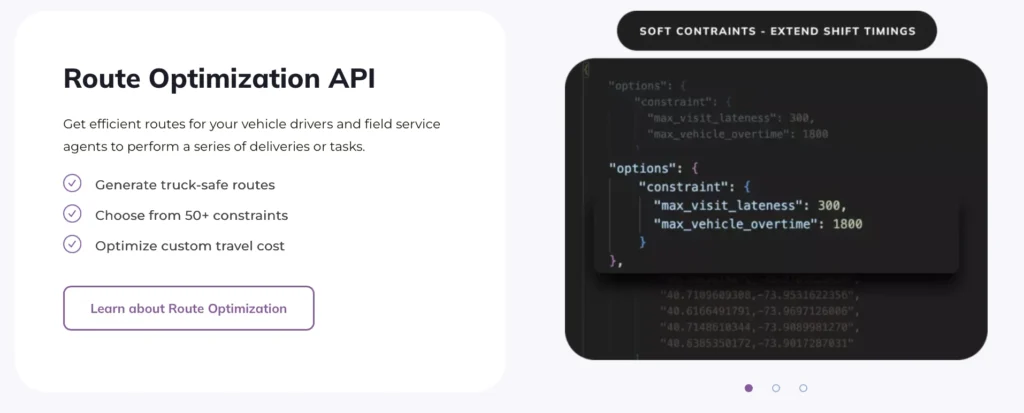
Route Optimization Engine for Complex, Real-World Constraints At the heart of NextBillion.ai is a powerful Route Optimization API that solves not just basic routing, but real-world operational constraints helping enterprises automate dispatching and route planning at scale. Key attributes:
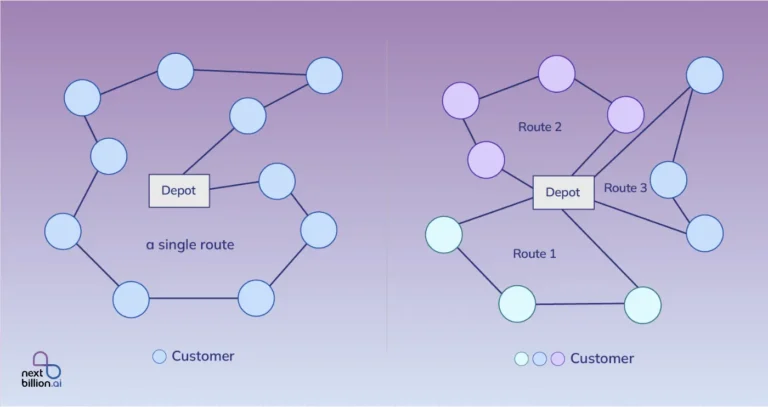
Supports both single and multi-vehicle routing problems. This means you can optimize for an entire fleet, not just individual trips.
For information on Route Optimization API, refer here.
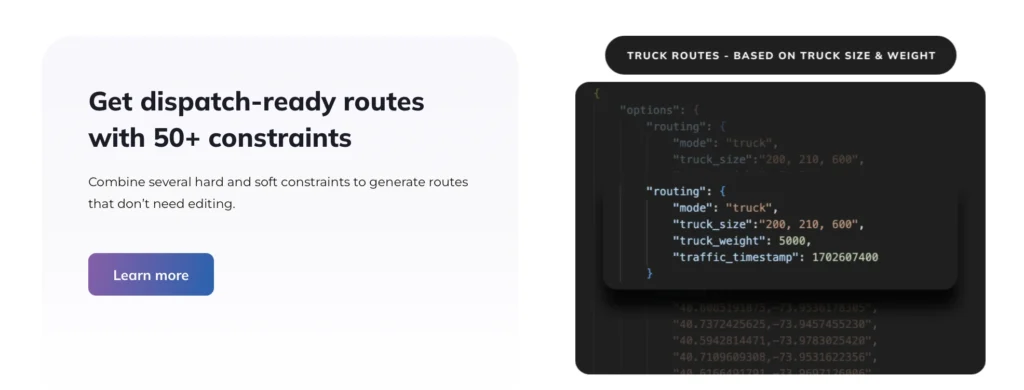
Handles 50+ constraints enabling realistic modeling of: vehicle capacity, time-windows, driver shifts, task sequencing, load constraints, refueling or rest stops, multi-depot, cargo type restrictions (e.g. hazardous, temperature sensitive), and more. This means even complex B2B logistics (with trucks, pallets, heavy loads) can be modeled accurately.
Supports task sequencing and grouping e.g. pickup → drop → refuel → next job; group orders going to nearby stops; combine tasks logically to reduce inefficiency.
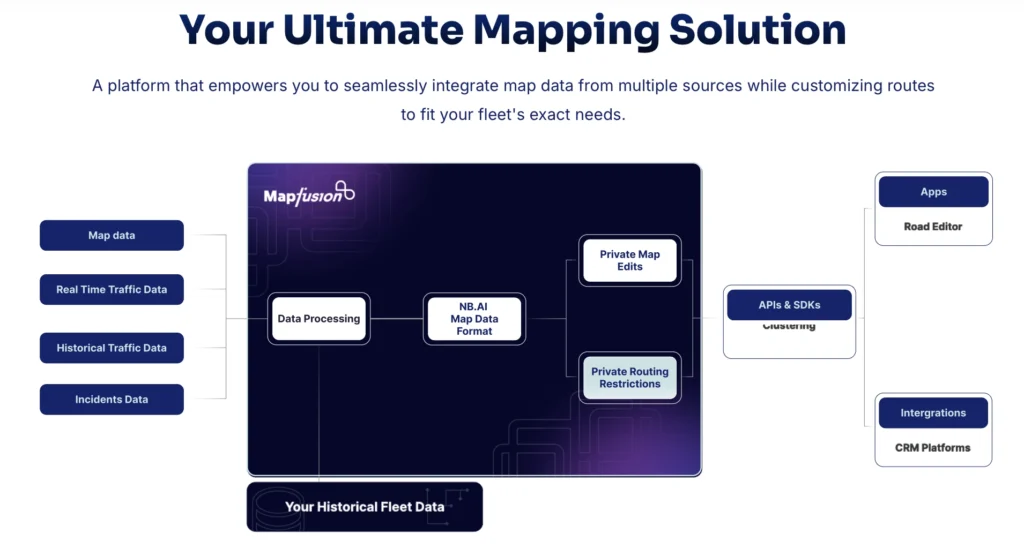
Custom Maps & Map Data Flexibility (MapFusion)
One of the biggest challenges for global B2B logistics especially in emerging markets is that publicly available map data often lacks local roads, private roads, warehouse-campus lanes, restricted zones, and region-specific constraints. NextBillion.ai addresses that with:
Map-agnostic architecture: You are not tied to a single map provider. NextBillion.ai can work with open-source maps or proprietary map data whichever works best for your territory.
Custom / Private Maps & Map Editing: Through its “MapFusion” layer, you can customize base maps: add private roads (e.g. inside warehouses, campuses), define access restrictions, draw entry & exit points, define warehouse yards, parking zones, loading-dock constraints basically tailor the map to exactly reflect your real-world infrastructure.
Real-Time Traffic, ETA Accuracy & Live Re-Routing
Logistics doesn’t happen in a vacuum. Traffic, road closures, delays, and unexpected changes affect deliveries. NextBillion.ai is built to handle that:
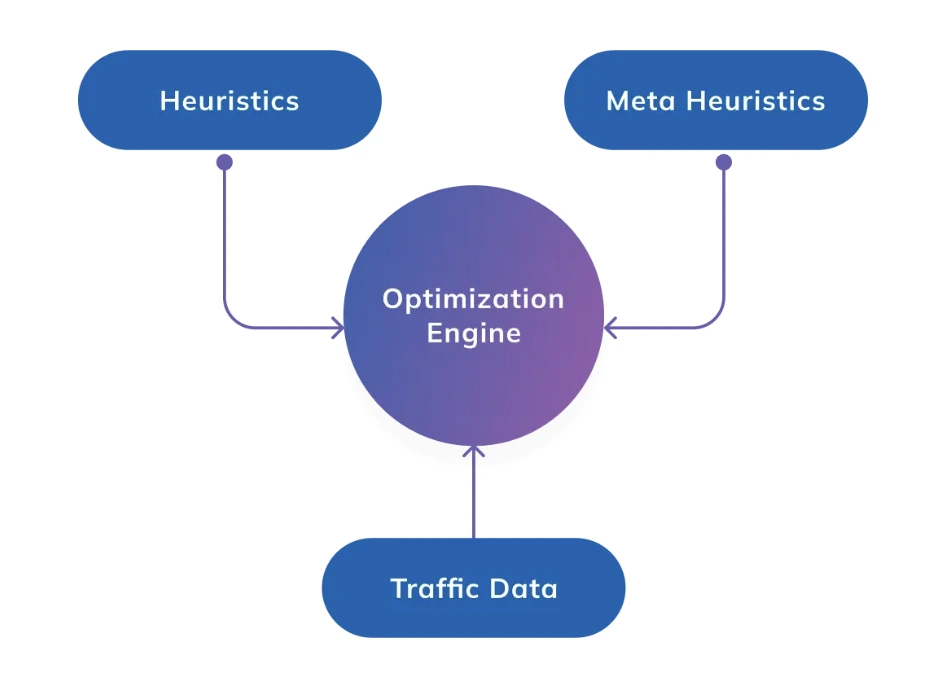
Its route optimization engine integrates live traffic feeds and historical traffic data to compute accurate ETAs. This is critical for meeting SLAs reliably and giving clients accurate delivery windows.
Supports instant re-routing / dynamic re-optimization when conditions change (traffic jams, weather, customer reschedule, urgent orders), which helps avoid delays and reduces manual dispatcher overhead.
Cost-Efficiency & Predictable Pricing for High-Volume Logistics
Mapping and routing costs can explode for logistics companies using standard consumer APIs, especially with heavy usage. NextBillion.ai addresses this with a business-friendly pricing model:
Instead of per-API-call billing (as many generic APIs do), NextBillion.ai allows pricing based on number of orders/stops or number of vehicles/agents, which often aligns better with how logistics firms operate.
This model helps keep mapping costs predictable and proportional to business volume that are useful for budgeting, especially in high-volume B2B operations (warehousing, pallet delivery, distribution, multi-stop logistics).
Scalability, High-Volume Support & Performance
Enterprise B2B operations often involve hundreds or thousands of stops, multiple vehicles, dynamic scheduling, and bulk dispatches. NextBillion.ai is built to scale:
Supports up to 10,000 stops per optimization problem, meaning you can plan an entire day’s fleet routing (or multi-depot deliveries) in a single API call.
Allows large distance/ETA matrix computations up to 5000 x 5000 origin-destination pairs, a scale far beyond typical consumer mapping APIs. This is ideal for bulk planning, fleet redistribution, zone-level allocation, depot-to-depot logistics, etc.
Delivers low-latency performance: The “Fast API” variant is optimized for real-time use cases such as dynamic dispatching, live routing, on-demand changes.
Designed for enterprise-grade reliability: high uptime SLA, scalable multi-tenant cloud infrastructure, and real-world performance even under heavy load.
Given your interest in delivery operations, supply-chain logistics, dispatching, order management, routing, tracking, and optimization, NextBillion.ai aligns extremely well with those needs. Concretely:
If you run a multi-warehouse, multi-depot, multi-vehicle B2B logistics operation, you benefit from large-scale route optimization (10,000 stops), multi-constraint routing (capacity, load types, time-windows), and modular APIs to fit existing systems.
For middle-mile or pallet-based distribution (common in B2B), truck-aware routing, cargo- and vehicle-dimension constraints, private-road support, and custom maps ensure realistic, compliant, and efficient routes.
For dynamic operations (e.g. backhaul returns, spot orders, emergency shipments), NextBillion.ai’s re-optimization, live traffic integration, and dispatch-ready APIs help you adapt quickly without manual overhead.
If you need data-driven cost control and scalability (e.g. many orders, many vehicles), the custom pricing, batch-distance matrix support, and efficient optimization engine help keep routing cost-effective.
For enterprise-grade security, compliance, and system integration especially if you integrate routing into larger ERP/TMS, or if you operate across geographies — NextBillion.ai’s flexibility, security certifications, and deployment options make it practically future-proof.
If you’re serious about transforming B2B delivery from ad-hoc, error-prone, and inefficient operations into a data-driven, optimized, scalable, SLA-compliant machine NextBillion.ai offers a solid foundation.
With its combination of:
flexible and customizable map data
sophisticated route optimization for fleets and constraints
real-time traffic & dynamic re-routing
scalable APIs for large fleets and high volumes
enterprise-grade security and integration flexibility
cost-efficient and predictable billing model
NextBillion.ai emerges as a logistics-grade routing platform that closes the gap between theoretical optimization and real-world delivery operations.
For B2B businesses especially those dealing with multi-stop deliveries, heavy loads/trucks, middle-mile distribution or complex supply-chain routing this isn’t just “another map API.” It’s a core infrastructure choice that can drive meaningful efficiency, cost savings, and service reliability at scale.
Conclusion
Improving B2B delivery efficiency requires a blend of:
data standardization
intelligent routing
automated scheduling
real-time visibility
optimized fleet usage
AI-led decision support
While traditional mapping platforms struggle to deliver this level of precision and control, NextBillion.ai is purpose-built for the complexity of B2B logistics. With highly customizable APIs, enterprise mapping capabilities, truck-aware routing, and powerful optimization workflows, NextBillion.ai helps businesses reduce costs, improve SLA performance, and operate with a level of efficiency and predictability the modern supply chain demands.
👉 So, without any delay book a demo with NextBillion.ai today and see how NextBillion.ai can help improve B2B delivery.
Prabhavathi is a technical writer based in India. She has diverse experience in documentation, spanning more than 10 years with the ability to transform complex concepts into clear, concise, and user-friendly documentation.