


Route Optimization API
Optimize routing, task allocation and dispatch
Distance Matrix API
Calculate accurate ETAs, distances and directions
Directions API
Compute routes between two locations
Navigation API & SDK
Turn by Turn Instructions for Drivers & Technicians
Route Optimization Software
Plan optimized routes with 50+ Constraints
Product Demos
See NextBillion.ai APIs & SDKs In action
AI Route Optimization
Learns from Your Fleet’s Past Performance
Platform Overview
Learn about how Nextbillion.ai's platform is designed
Road Editor App
Private Routing Preferences For Custom Routing
On-Premise Deployments
Take Full Control of Your Maps and Routing
About Us
Our story, vision
and mission
Contact Us
Reach out to us for any product- or media-related queries
Write to us at

Table of Contents
Machine learning–based route planning outperforms static, rules‑based systems for cross‑border logistics because it adapts to real‑world variability, risk profiles, and compliance constraints in real time. For shippers and logistics providers operating under trusted‑trader or similar customs facilitation programs, this adaptability directly supports secure, predictable, and audit‑friendly operations while improving cost and service KPIs.
In high‑compliance cross‑border environments, route planning is not just about finding the shortest path; it is a lever for security, regulatory adherence, and reliability across customs borders. Poorly planned routes can increase exposure to high‑risk zones, unapproved transit points, delays at borders, and customs inspections.
Key objectives for such route planning include:

Rules‑based routing uses explicit if‑then rules (e.g., “avoid country X”, “use border crossing Y for temperature‑controlled shipments”) encoded by operations or compliance teams. These systems are familiar in regulated environments because they are transparent, predictable, and easy to justify in audits.
Typical benefits:

Machine learning (ML) driven routing optimizes routes using historical and real‑time data traffic patterns, lane performance, dwell times, driver behavior, and past exceptions while still honoring compliance rules as hard constraints. This approach delivers security and predictability without sacrificing efficiency.
What ML adds on top of rules:
For compliance‑heavy networks, this translates into:
Aspect | Rules-based routing | ML-based routing (with rules as constraints) |
Compliance control | Hard, explicit rules; easy to demonstrate in audits. | Encodes the same rules as hard constraints and logs decisions for auditability. |
Adaptability to disruptions | Low; requires manual rule updates for each new case. | Learns from data and reacts to traffic, weather, and incidents in near real time. |
Risk mitigation | Depends on how detailed rules are; often coarse‑grained. | Can model fine‑grained risk profiles per lane, hub, or time window. |
Operational efficiency | Frequently yields compliant but sub‑optimal routes (time and cost). | Can cut distance and duration significantly while staying compliant. |
Scalability (stops, fleets) | Complex and brittle as stops, lanes, and rules grow. | Handles large task volumes and complex constraints with optimization engines. |
Maintenance effort | High; rule sets must be constantly reviewed and cleaned. | Focus shifts to data quality and strategic constraints instead of micro‑managing rules. |
The most robust setups usually combine both approaches: strict, explainable rules for compliance and security plus ML optimization inside those guardrails to maximize efficiency and predictability.
Nextbillion.ai is designed for large‑scale, constraint‑heavy logistics where traditional one‑size fits all routing often fails. Its APIs and SDKs let teams encode compliance and risk policies as constraints while leveraging AI/ML for optimization.
Relevant capabilities:
For high‑compliance logistics teams, Nextbillion.ai provides an ML‑driven routing core that can be wrapped in existing compliance and risk rules instead of forcing a choice between flexibility and control.
A practical approach is to evolve from pure rules to ML‑augmented routing in phases, using Nextbillion.ai as the technical backbone.
Suggested phases:
API example:
Request: POST
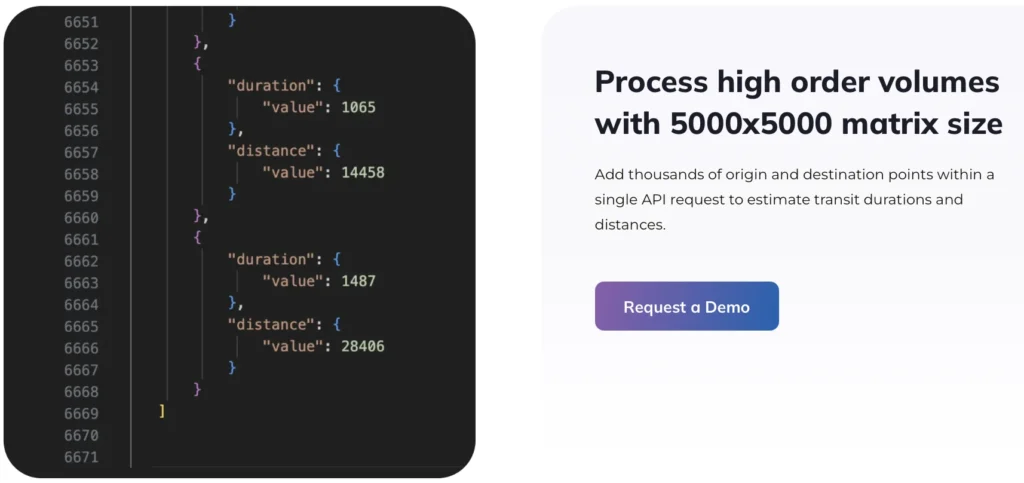
https://api.nextbillion.io/distancematrix/json?option=flexible&key={your_api_key}
API example:
Request: POST https://api.nextbillion.io/optimization/v2?key={your_api_key}
(Use this method to configure the constraints and properties of the optimization problem that you need to solve.)
Rules‑based route planning offers simplicity and control, while machine learning route planning delivers adaptability and continuous optimization. For modern, compliance‑heavy logistics networks, a hybrid model increasingly becomes the default choice to balance reliability with intelligence.
In logistics, fleet management, and last‑mile delivery, rules-based planning alone is no longer sufficient to cope with volatile demand patterns, network disruptions, and tightening service expectations. Machine learning‑driven routing, combined with enforceable business rules, delivers the agility and efficiency required to operate at scale while remaining auditable and policy‑compliant.
Choosing the right approach depends on your operational scale, data availability, network complexity, and service or cost priorities. Nextbillion.ai enables this hybrid intelligence by letting you encode constraints as hard rules while its optimization engine minimizes distance, time, and cost, helping logistics organizations optimize routes, reduce spend, and consistently exceed delivery expectations.
Explore how Nextbillion.ai supports high‑compliance and sustainability‑focused logistics operations.
Request a demo to see constraint‑based, ML‑enhanced routing in action.
Build logistics systems that scale with your growth and sustainability ambitions using Nextbillion.ai’s routing and optimization stack.
Yes. Authorities focus on risk management, predictability, and control rather than specific technologies, so ML routing is acceptable as long as routes that respect defined security and compliance policies and decisions are documented. With a platform like Nextbillion.ai, those policies become hard constraints, and ML operates inside those boundaries.
You define non‑negotiable policies (e.g., excluded countries, high‑risk regions, mandatory customs points) as hard routing constraints and no‑go zones. The optimization engine can only search within this allowed space, so every suggested route remains policy‑compliant by design.
Historical trip data (routes taken, actual times, delays, incidents), operational attributes (vehicle types, load profiles), and external context like traffic and weather are typically required for high‑quality ML routing. Better data yields better predictions for transit times, risk hotspots, and optimal departure windows.
By modeling constraints for preferred corridors, approved ports/borders, and lane‑specific time windows, and by using traffic‑ and data‑driven ETAs, Nextbillion.ai can steer shipments through the most reliable routes and times. This reduces queueing, congestion, and missed inspection slots, improving on‑time rates.
Yes. Nextbillion.ai is built as an API‑first, modular platform that can be integrated into existing TMS, WMS, or in‑house planning tools without a full system replacement. Teams typically call its routing, distance matrix, or optimization endpoints from existing workflows, then gradually shift more logic into the platform.
The main advantage is achieving strong operational control and security while significantly improving cost, speed, and reliability across the network. Instead of choosing between strict compliance and operational efficiency, both are achieved by treating rules as guardrails and using ML optimization to find the best possible routes within them.
Prabhavathi is a technical writer based in India. She has diverse experience in documentation, spanning more than 10 years with the ability to transform complex concepts into clear, concise, and user-friendly documentation.