

NB vs Roadnet
NextBillion vs Roadnet Route
Optimization API
- No legacy lock-ins
- No Performance Issues
- No rigid logic

- Request a live demo
(and get the trial API key) 



Product and tech leaders in modern logistics are switching
from Omnitracs to NextBillion.ai













Cut Costs, Not capabilities


Apply real-world routing constraints through
simple API calls.
And scale at speed without the cost overruns.
AI-Powered Route Optimization
NextBllion.ai provides AI-powered route optimization with scalable cloud and on-premise deployment, enabling real-time optimizations and continuous automation.
Roadnet offers PC-based routing with limited real-time adaptability, reducing scalability and automation.


Advanced Optimization Constraints That Match Your Operations
With NextBillion.ai, you can model 50+ real-world constraints and custom business rules directly in your API requests, no manual edits, no workarounds.
With Roadnet, you rely on predefined platform settings and manual adjustments, limiting how deeply you can customize constraints for complex, evolving operations.
Better Performance at Scale
With NextBillion.ai, users can experience faster response times, 99.9%+ uptime, and 24x7 pro-active support for fast, uninterrupted routing at scale.
Roadnet offers slower response time, limited scalability, and unresponsive support, leading to performance gaps under load.


Map Customization & Edits
Leverage full map edits for custom roads, private networks, POIs, turn restrictions, and compliance rules, all directly usable in NextBillion.ai’s routing APIs.
Roadnet provides limited ability to override map data or customize restrictions globally.
Feature Overview
| Features | NextBillion.ai | Roadnet |
| Depth of Constraints | 50+ constraints, custom rules, and real-world restrictions directly in the API request. | Handles basic delivery constraints; less flexible for deep, programmable rules. |
| Scalability | Designed for large workloads (1000 + stops). | Built for standard fleet routing; large-scale solver limits aren’t fully supported. |
| Real-time Optimization | Dynamic re-optimization with traffic and live conditions. | Supports route edits and dynamic/static routing via UI. |
| Compliance/Regulation Awareness | Supports vehicle dimensions, restrictions, and compliance-aware routing. | Commercial-vehicle friendly but not deeply regulation-aware. |
| Integration Model | API-first; easy to plug into TMS/ERP/custom systems. | Platform-first; strong UI but less flexible for custom integrations. |
| Use case flexibility | Works for last-mile, long-haul, mixed fleets, complex ops. | Strong for delivery & distribution fleets with platform workflows. |
| Map Control & Custom Routing Flexibility | Offers advanced map editing and customizations. | Does not support. |
| Transport-Mode Logic | Advanced support for vehicle-specific & compliant routing (dimensions, cargo restrictions). | General commercial routing; limited public info on deep compliance logic. |
| Objective Tuning | Native multi-hub / multi-depot optimization. | No |
| Pricing Model | Transparent: per vehicle / per order options + free reruns | Traditional enterprise pricing; based on platform seats/modules. |
| Speed & Stability | Faster, more reliable, 24/7 supported. | Slower, less scalable, limited support. |
Switch to NextBillion.ai Route Optimization
APIs in 3 simple steps
- 1
- 2
- 3
Get the trial
API key
Book a trial onboarding call and get the trial API key.
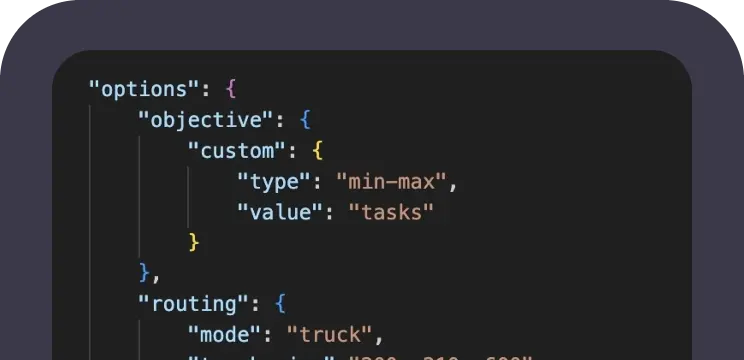
Test it with your
tech and data
Connect API with your tech stack and run it with your sample data.
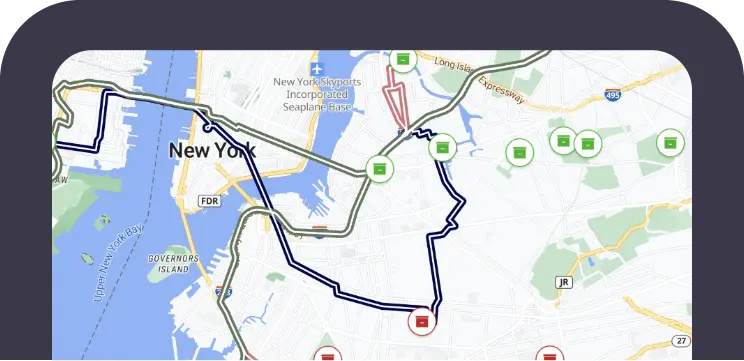
Push it to
production
Replace your Google routing APIs with NextBillion.ai
Product managers and developers
love NextBillion.ai APIs









Frequently asked questions
Unlike platform-led routing systems, NextBillion.ai can be embedded directly into existing TMS, ERP, dispatch and fleet-management systems. It also supports truck-specific restrictions, customized maps, private roads and configurable optimization objectives, making it suitable for complex and evolving logistics operations.
Roadnet supports standard delivery and distribution constraints through its platform settings. However, highly specialized or frequently changing requirements may require additional configuration or manual adjustments. This makes NextBillion.ai better suited to complex operations that require programmable routing logic and continuous automation.
Its API-first architecture enables businesses to automate recurring, high-volume planning and integrate optimized routes directly into their existing TMS, ERP or dispatch systems. This makes it suitable for growing operations that require consistent performance as routing volumes and operational complexity increase
This allows dispatch teams to respond to changing conditions without manually rebuilding the entire plan. Compared with Roadnet’s primarily UI-driven route-editing workflows, NextBillion.ai is better suited to automated, on-demand operations that require frequent updates at scale.
These capabilities are available across the Directions, Navigation and Distance Matrix APIs, helping fleets generate safer, more accurate and legally compliant routes and ETAs for different vehicle profiles.
Businesses can also display relevant points of interest and operational locations through customizable map layers, helping fleets incorporate depots, customer sites, service areas and other business-specific locations into their mapping applications.
It also offers ready-made integrations with platforms, alongside custom API integrations for proprietary systems. NextBillion.ai’s solutions team can support evaluation, configuration, testing and production deployment, reducing the effort required to incorporate its capabilities into an existing technology stack.
Teams can first connect NextBillion.ai’s APIs to their existing technology stack, test them with operational data and compare route quality and performance. Once validated, they can gradually move additional workloads to NextBillion.ai, reducing operational disruption and migration risk. NextBillion.ai also provides support across integration, testing, training and deployment
Roadnet does not publish standardized pricing on its website and directs businesses to contact its sales team for a customized quote. Its total cost may therefore depend on the selected products, fleet size, deployment and contractual terms. Businesses should compare both proposals based on their complete operational requirements, but NextBillion.ai’s usage-independent model can offer clearer cost forecasting for fleets with frequent or variable routing workloads.
NextBillion.ai’s solutions team can assist with data preparation, API configuration, testing and validation. Once the results meet the required operational benchmarks, the business can proceed with a phased rollout rather than making an immediate full-platform switch.